Dada, Absurdity and Anti-Fashion
Dada did not merely reject bourgeois style; it attacked the very logic that allowed clothing to function as an instrument of social order and institutional sanity. Born amid the catastrophe of the First World War, Dada deployed absurdity, assemblage, readymade subversion, and anti-art performance to turn clothing into an active critique of capitalist conformity. From Hugo Ball’s cubist cardboard liturgies to Sophie Taeuber-Arp’s geometric marionettes and the satirical photomontages of Berlin, Dada invented the disruptive grammar that continues to fuel contemporary anti-fashion and conceptual garment design.
The Cabaret Voltaire and the birth of anti-dress
In February 1916, on the narrow Spiegelgasse in neutral Zurich, a small collective of exile poets, painters, and deserters opened a tiny night club named the Cabaret Voltaire. Across the borders of Switzerland, the First World War was systematically converting millions of industrialized bodies into trench mud, justified by the polite rhetoric of European Enlightenment, nationalism, and institutional logic. For Hugo Ball, Emmy Hennings, Tristan Tzara, Marcel Janco, and Sophie Taeuber-Arp, bourgeois civilization had lost all moral entitlement to rational discourse. If rationalism culminated in the mechanized slaughter of the Western front, then nonsense, absurdity, and negation were the only ethical responses left.
Fashion was central to this social critique. Dress in the late 19th and early 20th centuries was not merely apparel; it was the rigid scaffolding through which bourgeois hierarchy, military discipline, and patriarchal authority maintained their daily dominion. The frock coat, the stiff winged collar, the military tunic, and the corseted evening gown functioned as uniform systems of class legitimacy. To accept the polite dress codes of the era was to endorse the culture that manufactured the slaughter.
Dada responded by launching an all-out war against the coherence of the dressed figure. Rather than reforming fashion—as did the contemporary dress-reform movements seeking rational hygiene—Dada practiced anti-fashion: the systematic sabotage of clothing’s decorative, commercial, and disciplinary functions. Garments were assembled from newspaper clippings, wrapping cord, cardboard cartons, metallic kitchen foil, and raw burlap sacks. Clothing was ripped from its utilitarian origins and thrust onto stage as an instrument of psychological provocation.
Hugo Ball and the cardboard priest: costume as sonic cage
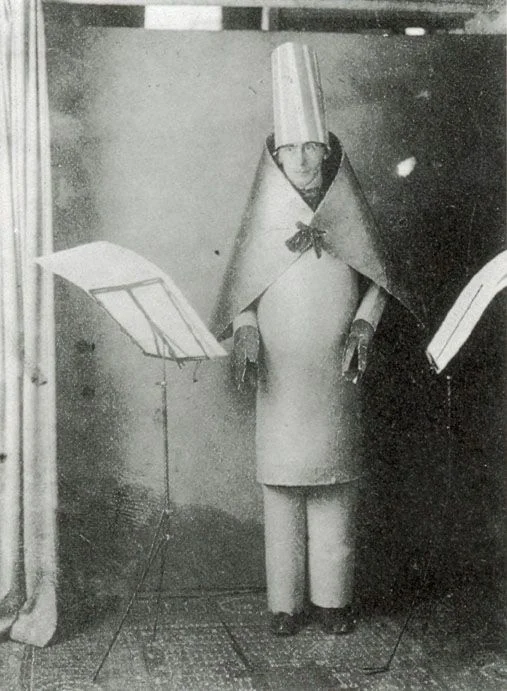
On the evening of June 23, 1916, Hugo Ball took the stage of the Cabaret Voltaire in a costume that would become the foundational monument of performance dress and radical anti-fashion. Having resolved to recite a sequence of phonetic sound poems—including the famous “Karawane”—Ball designed a rigid, wearable architecture that eliminated the human body’s capacity for familiar gesture.
Ball’s outfit was constructed entirely by hand using everyday, non-textile packaging materials:
- Cardboard column legs: Two tight, brilliant blue cylinders encased his lower limbs up to the hips, making bending of the knees impossible and forcing him to shuffle onto the stage like a mechanical apparatus.
- Winged cubist tabard: A towering waist-length cape constructed from heavy paperboard, gold-painted on the interior and silver on the exterior, fastened around the neck and spreading open like rigid wings when he lifted his elbows.
- High cylindrical shamanic hat: A tall witch doctor’s shako striped in black and blue, accentuating an unnatural, elongated cranial silhouette.
- Cardboard lobster gauntlets: Long conical cuffs projecting over his hands, depriving his fingers of articulate articulation.
Ball had to be carried into the darkened hall and placed at the music stand because the costume prevented autonomous walking. Once in place, the shiny silver and gold surfaces caught the gaslight while he read phonetic syllables—”gadji beri bimba / glandridi laula lonni cadori”—that renounced corrupted language. As the performance peaked, Ball recalled that his voice took on the ancient cadence of an ecclesiastical lamentation: trapped inside a cardboard cathedral, the artist became a magical bishop presiding over the burial of rational Europe.
Ball’s cardboard suit demonstrated a primary principle of avant-garde clothing: garments do not have to comfort, flatter, or facilitate movement. By deliberately imprisoning the limbs, clothing can dramatize physical constraint, expose vulnerability, and transform the human figure into an uncanny sculptural object.
Sophie Taeuber-Arp: marionettes, applied textiles, and radical craft
While Ball and Tzara engaged in theatrical noise, Sophie Taeuber-Arp executed one of the most intellectually rigorous design interventions of the entire Dada era. A trained dancer under Rudolf von Laban and an accomplished professor of textile design at the Zurich Kunstgewerbeschule, Taeuber-Arp operated with total disregard for the academic hierarchy that subordinated “decorative craft” beneath “fine art.”
For the 1918 Zurich production of Carlo Gozzi’s 1762 commedia dell’arte fable King Stag (König Hirsch), Taeuber-Arp designed a set of nineteen turned-wood marionettes and matching stage costumes that radically deconstructed the figurative actor. Psychoanalysis and war-trauma were transposed onto puppet figures: characters such as Dr. Complex and King Deramo were rendered as articulated geometric assemblies of cylinders, cones, brass studs, and painted wooden discs.
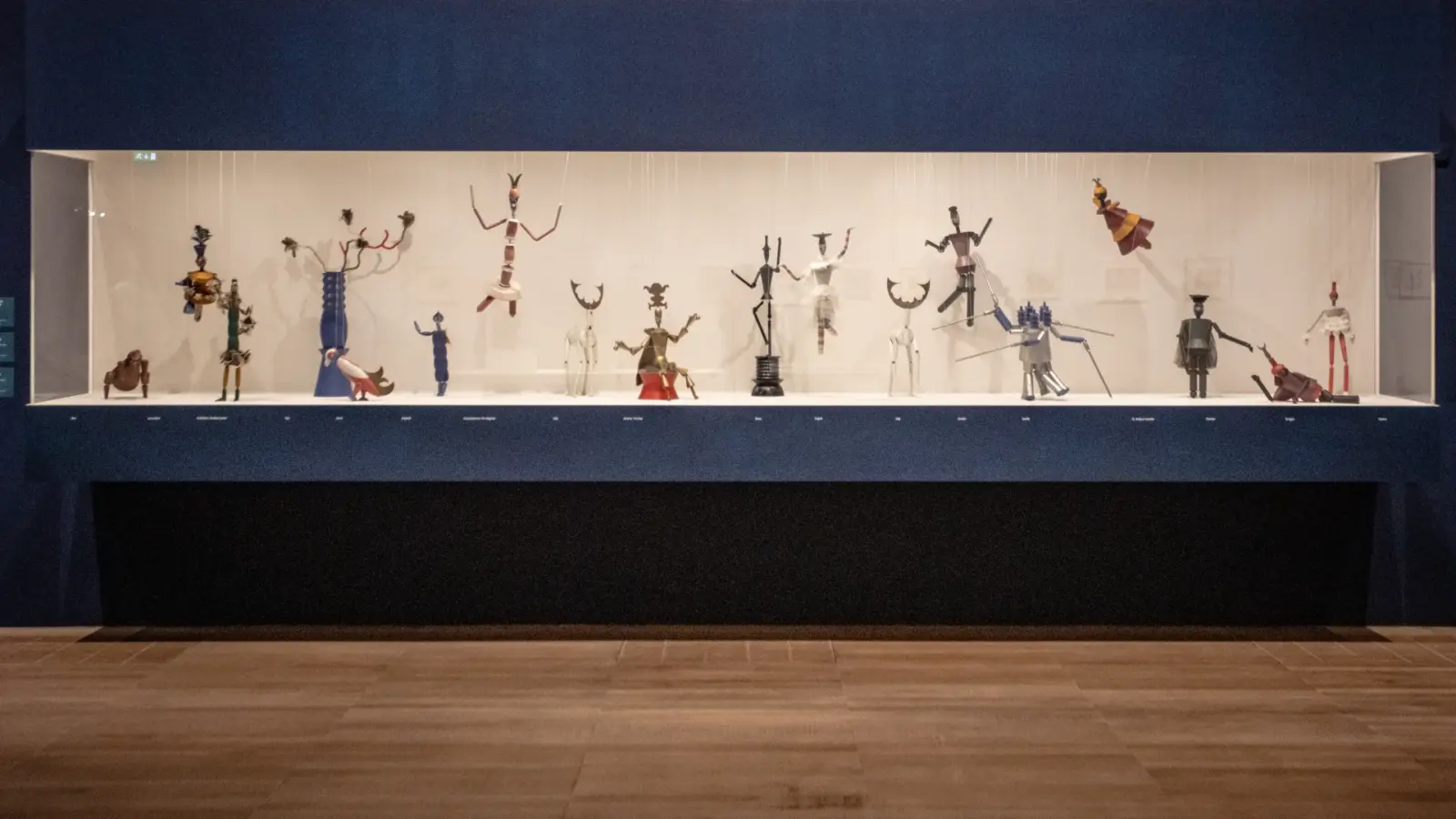
Taeuber-Arp’s marionettes and related beaded tapestries operated as blueprints for a new relationship between the body, geometry, and mechanical kineticism. Joint hardware—turnbuckles, wire hinges, screw-eyes, and exposed pins—was celebrated as primary aesthetic ornament. Instead of hiding the mechanics behind velvet doublets or historicist gowns, the puppets’ skeletons were identical with their dressed silhouettes.
Simultaneously, Taeuber-Arp’s abstract embroidery, woven tapestries, and beaded evening bags applied rigorous non-objective grids to everyday accessories years before the Bauhaus codified industrial design. Her wooden “Dada Heads” (Têtes Dada)—sculpted millinery-style hat blocks turned on a lathe and painted with geometric abstractions—satirized the vanity of modern bourgeois portraiture while elevating the practical tools of hatmaking into conceptual sculpture.
Berlin Dada and the sabotage of sartorial bourgeois authority
When Dada shifted to Berlin in 1917–1918 following the Russian Revolution and the German Armistice, its character turned fiercely political, militant, and satirical. Led by Hannah Höch, Raoul Hausmann, John Heartfield, George Grosz, and Wieland Herzfelde, Club Dada used the materials of the printing press—fashion plates, trade catalogues, newspaper headlines, and imperial military portraits—to execute what they called photomontage.
Hannah Höch, who worked as an editor and embroidery designer for the Ullstein publishing conglomerate (which produced Germany’s premier women’s fashion periodicals like Die Dame and Die Praktische Berlinerin), weaponized fashion imagery from the inside. Höch sliced through models’ corseted torsos, spliced mechanical ball bearings onto evening gowns, and attached primitive ethnological masks onto European flapper bodies in masterpieces such as Cut with the Kitchen Knife Dada Through the Last Weimar Beer-Belly Cultural Epoch of Germany (1919–1920).
Höch exposed how the Weimar media machine marketed the myth of the “New Woman” (Neue Frau)—promising female emancipation through the consumption of bobbed haircuts, short skirts, and cosmetics—while maintaining patriarchal ownership of female bodies. Her collages revealed clothing as an ideological battlefield where gender, class, and commercial manipulation intersected.
Meanwhile, Raoul Hausmann christened himself Der Dadasoph and designed the “Mechanical Head (The Spirit of Our Time)” around 1920: a wooden hairdresser’s dummy skull affixed with an ordinary tailor’s measuring tape, a collapsible pocket watch mechanism, a camera lens cylinder, and a brass ruler. Hausmann’s assemblage demonstrated that the modern European bourgeois citizen had no genuine internal thoughts; their consciousness was determined entirely by external measurements, tailoring standards, and commercial tallies.
The philosophical mechanics of anti-fashion
What distinguishes Dada anti-fashion from mere costume eccentricity or novelty is its systematic deployment of critical methods that dismantled the core assumptions of the capitalist fashion system:
- The Readymade and Displaced Context: Pioneered by Marcel Duchamp with his inverted urinal (Fountain, 1917) and bottle racks, the readymade demonstrated that an object’s aesthetic and monetary value is not intrinsic to its craft, but is an arbitrary institutional decree. In fashion, this unlocked the repurposing of industrial waste, workwear uniforms, safety pins, and non-precious detritus as sartorial capital.
- The Photomontage and Collage Pattern: By dismembering existing garments and reassembling them with jarring misalignments, Dada invalidated the classical standard of balanced tailoring. The seam became a visual fracture line rather than an invisible joint.
- Chance, Chaos, and Intuitive Assembly: Jean Arp’s practice of dropping torn scraps of paper and gluing them “according to the laws of chance” laid the groundwork for intentional garment distressing, raw raw-edged fraying, irregular dye runs, and asymmetrical draping.
- Defiance of Commercial Obsolescence: While seasonal fashion demands the rapid artificial obsolescence of last year’s silhouette to force continuous consumer spending, Dada anti-fashion produced unwearable, permanent prototypes that refused to participate in retail circulation.
Dada’s living ghost in contemporary avant-garde fashion
Without the nihilistic humor, assemblage techniques, and anti-bourgeois aggression of Dada, the landscape of contemporary avant-garde fashion would be unrecognizable. The modern vanguard designers who redefined clothing in the late 20th and 21st centuries owe their foundational creative liberties directly to the Cabaret Voltaire and Club Dada.
Maison Margiela is the purest heir to Dadaism in contemporary luxury. Martin Margiela’s whole oeuvre operates as a continuous application of the Duchampian readymade and Dada collage: trench coats assembled entirely from vintage leather belts, vests woven from broken ceramic plates and telephone wire, gloves tailored into evening tops, and trompe-l’œil photographic prints that satirize the glossy pretensions of the couture salon. Margiela’s faceless stocking masks directly echo Sophie Taeuber-Arp and Marcel Janco’s cardboard facial obliterations, stripping the mannequin of commercial ego.
Comme des Garçons founder Rei Kawakubo has frequently cited the imperative of negation—designing garments by starting from “the idea of not making clothes.” Her 1997 “Body Meets Dress, Dress Meets Body” collection, in which down-filled tumors and distorted humps were inserted beneath gingham dresses, executed a grotesque spatial sabotage of bourgeois feminine silhouette that belongs squarely in the lineage of Hugo Ball and Hannah Höch.
Walter Van Beirendonck carries forward Dada’s theatrical absurdity, cartoonish proportions, inflatable plastics, and biting political outrage, converting runway shows into multimedia protests against state censorship, ecological devastation, and warmongering. Likewise, the savage tailoring collages of Junya Watanabe, the distressed raw-edge assemblages of Yohji Yamamoto, and the subversive wearable sculpture of Iris van Herpen demonstrate that clothing achieves its highest artistic power not when it submits to commercial elegance, but when it dares to be absurd, disruptive, and uncompromisingly free.
Continue exploring early artistic movements with Futurism and the Birth of Radical Dress and Constructivism and Functional Clothing, or examine movement definitions in What Is Avant-Garde Fashion? and the foundational History of Avant-Garde Fashion.
References and further reading
- Hugo Ball / University of California Press — Flight Out of Time: A Dada Diary
- The Museum of Modern Art / Leah Dickerman — Dada: Zurich, Berlin, Hannover, Cologne, New York, Paris
- The Museum of Modern Art, Kunstmuseum Basel, Tate Modern — Sophie Taeuber-Arp: Living Abstraction
- Maud Lavin / Yale University Press — Cut with the Kitchen Knife: The Weimar Photomontages of Hannah Höch
- Brigitte Pichon and Karl Riha / G.K. Hall & Co. — Dada Zurich: A Clown's Game from Nothing
- Kunsthaus Zürich Dada Collection Archive — Dada Performance and the Cabaret Voltaire
- The Museum of Modern Art — HOW TO SEE | Sophie Taeuber-Arp