Futurism and the Birth of Radical Dress
Italian Futurism treated dress as moving architecture: a graphic construction activated by the stride, visible in the street and charged with political intent. Its clothing proposals converted speed, asymmetry and industrial modernity into cloth, while their militant language exposed the danger of confusing formal aggression with social progress.
The street as a field of action
Filippo Tommaso Marinetti launched Futurism in 1909 with a manifesto built around machines, velocity, youth and rupture. Painting soon proved too contained for that ambition. The group moved into typography, performance, sound, furniture, advertising and clothing, pursuing an art capable of reorganizing daily sensation.
Dress offered immediate access to public space. A painting waited on a wall; a coat crossed a square, entered a tram and altered the visual rhythm of a crowd. Fabric also introduced resistance. Wool pulled from the shoulder, a lapel opened as the torso turned, and a trouser crease registered the knee. Futurist dynamism could be worn, tested against anatomy and multiplied through movement.
Balla’s anti-neutral suit
Giacomo Balla developed his manifesto for men’s clothing during 1914. A French version appeared in May; the revised Italian Il vestito antineutrale followed in September, after the outbreak of the First World War. The change in title sharpened its interventionist politics. “Neutral” referred to subdued dress and to Italy’s position outside the conflict.
Balla attacked the conventional male suit as static, symmetrical and burdened by dark cloth. His alternative used acute angles, forceful color and unequal divisions across the jacket. Circular forms could occupy one side while squares structured the other. The front became a mobile graphic plane, broken by diagonals that widened or contracted as the rib cage moved.
Small removable elements called modificanti allowed the surface to change with mood or circumstance. This was an early model of transformable dress: identity edited through attachment, color and placement. The proposition reached beyond decoration. Clothing became a temporary system whose visual pressure could be recalibrated by the wearer.

Cut, cloth and the moving body
The radical point lies in the relationship between pattern and gait. A balanced lounge suit distributes its weight through paired fronts, matched sleeves and controlled drape. Balla disturbed that equilibrium. Oblique seams redirect the eye across the chest; contrasting panels split the torso into competing vectors; abbreviated sections expose the mechanics of the arm and hip. The wearer appears accelerated because the pattern refuses visual rest.
Many designs remained drawings, manifestos or singular pieces, so their industrial claims exceeded their production. The gap is historically useful. Futurist clothing was strongest as a proposition about what garments could communicate, less convincing as a scalable wardrobe. Its bright wool, felt appliqué and embroidered surfaces demanded handwork even while the rhetoric celebrated machines.
From suit to total design
Balla and Fortunato Depero’s 1915 Futurist Reconstruction of the Universe expanded the program into a complete environment. Depero’s later waistcoats compressed zigzags, letters and chromatic blocks onto a close sleeveless shape. The body carried the image without the excess volume of a coat, giving the textile a hard, poster-like clarity.
Ernesto Michahelles, known as Thayaht, approached modern dress through another route. His 1919 Tuta reduced clothing to a practical one-piece pattern intended for economical cutting and ordinary life. Its broad torso and uninterrupted vertical line gave the body a clean industrial outline. The Tuta differed from Balla’s optical attack, yet both treated the pattern as a plan for a new social figure.
The movement’s fashion writing remained heavily gendered. Early manifestos addressed men and often described the clothed body through combat, muscularity and national virility. Later proposals for women repeated the movement’s appetite for synthetic materials and transformation, while carrying its habitual objectification. Radical form did not guarantee radical social relations.
The politics inside the silhouette
Futurism’s celebration of war cannot be isolated from its design language. Marinetti and several associates pressed for Italian intervention in the First World War; Boccioni enlisted and died in 1916 after a military training accident. The movement’s later relationship with Fascism was complex, but its nationalism, cult of force and masculine violence were present well before Mussolini took power.
This history changes how the garments should be read. Aggressive diagonals and patriotic colors carried declared political meaning. Their technical invention remains significant, yet admiration for the cut cannot neutralize the ideology stitched into its presentation. Futurism established fashion as a manifesto and demonstrated how easily a silhouette can become propaganda.
Futurism’s material legacy
Futurism left no stable clothing industry. Its durable contribution is a vocabulary: asymmetric pattern cutting, modular alteration, synthetic color, bodily dynamism and fashion conceived as total environment. These ideas recur without requiring a direct visual quotation.
Issey Miyake later made motion structural through pleats whose depth opens around the joints. Walter Van Beirendonck has used saturated color and graphic volume to turn the dressed figure into a public signal. Comme des Garçons displaced bodily symmetry through padding and pattern pieces that redistribute visual weight. Each practice belongs to a distinct historical and ethical position; the connection lies in clothing treated as an active spatial proposition.
Futurist dress matters because it moved radical art onto the body and forced the suit to carry speed, conflict and belief. Its best designs remain formally alive. Their politics require equal attention. Continue with From the Military Avant-Garde to Art and Fashion, The History of Avant-Garde Fashion and A Complete Avant-Garde Fashion Timeline.
References and further reading
- Solomon R. Guggenheim Museum — Italian Futurism, 1909–1944: Reconstructing the Universe
- Solomon R. Guggenheim Museum — Italian Futurism Teaching Materials
- Futurism: An Anthology, Yale University Press / JSTOR — The Antineutral Suit: Futurist Manifesto (1914)
- The Museum of Modern Art — Futurism
- Museo Nacional Thyssen-Bornemisza — Giacomo Balla
- RMIT Design Hub — 1914 Now: Exhibition Guide
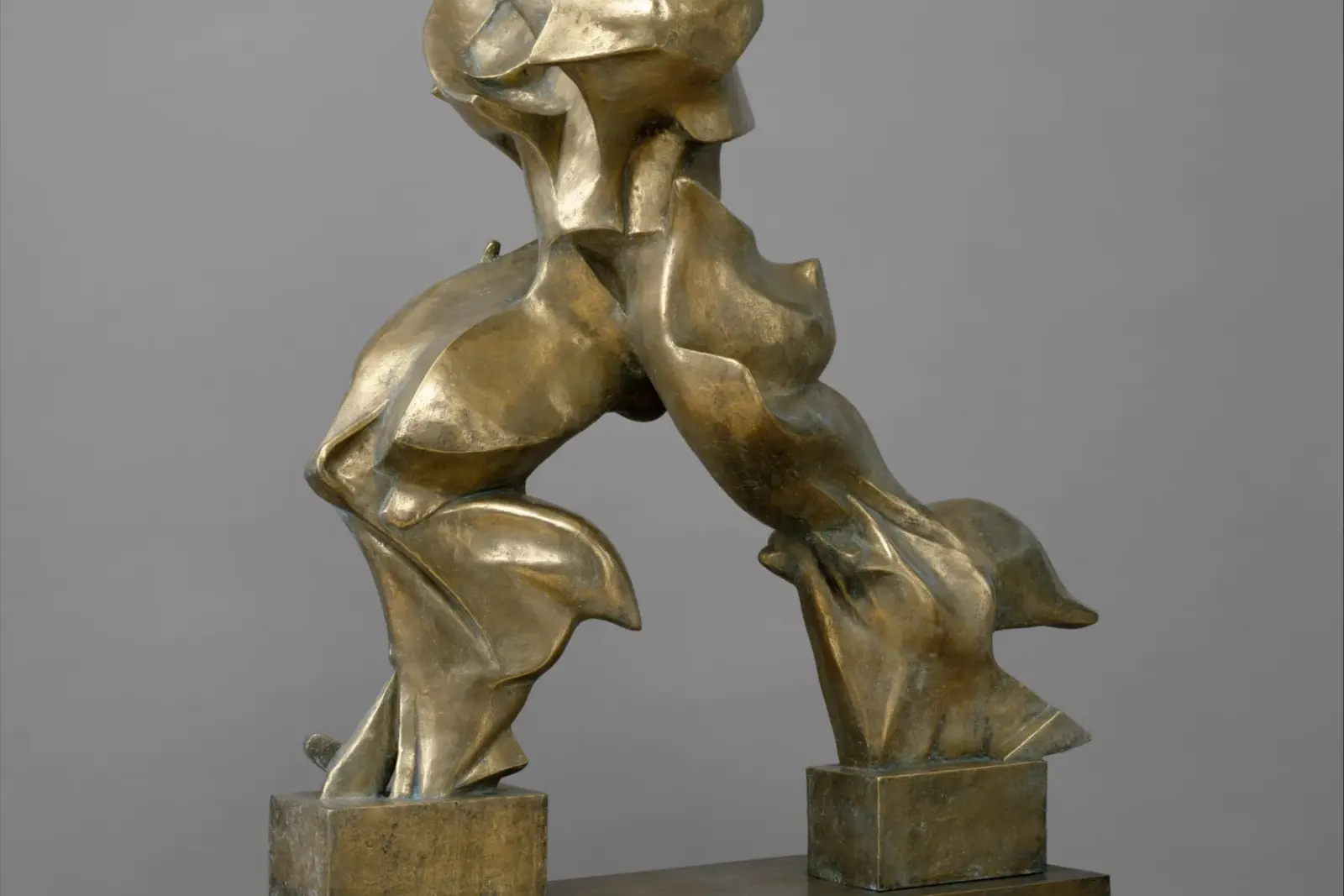
- The Metropolitan Museum of Art — Unique Forms of Continuity in Space
- Guggenheim Museum — Italian Futurism at the Guggenheim: Historical Context