0
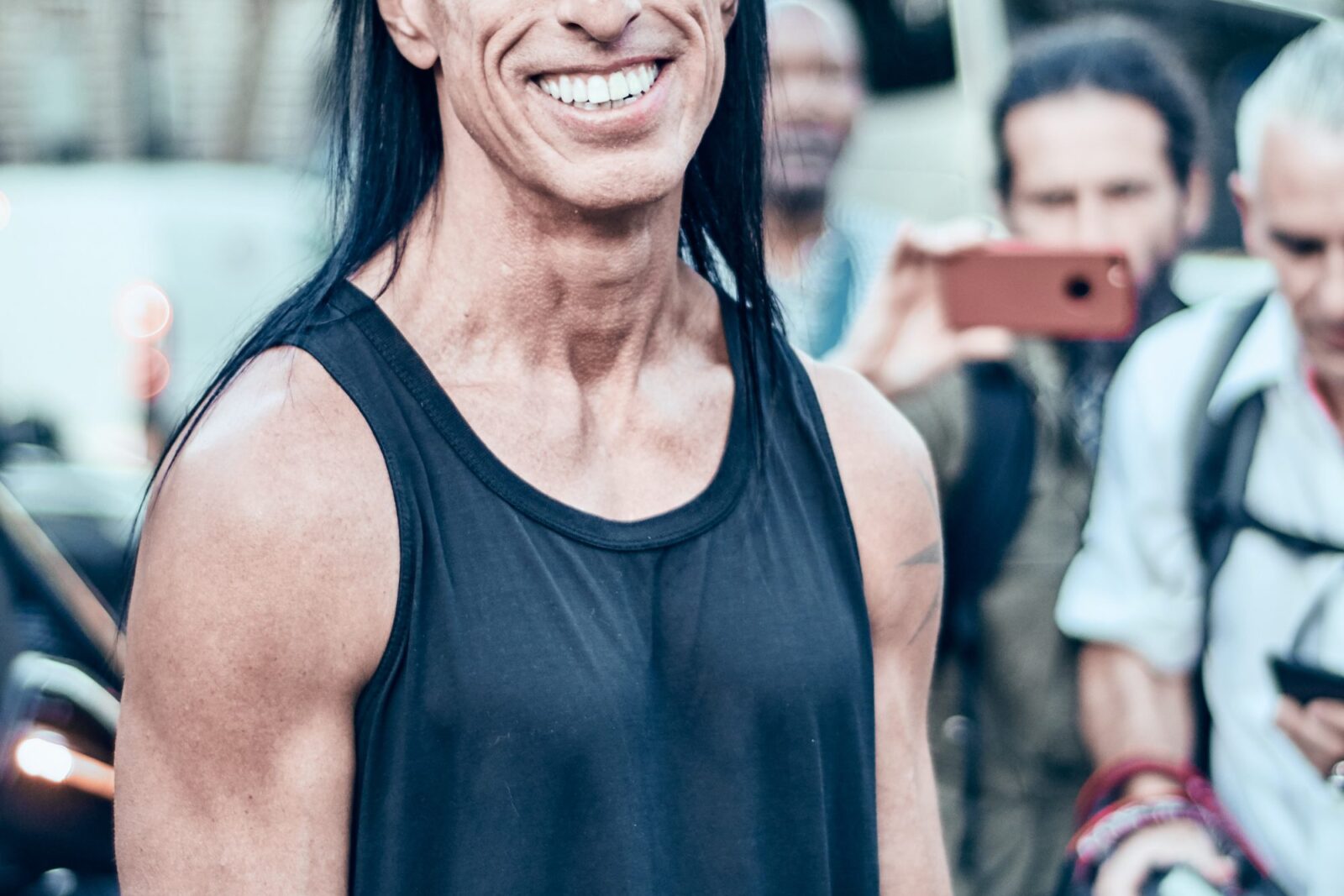
Rick Owens at Paris Fashion Week in September 2018
Rick Owens at Paris Fashion Week, September 2018. Photo: Myles Kalus Anak Jihem / Wikimedia Commons (CC BY-SA 4.0).

インタビュー リック・オウエンス インタビューコレクション

公開された9月 10, 2026

Few designers have constructed a world as complete as Rick Owens. The clothes are only one part of it. Across decades of interviews, Owens has discussed architecture, music, bodies, aging, sexuality, discipline, intolerance, beauty, Porterville, Los Angeles, Paris, Michèle Lamy and the mechanics of making clothes.

Rick Owens is unusually lucid about his own work. Heard together, these conversations form a primary-source record of an aesthetic taking shape: first as escape, then as a vocabulary, and finally as an environment large enough to hold clothes, furniture, buildings, performances and a community. This evolving Rick Owens interview collection brings together some of the most revealing video and written conversations available online on identity, craft, alternative beauty, Porterville, discipline and the making of an independent fashion universe, with RAW Looks commentary on the ideas that recur between them.

The purpose is simple: to let Rick Owens explain Rick Owens.

Rick Owens on Fashion Neurosis: Identity, Aging and Alternative Beauty

Bella Freud’s 2024 Fashion Neurosis conversation gives Owens room to connect clothing with the less tidy subjects around it: aging, physical presentation, sobriety, family, judgment and the way identity settles into repeated gestures. His concise statement—“I like a uniform”—is less a styling tip than a position on self-knowledge.

Owens’s uniform demonstrates that personal style does not depend on constant novelty. Long lines, severe footwear, exposed or compressed areas of the body and a restricted palette become more communicative through repetition. The adjustments matter because the base remains stable. Clothing is used to clarify a person rather than to disguise uncertainty with seasonal consumption.

The same logic shapes his collections. Owens has long altered the perceived location of a shoulder, extended the leg with heels and platforms, exposed the torso, or allowed fabric to fall away from the body. His own physical presentation belongs to this inquiry. Aging is not treated as something to conceal, and attractiveness is not confined to a polished, youthful norm. His discussion of his father, sobriety and the judgments people make about bodies keeps the clothes attached to lived experience: the uniform is both discipline and self-portrait.

Rick Owens in conversation with Bella Freud for Fashion Neurosis, 2024.

Wagner, Porterville and Imagining Something Bigger

In a 2013 GQ interview, Owens was asked to name the music that defined him. He chose Wagner’s Wesendonck Lieder, recalling its force when he was young: “It made me think about something bigger than where I was.” Read beside his later accounts of growing up in Porterville, the line offers a useful key to the career that followed.

A young person in a culturally restrictive environment discovers, through music, an aesthetic scale beyond his immediate surroundings. Los Angeles then supplies the technical education and outsider culture; Paris supplies a public stage. Over time, the aspiration toward “something bigger” becomes literal in concrete interiors, furniture, elevated footwear and monumental runway presentations. Fashion is not merely a route out of one place. It is a method for imagining a more expansive one.

The interview closes with another compact refusal: “Style isn’t everything.” Owens is not dismissing appearance. He is separating conviction from shopping for its own sake. Style has force when it follows an established set of values; without that necessity, it is only another form of acquisition.

Read the full 2013 GQ interview.

Draping as Handwriting

Speaking backstage about Fall 2016, Owens described reducing the collection to a physical gesture: “The draping almost becomes like my handwriting.” The comparison is exact. A handwritten signature remains identifiable through movement, pressure and rhythm; Owens’s clothes do the same through the fall of fabric around the body.

This is authorship without dependence on a visible logo. Bias, twist, suspension and asymmetry create a design vocabulary that survives changes in colour, material and proportion. A garment can become more vaporous or more armoured and still retain the same hand. Repetition, in this context, is not a failure of invention. It is how a language gains syntax.

The conversation also complicates the routine reduction of Rick Owens to darkness. He calls the collection softer, gentler and more optimistic. Those qualities do not require him to abandon severity. They emerge through transparency, motion and the sense that the clothes are dissolving into the space around them.

Watch Rick Owens discuss Fall 2016 at Vogue.

Beyond Fashion: Building a Complete World

To understand Rick Owens solely through clothing is to see only part of the project. His aesthetic extends into furniture, architecture, art and the spaces he inhabits, often with the same monumental proportions, severe materials and highly controlled sense of atmosphere found in his collections. In Vogue’s Objects of Affection, Owens opens the doors to his home and explains the objects he has chosen to surround himself with — from furniture and artworks to ancient artefacts — offering an unusually intimate view of how his visual language exists beyond the runway.

Rick Owens invites Vogue into his home, where furniture, art and collected objects reveal how his creative language extends far beyond fashion.

What makes the film particularly revealing is the consistency between these objects and Owens’s fashion. His environment does not feel like a separate collection of design references assembled around a successful designer; it feels like another expression of the same vocabulary. Furniture becomes sculptural and bodily, domestic objects acquire ritualistic weight, and historical pieces coexist with severe contemporary forms. The boundaries between fashion designer, furniture designer, collector and image-maker become increasingly difficult — and perhaps unnecessary — to define.

This is one of the reasons Owens’s career is so inspiring beyond the clothes themselves. Rather than continually adapting his identity to different creative disciplines, he has allowed a relatively small set of deeply personal ideas to expand outward. A silhouette can become a chair; the material severity of a garment can become an interior; an interest in ancient civilizations can surface in both a runway collection and the objects inside his home. Over time, these connections have produced something larger than a recognizable fashion aesthetic: a coherent world in which clothing, bodies, furniture, architecture and art appear to belong to the same language.

Rick Owens & Michèle Lamy: A Creative Partnership

Rick Owens’s creative world cannot be understood entirely as the work of a solitary designer. Michèle Lamy has been intertwined with its development since their years in Los Angeles, first as Owens’s employer and collaborator and later as his wife, creative partner and a singular presence within the wider Rick Owens universe. Their relationship is particularly compelling because their identities remain so distinct: Owens often appears controlled and austere, while Lamy brings an instinctive, social and almost ritualistic energy to the world they have built around them.

Sorbet Magazine’s 2014 In Bed With interview offers a rare opportunity to watch the two together rather than encounter Lamy merely as a figure in Owens’s biography. The intimacy of the setting strips away much of the scale associated with the Rick Owens runway and reveals something more personal: two highly individual characters whose lives, environments and creative practices have become deeply interconnected.

Rick Owens and Michèle Lamy in conversation with Sorbet Magazine for In Bed With: Back to Black, 2014, offering an intimate glimpse into the creative and personal partnership behind their shared world.

What emerges is also an important counterpoint to the mythology of the lone fashion designer. The Rick Owens universe has an unmistakable author, but it has never developed in isolation. Lamy has played a fundamental role in the culture surrounding the house, particularly through furniture, spaces, collaborations and the network of artists, musicians and unconventional personalities that orbit it. Their partnership demonstrates how a strong creative identity can be shaped through exchange without becoming diluted by it.

The Body as Architecture

For Spring 2016, women carried other women down the runway, their bodies strapped together so that limbs projected from the silhouette. Owens described his subject as “fashion in a very physical way.” The phrase matters because the show’s force came from construction as much as spectacle: one body became the extension, support and counterweight of another.

Owens rejected a simple bondage reading. In his account, the work concerned unity, childbearing, women supporting families, resilience and grace under pressure. That interpretation does not neutralise the image’s unease; it gives the unease structure. The silhouette is distorted, but the distortion depends on trust and shared weight.

Here the body operates as architecture. It carries, braces and enlarges. The show makes visible a principle already present in Owens’s cutting: clothes can change the body’s apparent boundaries, and bodies can in turn become material for a larger human form. It also places femininity in strength, burden and mutual dependence rather than decorative passivity.

Watch the Spring 2016 backstage interview at Vogue.

Looking Back: Women Supporting Women

Vogue’s later Best Show Ever retrospective is valuable because Owens revisits Spring 2016 after the immediate controversy has passed. He returns to a long-running question—how far clothing can extend away from the body—while also explaining that the runway proposition must eventually be translated into clothes people can inhabit.

That movement between spectacular image and wearable garment is central to his practice. The runway can make an idea monumental, but the idea survives only if its proportions, closures or drape can be edited into everyday use. Owens’s retrospective reading also shows fashion as a social performance rather than a sealed object.

“Going to church is a fashion show,” he says. The point is not that every ritual is frivolous. It is that clothing, grooming, gesture, behaviour and context work together whenever people construct and communicate beauty. A congregation, a courtroom and a runway each choreograph bodies according to shared codes. Owens’s shows expose those codes by making their choreography unusually visible.

Watch the full Vogue retrospective, Women Supporting Women.

Rick Owens and Tim Blanks: A Continuing Conversation

The seasonal conversations between Rick Owens and Tim Blanks are best watched consecutively. Their value lies less in extracting a slogan from either video than in hearing a designer place one collection beside another. Autumn/Winter 2017 and Spring/Summer 2017 share a vocabulary of ceremonial volume, elongated line, purity, protection and forms that appear at once archaic and speculative.

Owens continually edits this vocabulary. A silhouette may become more vertical, a material more yielding, a reference more medieval or a surface more industrial, yet the underlying grammar remains legible. Each season is a revision inside a continuing body of work, not a detached theme invented to fill a calendar.

Rick Owens in conversation with Tim Blanks after the Autumn/Winter 2017 show.

Placed beside the Autumn/Winter conversation, the Spring/Summer 2017 interview makes continuity visible. Familiar volumes and ceremonial references return in a different register; repetition acts as testing, not stasis.

Rick Owens in conversation with Tim Blanks after the Spring/Summer 2017 show.

The strength of Rick Owens’s design vocabulary is not that it constantly erases its past. It is strong enough to be modified without losing authorship. That distinction separates continuity from self-imitation: development occurs through sustained attention to a limited set of forms.

Porterville, Intolerance and Alternative Beauty

Fall/Winter 2024 brought Owens back to Porterville, the California town where he grew up, but the collection was shown inside the Paris home he shares with Michèle Lamy. The setting made the autobiographical turn spatial: guests entered the domestic and working environment from which the broader Rick Owens universe had developed.

In GQ, Owens remembered Porterville through the intolerance he experienced there. He connected that history directly to his aesthetic practice: “When you can blur the standards of beauty, you can open up minds…” It is one of his clearest statements about the ethical dimension of form.

Exaggerated proportions, unconventional casting and bodies outside luxury fashion’s narrow defaults are often described as provocation. Owens proposes something more exact. An alternative silhouette can loosen an accepted standard; once one standard becomes negotiable, others may follow. This does not make a platform boot or inflated coat a political solution. It makes aesthetics a daily site where tolerance can be rehearsed.

The intimacy of Porterville also clarifies why autobiography has become more explicit in his later work. Places, family memory, Michèle Lamy and the architecture of home are not background details. They are working material. RAW Looks explored this interdependence of clothes, space and biography in Rick Owens: Temple of Love.

Read GQ’s Fall/Winter 2024 Porterville interview.

From Porterville to Hollywood: The Individual Becomes the Collective

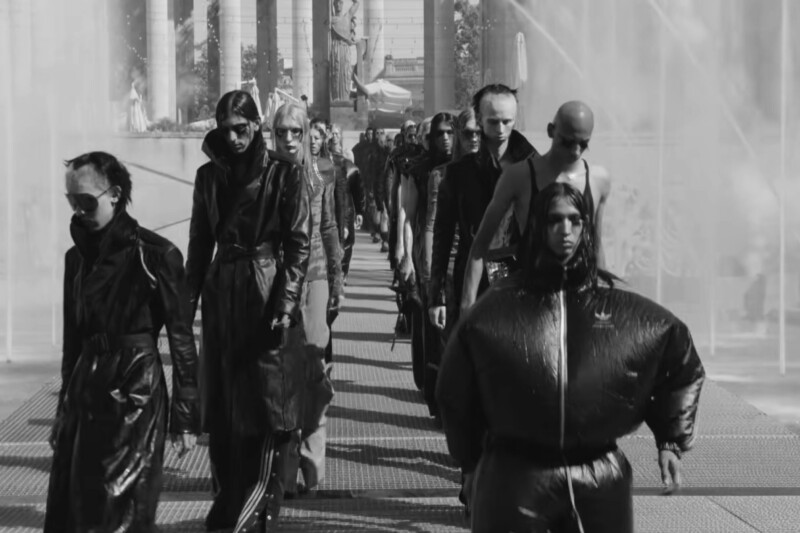
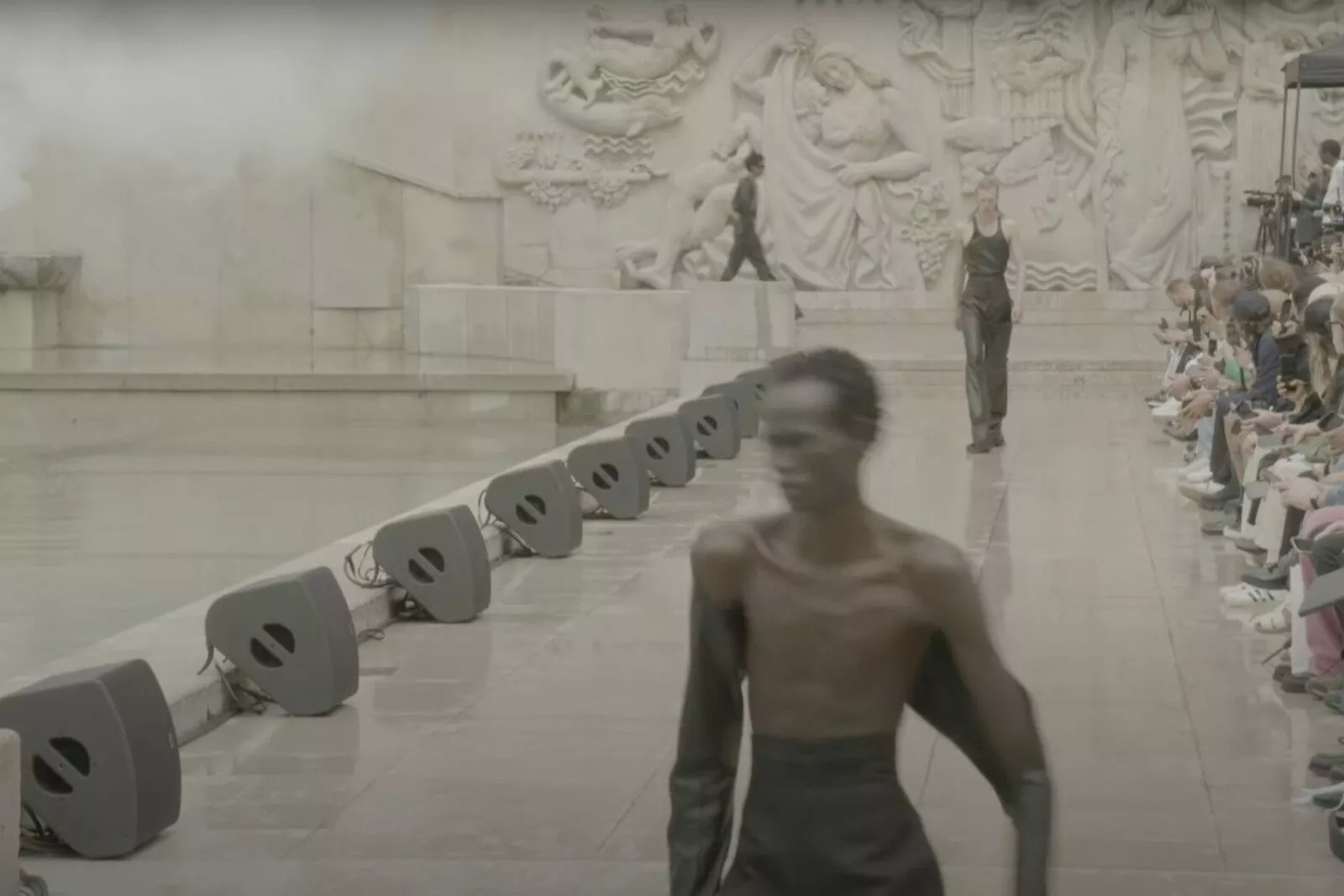
Spring/Summer 2025, titled Hollywood, reversed Porterville’s scale. Where the earlier presentation was domestic, inward-looking and restricted by the dimensions of Owens and Lamy’s home, Hollywood returned to the Palais de Tokyo with exactly 200 participants. Ten looks were repeated across twenty bodies each, transforming casting into composition.

The multiplication changes how repetition reads. A look is no longer an isolated proposition advancing down a runway; it becomes a unit inside a larger structure. Different shapes and sizes remain visible, but together the cast produces the monument. Owens described the practical challenge as accommodating every body type while retaining a recognisable Rick Owens look.

This collective performance extends the question posed in Spring 2016. Which bodies may fashion render monumental, beautiful or powerful? The answer here is not delivered through a token exception within conventional casting. Scale itself belongs to the participants. Their coordinated movement turns a runway audience into witnesses to a temporary public body.

The sequence from Porterville to Hollywood also reveals a movement from personal memory toward community: the individual history remains the source, but the visual language becomes capacious enough for others to occupy it. The Spring/Summer 2026 Temple collection would continue this use of water, architecture and collective ritual.

Read GQ’s backstage report on the 200-person Hollywood show.

Why Rick Owens Remains Inspiring

Independence. Owens has built a globally significant house without allowing its identity to dissolve into the general rhythm of luxury fashion. The interviews show the practical side of that independence: knowing what to refuse, accepting repetition and protecting the conditions in which a precise body of work can continue.

Craft. Before the grand spaces and runway performances, there was pattern cutting. Owens trained to make patterns and spent years working as a patternmaker in Los Angeles, including for Lamy. That history matters. The sculptural authority of the clothes is grounded in an understanding of how fabric is cut, balanced and made to act on a body.

Repetition. The personal uniform and recurring runway silhouettes make the same argument. Repetition can deepen identity when it remains attentive. A sleeve, shoulder, hem or drape is returned to because it still contains possibilities.

Alternative beauty. Owens repeatedly proposes bodies and proportions outside conventional luxury ideals. This is central to his place in the history of avant-garde fashion: formal experiment becomes a way to question who is permitted to appear elegant, desirable or commanding. For readers new to the term, RAW Looks’ guide to what avant-garde fashion means places that challenge in a wider context.

Autobiography and discipline. Porterville, Los Angeles, Michèle Lamy, a Catholic upbringing, music, architecture, physicality and aging repeatedly enter the work. Yet the interviews resist romanticising Owens as a purely decadent outsider. Beneath the spectacle is early rising, technical labour, editing and the discipline of maintaining a language across decades.

Constructing a world. Rick Owens did more than develop a recognisable fashion style. He gradually created an environment in which his values, aesthetic preferences, bodies, objects, architecture, music and communities could coexist. That may be his most transferable lesson for other creative people: a coherent world is built through the patient accumulation of related decisions.

The most compelling quality revealed by listening to Owens over many years is continuity. The young person who heard in Wagner the possibility of something larger eventually made that larger environment tangible, then opened it to a collective. The darkness is real, but so are humour, tenderness, vulnerability and an insistent optimism about the possibility of other forms.

This page is intended as an evolving archive. It will be expanded as substantial new Rick Owens interviews appear. Until then, these conversations offer an unusually direct record of how an independent fashion language is made, repeated and enlarged. For its continuing expression, see RAW Looks’ guide to modern avant-garde fashion.

Shop Rick Owens Online

032c
1017 ALYX 9SM
44 Label Group
A-Cold-Wall*
A1923
ACRONYM
AIREI
AMBUSH
Andrea Ya'aqov
Ann Demeulemeester
Avant Toi
Biek Verstappen
Boris Bidjan Saberi
By Walid
CASEY CASEY
COMMUNS
CROSS ELEMENTS
Chiahung Su
Chin Teo
Comme des Garçons
Daniel Andresen
Daub
David Zacek
Det Blev Sent
Detaj
Devoa
Dries Van Noten
EMATYTE
Estoras
FREI-MUT
Feng Chen Wang
Forme D'expression
GIANVEER
Gary Girin
Gaspard Hex
Giorgio Brato
Goti
Greg Lauren
Guidi
HAVEN
Hannes Roether
Hannibal
Heliot Emil
Helmut Lang
Individual Sentiments
Innerraum
Isaac Sellam
Isabel Benenato
Issey Miyake
Jacques Marie Mage
Jan-Jan Van Essche
John Hardy
Julius
Junya Watanabe
Juun.J
KAPITAL
King Baby
Kolor
Kuboraum
K´ANG
Label Under Construction
Layer-0
Leon Emanuel Blanck
M.A+
MARSÈLL
MD75
MIHARA YASUHIRO
MJB Marc Jacques Burton
Mad Et Len
Maison Margiela
Marina Yee
Masnada
Matsuda
Maurizio Altieri
Møsais Paris
Nahmias
Nemen
Nick Fouquet
Oberflacht
Officine Creative
Papcun
Parts of Four
Poème Bohémien
Proposition Clothing
R13
ROMBAUT
Rains
Red Wing Boots
Reinhard Plank
Rick Owens
Rigards
Rosa Maria Jewellery
Sacai
Shoto
Song for the Mute
Songzio
Suzusan
TAAKK
TOOGOOD
Taichi Murakami
Takahiromiyashita TheSoloist
Ten C
The Elder Statesman
The Viridi-Anne
Tobias Birk Nielsen
Transit
Tuforee
Uma Wang
VAVA Eyewear
Walter Van Beirendonck
Werkstatt:München
Y-3
Yohji Yamamoto
Ziggy Chen
_0.hide
thom/krom
Show similar?This option will show you items from similar brands.
Backpacks
Bags
Belts
Boots
Caps & Hats
Fragrances
Gloves
Hoodies & Sweaters
Interior
Jackets
Jeans
Jewelry
Key Chains & Holders
Leather Jackets
Longsleeves
Pants
Pocket Knifes
Scarfs
Shirts
Shorts
Sneakers
Sunglasses
Swimwear
T-Shirts
Tank Tops
Unkategorisiert
Wallets
Watches
shoes
Beige
Black
Blue
Brown
Gold
Green
Grey
Orange
Pink
Red
Silver
White
Yellow
Sale
Shuffle
Price low to high
Price high to low

Shop Rick Owens at the best Avant-Garde Fashion Stores worldwide

External Links

Boris Bidjan Saberi P23パンツ P34ビニールコーティングワックスのクローズアップ

サインアップ - 特典を楽しもう

  • お気に入りのブランド&店舗を保存
  • お気に入りブランドの新商品や限定商品のお知らせを受け取る
  • 限定クーポンコードや割引へのアクセス

参加する

限定メーリングリストに登録して、__PH0__の通知を受け取る 新しいブランドや店舗を特集したときに、__PH0__したときにお知らせを受け取る 厳選した新商品セレクションを公開し、 受け取る 限定プロモーションオファーを直接受信トレイにお届けします。

ブランド

    店舗

      投稿

        商品

          注目の商品

            ナレッジベース

              Boris Bidjan Saberi P23パンツ P34ビニールコーティングワックスのクローズアップ

              サインアップ - 特典を楽しもう

              • お気に入りのブランド&店舗を保存
              • お気に入りブランドの新商品や限定商品のお知らせを受け取る
              • 限定クーポンコードや割引へのアクセス