From the Military Avant-Garde to Art and Fashion
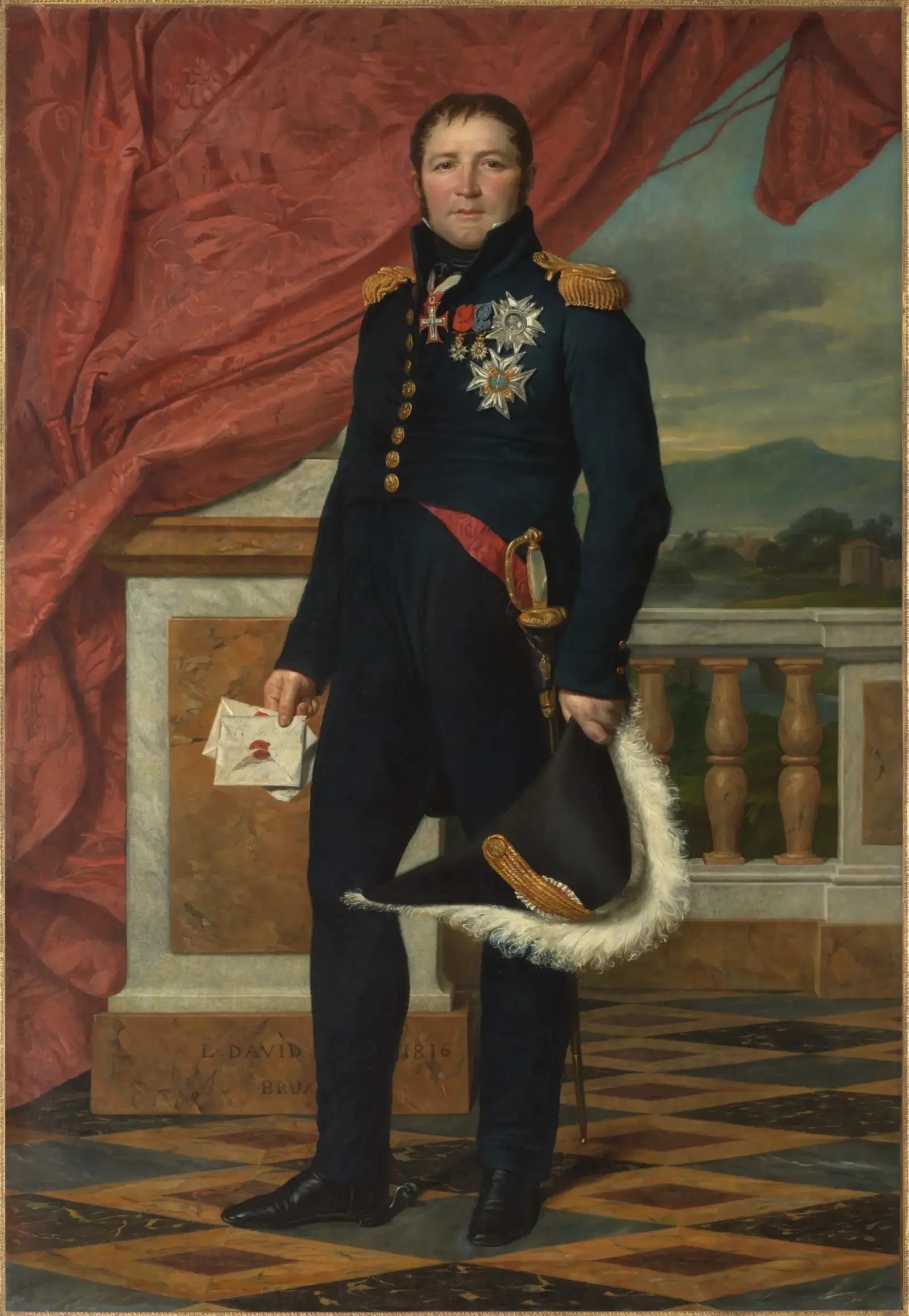
Before the avant-garde described a black asymmetric coat or an experimental runway, it named soldiers moving ahead of the main army. The phrase carried risk, reconnaissance and strategic distance. Its passage into politics and art changed the cultural meaning of progress; its later use in fashion gave garments a new critical charge.
A word born in formation
Avant-garde translates from French as advance guard or vanguard. Medieval military usage identified the unit positioned in front of the main force: scouts and combatants entering uncertain ground first. The formation implied proximity to danger, yet its purpose was practical. It gathered intelligence, tested routes and opened space for those behind it.
The metaphor retained this physical logic when it entered political language after the French Revolution. Progress acquired a spatial image. A small group moved beyond the present, accepted exposure and prepared a path for society. That image still shadows fashion criticism whenever a designer is described as “ahead.” The word carries a claim about historical direction, not a synonym for eccentric taste.
1825: artists at the front
The decisive cultural usage appears in the Saint-Simonian dialogue L’Artiste, le savant et l’industriel, published in 1825 and associated with Olinde Rodrigues. Its artist proposes that artists should act as society’s avant-garde, using images and imagination to communicate new ideas with exceptional speed. Scholarship often attaches the passage to Henri de Saint-Simon, whose social theory placed artists, scientists and industrialists at the head of reform. The precise attribution matters; so does the argument. Art was assigned an active public function.
During the nineteenth century, the political and artistic meanings began to separate. The label came to identify smaller cultural groups operating against academies, official taste and bourgeois certainty. Innovation moved from a collective social mission toward a disputed position inside art. That shift created a problem fashion still faces: does the avant-garde transform life, or does it specialize in advanced forms for a restricted audience?
Modern art enters daily life
The historical avant-gardes of the early twentieth century rejected the idea that painting and sculpture should remain isolated objects. Futurism, Constructivism, Dada, the Bauhaus and Surrealism pushed art into typography, theatre, furniture, photography, textiles and public behavior. Clothing became unavoidable. It touched skin, directed posture and carried ideology through the street.
This expansion changed the scale of artistic thought. A geometric composition printed on cotton moved with a worker. A jacket built from aggressive diagonals converted the torso into a moving graphic. A familiar hat displaced into an absurd form disturbed the social codes of a room. Fabric had gravity, friction and memory; the dressed body supplied time.
Dress becomes a manifesto
Futurism: speed cut into the suit
Filippo Tommaso Marinetti’s 1909 Futurist manifesto demanded rupture with inherited culture. Giacomo Balla soon carried its dynamic lines and hard color into clothing proposals. His 1914 anti-neutral suit attacked the dark, symmetrical male uniform with asymmetrical panels and graphic force. The cut projected velocity even when the wearer stood still.
Futurism also exposes the danger inside the military metaphor. Its celebration of war and nationalism led into accommodation with Italian Fascism. Formal aggression cannot be detached from political aggression. A sharp silhouette may announce freedom, discipline or domination; the garment never cancels its historical setting.
Constructivism: clothing organized around action
After the Russian Revolution, Varvara Stepanova and Lyubov Popova worked across theatre, textiles and industrial production. Stepanova’s production clothing used geometric divisions calibrated to work and athletic movement. Reinforced areas, broad openings and directional bands made activity visible across the body. Ornament lost its autonomy. Every line answered to construction or motion.
The factory rarely fulfilled the artists’ ambitions. Technical limits and political conditions narrowed their experiments. The proposition survived: clothing could be designed as a social system, with the pattern derived from use and collective production.
Dada and Surrealism: the unstable object
Dada introduced chance, collage, parody and the readymade as attacks on cultural reason after the First World War. Surrealism turned toward dreams, erotic displacement and the uncanny body. Fashion absorbed these methods through objects close enough to the skin to make discomfort intimate.
Elsa Schiaparelli gave that contact material precision. Her trompe-l’œil knits made a flat stitch impersonate a tied bow. Later collaborations with Salvador Dalí and Jean Cocteau produced dresses, hats and embroideries in which anatomy slipped, objects changed scale and surfaces lied. Couture technique kept the disturbance exact: weighted silk fell cleanly while an image unsettled the body beneath it.
How fashion inherited the term
Fashion adopted “avant-garde” unevenly. Designers rarely formed a unified movement comparable to Futurism or Constructivism. The word became a critical category for work that displaced the waist, exposed assembly, altered gendered proportions or treated a collection as an argument. Its authority came from physical decisions.
That material standard clarifies the later lineage. Issey Miyake engineered cloth around motion and production. Comme des Garçons gave absence and excess space a hard silhouette. Yohji Yamamoto cut protective volume in wool whose weight completed the form as the wearer walked. Their work did not copy the appearance of the early art movements. It inherited their license to reconstruct the terms of practice.
The advance guard after the myth of progress
The old military image suggests one front, one direction and a main body destined to follow. Contemporary fashion offers no such certainty. Innovation develops across independent ateliers, subcultures, technical laboratories and regions excluded from the traditional capitals. Some experiments enter ordinary wardrobes; others remain singular because their value depends on difficulty.
The term retains force when it identifies risk with consequence. A garment changes the body’s accepted outline. A seam reveals the labor hidden by finish. A textile process reorganizes production. A show changes who may occupy fashion’s public space. Novel appearance alone carries little historical weight.
Understanding this lineage keeps “avant-garde” from collapsing into a retail adjective. The phrase began with bodies exposed at the front of a formation, moved through a political theory of art and reached fashion through garments that made ideas physical. Read What Is Avant-Garde Fashion? for the complete definition, then continue with The History of Avant-Garde Fashion and A Complete Avant-Garde Fashion Timeline.
References and further reading
- National Galleries of Scotland — Avant-garde
- Oxford Academic — Origins: Emergence and Consolidation, 1820–1914
- University of Chicago — Theories of Media — Avant-Garde
- Solomon R. Guggenheim Museum — Italian Futurism, 1909–1944: Reconstructing the Universe
- The Museum of Modern Art — Revolution: Russian Avant-Garde, 1912–1930
- The Museum of Modern Art — Woven Histories — Extended Labels
- The Metropolitan Museum of Art — Elsa Schiaparelli (1890–1973)
- The Metropolitan Museum of Art — General Étienne-Maurice Gérard, 1816
- Victoria and Albert Museum — Yohji Yamamoto: Poet of Black