Issey Miyake: Movement, Technology and the Pleat
Issey Miyake never considered himself a couturier; he operated as an industrial designer whose raw medium happened to be cloth. While twentieth-century Parisian fashion clung to the aristocratic fantasy of hand-stitched exclusivity and corseted bodily discipline, Miyake looked toward the democratic utility of the assembly line, the chemistry of synthetic polymers, and the uninhibited mechanics of human motion. Emerging from postwar Tokyo after surviving the atomic destruction of Hiroshima at age seven, he carried an aversion to nostalgic mourning and decorative vanity. His laboratory in Tokyo dismantled the fundamental dogma of Western pattern cutting: the belief that flat fabric must be carved, darted, and forced against the skin into an idealized anatomical mold. Alongside contemporaries explored in our monograph on パリにおける日本のファッション革命, Issey Miyake overturned Eurocentric beauty standards. By inventing garment pleating in 1988, launching )、そしてモノリシックな一体型織り( in 1993, and engineering zero-waste digital weaving through A-POC in 1999, Miyake transformed synthetic polyester into high-technology architecture—proving that true avant-garde luxury liberates the body instead of constraining it.
Fashion houses manufacture obsolescence; Issey Miyake engineered infrastructure.
While European luxury conglomerates fixated on seasonal hemline fluctuations, gilded hardware, and status signifiers designed for museum vitrines, Issey Miyake treated the garment as an ergonomic interface. He wanted to know what happens when a body sprints across a room, sits cross-legged on a tatami mat, or packs a wardrobe into an overnight bag without summoning an iron.
His work demolished the foundational premise of Western sartorial construction. For three centuries, Parisian haute couture operated on an invasive, subtractive principle: tailor shears slashed flat textiles into geometric fragments, darting and stitching them over horsehair padding to force the soft contours of human flesh into a rigid, European anatomical silhouette. Miyake chose an alternate path. Steeped in traditional Japanese spatial mechanics, industrial chemistry, and mechanical engineering, he treated clothing as an uninterrupted continuum between cloth and movement. His garments do not dictate posture; they yield to the momentum of the wearer.
The revolt against haute couture: May 1968 and the democratic mandate
Miyake learned the rules of European dressmaking only to discard them. After graduating with a degree in graphic design from Tama Art University in Tokyo in 1964—where he staged his first exhibition, A Poem of Cloth and Stone—he moved to Paris in 1965 to enroll at the École de la Chambre Syndicale de la Couture Parisienne. He absorbed the rigorous craft of classical draping, serving as an assistant to Guy Laroche and subsequently drafting sketches in the quiet ateliers of Hubert de Givenchy. He watched aristocratic dowagers undergo three fittings for a single silk taffeta evening gown. The discipline was immaculate; the purpose felt dead.
The breaking point arrived in May 1968. Cobblestones flew across the Boulevard Saint-Michel as students and factory workers brought Paris to an economic standstill, occupying universities and demanding the dismantling of bourgeois hierarchies. Trapped inside his apartment, Miyake looked down from his window onto the barricades. The revelation struck with total clarity: haute couture was an archaic, decorative relic functioning for fewer than three thousand wealthy women worldwide. Outside, the real century was unfolding in blue jeans, workwear chore jackets, and cotton jerseys. Why design gilded cages when people needed clothes to run in?
He crossed the Atlantic to New York in 1969, taking a position with American ready-to-wear designer Geoffrey Beene on Seventh Avenue. There, he witnessed the industrial speed of automated cutting tables, synthetic fiber blends, and functional athletic garments. When he returned to Tokyo in 1970 to establish the Miyake Design Studio (MDS), his mandate was clear: he would not make fashion for elites. He would produce universal tools for living.
His inaugural presentations in New York in 1971 and Paris in 1973 signaled an immediate rupture. Instead of tailored jackets with stiff horsehair chest canvases, he sent out unlined coats cut from Japanese sashiko-stitched judo canvas, hand-dyed cottons, and utilitarian jumpsuits. The garments featured no buttons, no zippers, and no internal lining. Western critics, accustomed to the structured elegance of Yves Saint Laurent, struggled to categorize garments that resembled oversized kites until a human body activated their folds. Miyake had planted the seeds of an industrial revolt.
A Piece of Cloth (A-POC): The single-thread geometry of planar dress
European tailoring cuts fabric; Japanese dressmaking respects it. In the traditional kimono tradition, a garment is assembled from a single thirty-six-centimeter bolt of unbroken cloth (*tanmono*), cut strictly along straight geometric lines and sewn without curving seams or darting. Surplus fabric is folded into hem allowances rather than discarded on the workroom floor. The textile remains an autonomous plane; it wraps around the wearer, mediated by the empty air between skin and weave—the spatial interval known as が立っていた。1981年に王立美術アカデミーを卒業したドゥムルメステールは、ロック詩人パティ・スミス、バイロン卿、19世紀のボヘミアンな仕立てに負ったシグネチャーのダークロマンティシズムを確立した:.
Miyake elevated this cultural philosophy into an industrial design doctrine termed A Piece of Cloth (A-POC). He formulated the premise with deceptive simplicity: start with a single thread, feed it into a machine, and emerge with a complete garment without cutting or stitching a seam. Conventional mass manufacture generates catastrophic waste, routinely discarding fifteen to twenty percent of woven yardage in cutting-room scraps. Miyake found this wastefulness intolerable. He wanted the loom to behave like an organic printer.
In 1999, working in close collaboration with textile engineer Dai Fujiwara, Miyake unveiled the commercial fruition of A-POC. Utilizing computer-controlled industrial jacquard looms, the MDS team programmed digital algorithms that interlaced warp and weft threads into continuous, double-layered tubular textiles. As the machine ran, it did not weave flat yardage; it wove finished jackets, skirts, gloves, and bags embedded directly inside the tubular structure, complete with finished hemlines and structural ribbing.
The consumer participated in the final manufacturing act. Rolls of red or black knit emerged from the loom like giant rolls of perforated paper towels. Using ordinary scissors, wearers cut along faint dotted outlines cast into the yarn to release their garments. Because the computer programmed the synthetic fibers to self-fuse at the boundary lines, the edges never frayed. No needle. No thread. No waste. A flat tubular scroll unspooled into an entire wardrobe, bridging ancient warp-and-weft logic with digital algorithmic production.
Garment-pleating technology: Chemical memory, craft paper, and 2.5x distortion
Pleating is ancient; garment pleating was Miyake’s invention. In Western decorative arts, accordion pleats trace back to Mariano Fortuny’s 1907 silk Delphos gowns and Parisian craft ateliers like Gérard Lognon. Yet traditional pleating suffered from a fatal industrial flaw: fabric was pleated *before* it was cut. Patternmakers had to slice into pre-pleated textiles, sew fragile seams that flattened under the presser foot, and instruct wealthy clients to ship their garments across continents for delicate dry cleaning. Water erased the folds instantly. Traditional pleats were high-maintenance luxuries.
Between 1988 and 1989, Miyake inverted the entire chronological sequence. Instead of pleating raw cloth, he decided to pleat the finished garment. The concept sounded absurd to traditional tailors: how do you run a three-dimensional shirt or pair of trousers through a flat rolling machine without crushing the armholes or blowing out the seams?
The industrial protocol required precise material chemistry and mechanical bravery. Miyake abandoned natural fibers, selecting a featherweight 100% monofilament polyester twill engineered by Japanese textile giants Toray and Teijin. Working inside his Tokyo research lab, technicians cut and assembled garments at nearly 2.5 to 3 times their intended finished human measurements. A shirt looked like a gigantic, clownish parachute with cavernous sleeves and elongated hemlines.
Next came the thermal transformation. Technicians hand-folded the oversized polyester garment, sandwiching it flat between two bespoke sheets of recycled Japanese craft paper. The paper-wrapped package was fed through a heated mechanical roller press running at exactly 200°C (392°F). Under intense heat and pneumatic pressure, thermoplastic physics took over: the synthetic polymer chains reached their glass transition point, melted slightly, and permanently rearranged their crystalline molecular lattice around the folds of the craft paper.
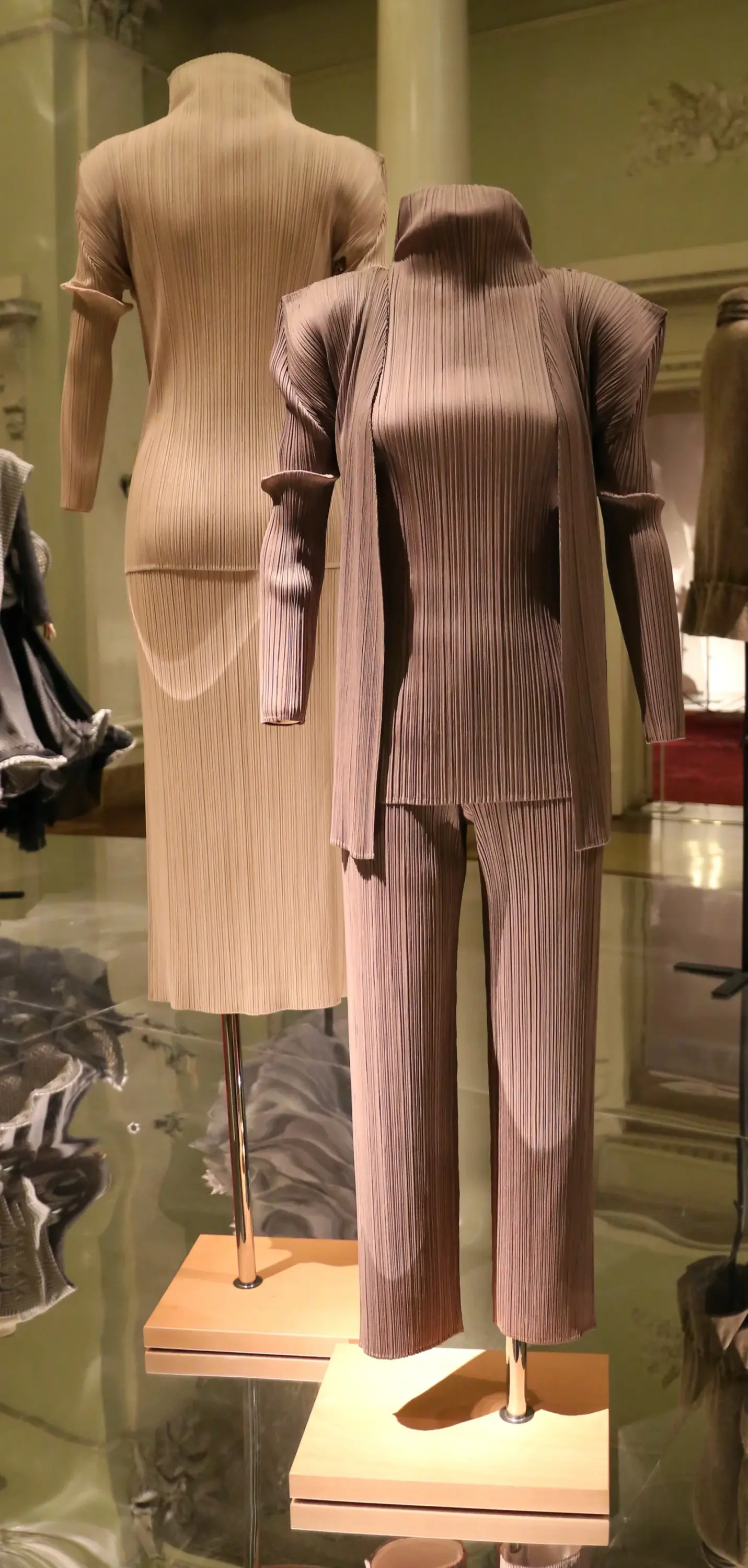
When the sandwich emerged from the rollers and cooled, technicians pulled away the paper like peeling a protective skin. The giant garment had contracted down to human proportions, stamped with permanent, razor-sharp architectural ridges. Synthetic memory was locked forever. Water could not unseat the folds; detergent could not relax them. The garment could be washed in a bathroom sink, hung over a shower rod to dry in twenty minutes, and rolled into a tight spiral doughnut inside a suitcase without taking a crease. The iron was obsolete.
Launched commercially in 1993, )、そしてモノリシックな一体型織り( democratized avant-garde dress. While peers like レイ・カワクボ そして Yohji Yamamoto deployed black wool to construct protective intellectual armor, Miyake flooded the streets with brilliant cobalt blues, acid yellows, and vermilion pinks. His pleats moved with the velocity of modern life. Mothers, dancers, architects, and travelers adopted the line as an essential everyday tool, erasing the boundary between runway couture and daily domestic utility.
Kinetic choreography: William Forsythe, The Frankfurt Ballet, and kinetic friction
Cloth lives only when it moves. Miyake detested the static inertia of mannequins and runway models stalking catwalks with bored, wooden gaits. He understood that his pleats were kinetic instruments whose geometry could only be revealed through centrifugal force, acceleration, and bodily exhaustion.
In 1991, American choreographer William Forsythe invited Miyake to design the costumes for the Frankfurt Ballet’s production of The Loss of Small Detail. Forsythe was executing his own radical deconstruction of classical ballet, pushing dancers into extreme, off-axis hyperextensions, frantic floor work, and rapid athletic sprints. Traditional stage costumes—tutus, stiff doublets, and restrictive lycra leotards—tore under the strain or locked the pelvic joints.
Miyake delivered hundreds of custom pleated polyester tunics, leotards, and flared trousers. The stage rehearsal produced immediate shock. When dancers leaped and contorted across the Frankfurt stage, the micro-pleats expanded radially like accordion bellows, echoing the muscular torque of each limb before snapping instantly back against the skin. The fabric acted as an external respiratory system. Air rushed through the polyester ridges, catching stage lights and making speed visible to the audience in iridescent ripples.
Forsythe realized that Miyake’s garments did not merely clothe the choreography; they actively generated it. Dancers discovered that the centrifugal whip of pleated cuffs and flared hems provided tactile feedback, altering their balance and propelling them into turns. The Frankfurt collaboration cemented Miyake’s conviction that garment pleating was not a surface embellishment, but a dynamic architecture engineered for unencumbered kinetic freedom.
The sculptural lens: Irving Penn and the autonomous silhouette
Most fashion designers hover nervously over photographers, demanding flattering angles, commercial angles, and recognizable celebrity faces. Miyake did the opposite: he stayed away. For thirteen years, between 1983 and 1999, Miyake entrusted the visual documentation of his seasonal collections to legendary American photographer Irving Penn. Across more than forty editorial sessions in Penn’s Manhattan studio, Miyake never attended a single shoot. He gave Penn carte blanche.
Their creative exchange was conducted entirely through the mail. Twice a year, Miyake’s Paris staff packed shipping trunks with garments and sent them across the Atlantic to Penn’s studio on Fifth Avenue. Penn worked with a single stylist, Jun Kanai, dressing dancers and contortionists against seamless white paper rolls under harsh, raking tungsten light. He stripped away all contextual distractions—no sets, no props, no lifestyle fantasy.
Through Penn’s 8×10 view camera, Miyake’s creations ceased to look like commercial clothing. Rattan corsets resembled tribal shields; molded plastic bustiers evoked futuristic insect carapaces; oversized pleated polyester tunics surged across the frame like volcanic basalt formations or primeval deep-sea creatures. Penn photographed the garments from severe profiles, emphasizing structural tension, hard shadow, and unexpected volume.
When the contact sheets arrived in Tokyo, Miyake studied them with genuine astonishment. Penn showed Miyake possibilities within his own garments that the designer had never consciously conceived while drafting at the cutting table. The images validated Miyake’s core premise: once severed from the designer’s hands, a truly innovative garment functions as an autonomous sculptural object, capable of generating its own visual poetry when confronted by an uncompromising lens.
The industrial modernist uniform: Steve Jobs and the abolition of ornament
The purest realization of Miyake’s industrial philosophy emerged not on a runway, but in the everyday wardrobe of Silicon Valley’s most exacting modernist. In the early 1980s, Apple co-founder Steve Jobs visited Sony headquarters in Shinagawa, Tokyo. Touring the assembly floors alongside Sony chairman Akio Morita, Jobs noticed that every worker—from factory-line assemblers to senior executives—wore identical dark jackets. When Jobs inquired, Morita explained that in postwar Japan, factory workers had few clothes to wear; Sony had hired Issey Miyake to design a durable, high-tech uniform that united employees and eliminated social friction.
Miyake’s Sony jacket was a masterpiece of utilitarian industrial design: crafted from ripstop nylon with zip-off sleeves, it transitioned seamlessly from warm factory floors to chilly outdoor commutes. Jobs was captivated. He returned to Cupertino and lobbied Apple employees to adopt a company uniform designed by Miyake. The proposal was laughed out of the room by Silicon Valley engineers who treasured their casual flannel shirts and sneakers. The corporate uniform was dead.
Jobs pivoted. If Apple would not wear a uniform, he would wear one himself. He reached out to Miyake directly, asking the designer to produce a personal wardrobe that would liberate him from daily wardrobe decisions and reflect his austere, Bauhaus-inspired design ethos. Miyake responded by producing approximately one hundred identical black mock-turtlenecks, engineered from a breathable, fine-gauge silk and cotton knit.
For the remainder of his life, Jobs wore that black turtle neck at every keynote presentation, product launch, and public appearance. The choice was not celebrity eccentricity; it was pure functionalist discipline. Like Miyake’s pleats, the black mock-turtleneck eliminated cognitive drag. It served as a uniform for intellectual labor, aligning Silicon Valley computational minimalism with Miyake’s lifelong mission to strip away decorative vanity in favor of durable, functional utility.
Material alchemy: Washi paper, recycled PET, and the 132 5 mathematics
Miyake never stopped treating fashion as material science. In 2007, he stepped back from daily runway presentations to establish 21_21 DESIGN SIGHT—a multidisciplinary design research museum in Tokyo designed by architect Tadao Ando—and founded the Reality Lab research team. The mission was explicit: develop regenerative manufacturing systems that address environmental collapse through advanced mathematics and recycled industrial matter.
In Autumn 2010, the Reality Lab launched 132 5. ISSEY MIYAKE. The enigmatic numbers encoded a precise topological formula: a single piece of cloth (1) takes on a three-dimensional shape (3), is folded completely flat into two dimensions (2), and when picked up by the wearer, expands into a fifth dimension (5)—the dimension of lived time and movement. Working with computer scientist Jun Mitani, the team applied algorithmic 3D geometry to fold garments entirely flat along laser-creased geometric tessellations, exactly like algorithmic origami.
The material composition was equally radical. Miyake rejected virgin textiles, partnering with Teijin to utilize Eco-circle fibers—a closed-loop polyester yarn chemically recycled from discarded plastic bottles and post-consumer synthetic garments. The resulting geometric polygons lie entirely two-dimensional on a table; when the wearer lifts the collar, the flat origami polygon effortlessly pops up into a sculptural tunic, dress, or jacket without requiring internal bone structures or tailored armholes.
This technological daring was grounded in deep historical roots. Throughout his career, Miyake balanced space-age synthetic polymers with ancient Japanese craft traditions. He spent decades collaborating with rural artisans in Tohoku and Kyoto, combining handmade mulberry washi paper with raw linen, experimenting with natural indigo vat dyeing, and weaving coarse ramie on century-old wooden shuttle looms. He refused to view technology and handcraft as opposing forces. To Miyake, a hand-carved wooden shuttle and a computer-controlled jacquard loom were simply tools along the same unbroken continuum of human ingenuity.
His passing in August 2022 marked the departure of fashion’s most fearless technologist. Yet his legacy remains alive wherever cloth meets kinetic energy. In an industry still intoxicated by seasonal disposability, digital hype, and superficial luxury, Miyake’s five decades of work offer an uncompromising alternative: clothing that respects the earth, embraces the machine, and frees the human body to dance.
Related Brand Archives & Historical Monographs
Explore curated archival pieces and deep historical analyses across the avant-garde continuum: browse the curated Issey Miyake brand archive, examine our monographs on Comme des Garçons そして Yohji Yamamoto, or study foundational historical analyses including パリの日本のファッション革命, レイ・カワクボと欠如の建築や ヨウジヤマモトと黒の詩.
参考文献とさらなる読み物
- Wikimedia Foundation — Issey Miyake: Biography, Design Philosophy, and Archival Collections
- Wikimedia Foundation — William Forsythe: Ballett Frankfurt and Costume Collaborations
- Wikimedia Foundation — Irving Penn: Studio Practice and Photographs of Issey Miyake Designs
- Wikimedia Foundation — Steve Jobs: Modernist Aesthetics and the Miyake Uniform
- Wikimedia Foundation — Tama Art University: History and Notable Alumni in Industrial Design
- Kyoto Costume Institute (KCI) — Kyoto Costume Institute Digital Archives: Japanese Avant-Garde Fashion Collections
- WOWOW / 713 Magazine — Issey Miyake "Moves" (1993 Documentary)
画像のクレジット
- Issey Miyake addressing the press at the National Art Center in Tokyo, March 2016. Photograph by Hsinhuei Chiou, Wikimedia Commons, CC BY-SA 4.0.
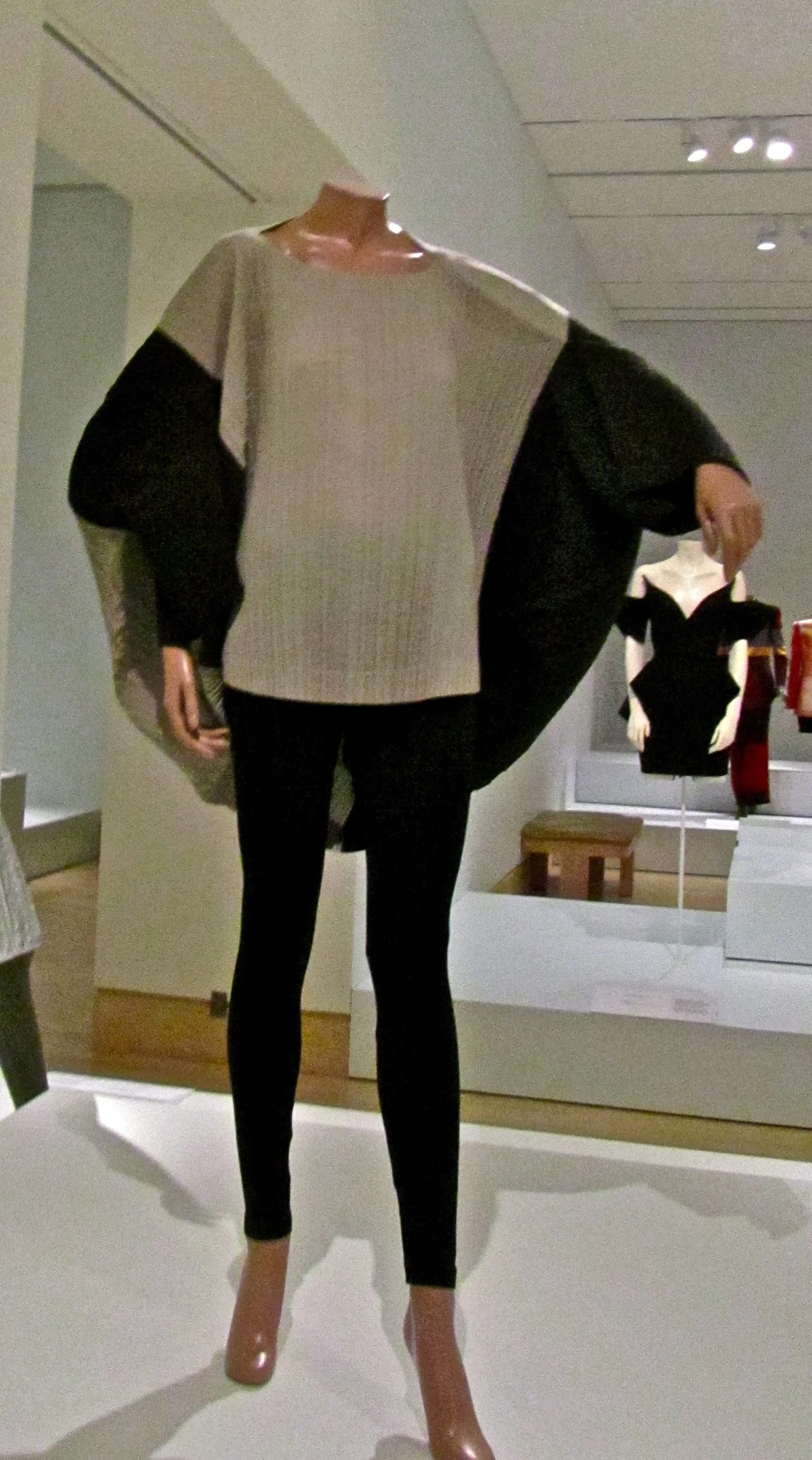
- Archival garment from the Rhythm Pleats collection, Autumn/Winter 1990. Photograph by ellenm1 / Flickr, Wikimedia Commons, CC BY 2.0.
- Two Pleats Please ensembles in micro-pleated polyester, 1995. Photograph by Sailko, Galleria del Costume, Palazzo Pitti, Florence, Wikimedia Commons, CC BY 3.0.