Иссей Мияке: движение, технологии и складка
Issey Miyake never considered himself a couturier; he operated as an industrial designer whose raw medium happened to be cloth. While twentieth-century Parisian fashion clung to the aristocratic fantasy of hand-stitched exclusivity and corseted bodily discipline, Miyake looked toward the democratic utility of the assembly line, the chemistry of synthetic polymers, and the uninhibited mechanics of human motion. Emerging from postwar Tokyo after surviving the atomic destruction of Hiroshima at age seven, he carried an aversion to nostalgic mourning and decorative vanity. His laboratory in Tokyo dismantled the fundamental dogma of Western pattern cutting: the belief that flat fabric must be carved, darted, and forced against the skin into an idealized anatomical mold. Alongside contemporaries explored in our monograph on японскую модную революцию в Париже, Issey Miyake overturned Eurocentric beauty standards. By inventing garment pleating in 1988, launching Pleats Please in 1993, and engineering zero-waste digital weaving through A-POC in 1999, Miyake transformed synthetic polyester into high-technology architecture—proving that true avant-garde luxury liberates the body instead of constraining it.
Fashion houses manufacture obsolescence; Issey Miyake engineered infrastructure.
While European luxury conglomerates fixated on seasonal hemline fluctuations, gilded hardware, and status signifiers designed for museum vitrines, Issey Miyake treated the garment as an ergonomic interface. He wanted to know what happens when a body sprints across a room, sits cross-legged on a tatami mat, or packs a wardrobe into an overnight bag without summoning an iron.
His work demolished the foundational premise of Western sartorial construction. For three centuries, Parisian haute couture operated on an invasive, subtractive principle: tailor shears slashed flat textiles into geometric fragments, darting and stitching them over horsehair padding to force the soft contours of human flesh into a rigid, European anatomical silhouette. Miyake chose an alternate path. Steeped in traditional Japanese spatial mechanics, industrial chemistry, and mechanical engineering, he treated clothing as an uninterrupted continuum between cloth and movement. His garments do not dictate posture; they yield to the momentum of the wearer.
The revolt against haute couture: May 1968 and the democratic mandate
Miyake learned the rules of European dressmaking only to discard them. After graduating with a degree in graphic design from Tama Art University in Tokyo in 1964—where he staged his first exhibition, A Poem of Cloth and Stone—he moved to Paris in 1965 to enroll at the École de la Chambre Syndicale de la Couture Parisienne. He absorbed the rigorous craft of classical draping, serving as an assistant to Guy Laroche and subsequently drafting sketches in the quiet ateliers of Hubert de Givenchy. He watched aristocratic dowagers undergo three fittings for a single silk taffeta evening gown. The discipline was immaculate; the purpose felt dead.
The breaking point arrived in May 1968. Cobblestones flew across the Boulevard Saint-Michel as students and factory workers brought Paris to an economic standstill, occupying universities and demanding the dismantling of bourgeois hierarchies. Trapped inside his apartment, Miyake looked down from his window onto the barricades. The revelation struck with total clarity: haute couture was an archaic, decorative relic functioning for fewer than three thousand wealthy women worldwide. Outside, the real century was unfolding in blue jeans, workwear chore jackets, and cotton jerseys. Why design gilded cages when people needed clothes to run in?
He crossed the Atlantic to New York in 1969, taking a position with American ready-to-wear designer Geoffrey Beene on Seventh Avenue. There, he witnessed the industrial speed of automated cutting tables, synthetic fiber blends, and functional athletic garments. When he returned to Tokyo in 1970 to establish the Miyake Design Studio (MDS), his mandate was clear: he would not make fashion for elites. He would produce universal tools for living.
His inaugural presentations in New York in 1971 and Paris in 1973 signaled an immediate rupture. Instead of tailored jackets with stiff horsehair chest canvases, he sent out unlined coats cut from Japanese sashiko-stitched judo canvas, hand-dyed cottons, and utilitarian jumpsuits. The garments featured no buttons, no zippers, and no internal lining. Western critics, accustomed to the structured elegance of Yves Saint Laurent, struggled to categorize garments that resembled oversized kites until a human body activated their folds. Miyake had planted the seeds of an industrial revolt.
A Piece of Cloth (A-POC): The single-thread geometry of planar dress
European tailoring cuts fabric; Japanese dressmaking respects it. In the traditional kimono tradition, a garment is assembled from a single thirty-six-centimeter bolt of unbroken cloth (*tanmono*), cut strictly along straight geometric lines and sewn without curving seams or darting. Surplus fabric is folded into hem allowances rather than discarded on the workroom floor. The textile remains an autonomous plane; it wraps around the wearer, mediated by the empty air between skin and weave—the spatial interval known as Ма.
Miyake elevated this cultural philosophy into an industrial design doctrine termed A Piece of Cloth (A-POC). He formulated the premise with deceptive simplicity: start with a single thread, feed it into a machine, and emerge with a complete garment without cutting or stitching a seam. Conventional mass manufacture generates catastrophic waste, routinely discarding fifteen to twenty percent of woven yardage in cutting-room scraps. Miyake found this wastefulness intolerable. He wanted the loom to behave like an organic printer.
In 1999, working in close collaboration with textile engineer Dai Fujiwara, Miyake unveiled the commercial fruition of A-POC. Utilizing computer-controlled industrial jacquard looms, the MDS team programmed digital algorithms that interlaced warp and weft threads into continuous, double-layered tubular textiles. As the machine ran, it did not weave flat yardage; it wove finished jackets, skirts, gloves, and bags embedded directly inside the tubular structure, complete with finished hemlines and structural ribbing.
The consumer participated in the final manufacturing act. Rolls of red or black knit emerged from the loom like giant rolls of perforated paper towels. Using ordinary scissors, wearers cut along faint dotted outlines cast into the yarn to release their garments. Because the computer programmed the synthetic fibers to self-fuse at the boundary lines, the edges never frayed. No needle. No thread. No waste. A flat tubular scroll unspooled into an entire wardrobe, bridging ancient warp-and-weft logic with digital algorithmic production.
Garment-pleating technology: Chemical memory, craft paper, and 2.5x distortion
Pleating is ancient; garment pleating was Miyake’s invention. In Western decorative arts, accordion pleats trace back to Mariano Fortuny’s 1907 silk Delphos gowns and Parisian craft ateliers like Gérard Lognon. Yet traditional pleating suffered from a fatal industrial flaw: fabric was pleated *before* it was cut. Patternmakers had to slice into pre-pleated textiles, sew fragile seams that flattened under the presser foot, and instruct wealthy clients to ship their garments across continents for delicate dry cleaning. Water erased the folds instantly. Traditional pleats were high-maintenance luxuries.
Between 1988 and 1989, Miyake inverted the entire chronological sequence. Instead of pleating raw cloth, he decided to pleat the finished garment. The concept sounded absurd to traditional tailors: how do you run a three-dimensional shirt or pair of trousers through a flat rolling machine without crushing the armholes or blowing out the seams?
The industrial protocol required precise material chemistry and mechanical bravery. Miyake abandoned natural fibers, selecting a featherweight 100% monofilament polyester twill engineered by Japanese textile giants Toray and Teijin. Working inside his Tokyo research lab, technicians cut and assembled garments at nearly 2.5 to 3 times their intended finished human measurements. A shirt looked like a gigantic, clownish parachute with cavernous sleeves and elongated hemlines.
Next came the thermal transformation. Technicians hand-folded the oversized polyester garment, sandwiching it flat between two bespoke sheets of recycled Japanese craft paper. The paper-wrapped package was fed through a heated mechanical roller press running at exactly 200°C (392°F). Under intense heat and pneumatic pressure, thermoplastic physics took over: the synthetic polymer chains reached their glass transition point, melted slightly, and permanently rearranged their crystalline molecular lattice around the folds of the craft paper.
When the sandwich emerged from the rollers and cooled, technicians pulled away the paper like peeling a protective skin. The giant garment had contracted down to human proportions, stamped with permanent, razor-sharp architectural ridges. Synthetic memory was locked forever. Water could not unseat the folds; detergent could not relax them. The garment could be washed in a bathroom sink, hung over a shower rod to dry in twenty minutes, and rolled into a tight spiral doughnut inside a suitcase without taking a crease. The iron was obsolete.
Launched commercially in 1993, Pleats Please democratized avant-garde dress. While peers like Рей Кавакубо и Yohji Yamamoto deployed black wool to construct protective intellectual armor, Miyake flooded the streets with brilliant cobalt blues, acid yellows, and vermilion pinks. His pleats moved with the velocity of modern life. Mothers, dancers, architects, and travelers adopted the line as an essential everyday tool, erasing the boundary between runway couture and daily domestic utility.
Kinetic choreography: William Forsythe, The Frankfurt Ballet, and kinetic friction
Cloth lives only when it moves. Miyake detested the static inertia of mannequins and runway models stalking catwalks with bored, wooden gaits. He understood that his pleats were kinetic instruments whose geometry could only be revealed through centrifugal force, acceleration, and bodily exhaustion.
In 1991, American choreographer William Forsythe invited Miyake to design the costumes for the Frankfurt Ballet’s production of The Loss of Small Detail. Forsythe was executing his own radical deconstruction of classical ballet, pushing dancers into extreme, off-axis hyperextensions, frantic floor work, and rapid athletic sprints. Traditional stage costumes—tutus, stiff doublets, and restrictive lycra leotards—tore under the strain or locked the pelvic joints.
Miyake delivered hundreds of custom pleated polyester tunics, leotards, and flared trousers. The stage rehearsal produced immediate shock. When dancers leaped and contorted across the Frankfurt stage, the micro-pleats expanded radially like accordion bellows, echoing the muscular torque of each limb before snapping instantly back against the skin. The fabric acted as an external respiratory system. Air rushed through the polyester ridges, catching stage lights and making speed visible to the audience in iridescent ripples.
Forsythe realized that Miyake’s garments did not merely clothe the choreography; they actively generated it. Dancers discovered that the centrifugal whip of pleated cuffs and flared hems provided tactile feedback, altering their balance and propelling them into turns. The Frankfurt collaboration cemented Miyake’s conviction that garment pleating was not a surface embellishment, but a dynamic architecture engineered for unencumbered kinetic freedom.
The sculptural lens: Irving Penn and the autonomous silhouette
Most fashion designers hover nervously over photographers, demanding flattering angles, commercial angles, and recognizable celebrity faces. Miyake did the opposite: he stayed away. For thirteen years, between 1983 and 1999, Miyake entrusted the visual documentation of his seasonal collections to legendary American photographer Irving Penn. Across more than forty editorial sessions in Penn’s Manhattan studio, Miyake never attended a single shoot. He gave Penn carte blanche.
Их творческий обмен проходил исключительно через почту. Два раза в год команда Мияке в Париже упаковывала грузовые ящики с одеждой и отправляла их через Атлантику в студию Пена на Пятой авеню. Пен работал с единственным стилистом, Джуном Канаи, одевая танцоров и контortionистов на фоне бесшовных белых бумажных рулонов при резком, рвущем в tungsten свете. Он убрал все контекстуальные отвлекающие факторы — никаких декораций, никаких реквизитов, никакой фэнтези о стиле жизни.
Через 8×10 видоискатель Пена творения Мияке перестали выглядеть как коммерческая одежда. Корсеты из ротанга напоминали племенные щиты; формованные пластиковые бюстье вызывали ассоциации с футуристическими панцирями насекомых; объемные плиссированные полиэстеровые туники стремительно заполняли кадр, как вулканические базальтовые образования или первобытные глубоководные существа. Пен фотографировал одежду с жестких профилей, подчеркивая структурное напряжение, резкие тени и неожиданный объем.
Когда контактные листы прибыли в Токио, Мияке изучал их с искренним удивлением. Пен показал Мияке возможности в его собственных нарядах, которые дизайнер никогда не осознавал, работая на раскройном столе. Изображения подтвердили основную идею Мияке: как только одежда отделяется от рук дизайнера, поистине инновационный наряд функционирует как автономный скульптурный объект, способный генерировать свою собственную визуальную поэзию, когда сталкивается с непримиримой линзой.
The industrial modernist uniform: Steve Jobs and the abolition of ornament
Чистейшее воплощение промышленной философии Мияке возникло не на подиуме, а в повседневном гардеробе самого требовательного модерниста Силиконовой долины. В начале 1980-х годов соучредитель Apple Стив Джобс посетил штаб-квартиру Sony в Синагаве, Токио. Обходя сборочные линии вместе с председателем Sony Акио Морита, Джобс заметил, что каждый работник — от сборщиков на конвейере до старших руководителей — носил одинаковые темные куртки. Когда Джобс спросил, Морита объяснил, что в послевоенной Японии у рабочих было мало одежды; Sony наняла Иссей Мияке для разработки прочной, высокотехнологичной униформы, которая объединила бы сотрудников и устранила социальное трение.
Куртка Мияке для Sony была шедевром утилитарного промышленного дизайна: изготовленная из рипстоп-нейлона с отстегивающимися рукавами, она плавно переходила от теплых заводских полов к холодным уличным поездкам. Джобс был очарован. Он вернулся в Купертино и убедил сотрудников Apple принять униформу, разработанную Мияке. Это предложение было высмеяно инженерами Силиконовой долины, которые ценили свои повседневные фланелевые рубашки и кроссовки. Корпоративная униформа была мертва.
Джобс изменил курс. Если Apple не будет носить униформу, он сам будет ее носить. Он обратился к Мияке напрямую, попросив дизайнера создать личный гардероб, который освободил бы его от ежедневных решений о нарядах и отражал бы его строгую, вдохновленную Баухаусом философию дизайна. Мияке ответил, создав примерно сто одинаковых черных водолазок, изготовленных из дышащего, тонкого шелка и хлопка.
На протяжении всей своей жизни Джобс носил эту черную водолазку на каждой ключевой презентации, запуске продукта и публичном выступлении. Этот выбор не был эксцентричностью знаменитости; это была чистая функциональная дисциплина. Как и плиссы Мияке, черная водолазка устраняла когнитивное напряжение. Она служила униформой для интеллектуального труда, связывая минимализм вычислений Силиконовой долины с жизненной миссией Мияке по устранению декоративной суеты в пользу прочной, функциональной утилиты.
Material alchemy: Washi paper, recycled PET, and the 132 5 mathematics
Мияке никогда не переставал рассматривать моду как материальную науку. В 2007 году он отошел от ежедневных показов мод, чтобы основать 21_21 DESIGN SIGHT — многопрофильный музей исследовательского дизайна в Токио, спроектированный архитектором Тадао Андо, — и основал команду Reality Lab для исследований. Миссия была ясной: разработать регенеративные производственные системы, которые решают проблемы экологического коллапса с помощью продвинутой математики и переработанных промышленных материалов.
Осенью 2010 года Reality Lab запустила 132 5. ИССЕЙ МИЯКЕ.. Эти загадочные числа закодировали точную топологическую формулу: один кусок ткани (1) принимает трехмерную форму (3), полностью складывается в две измерения (2), и когда его поднимает носитель, он расширяется в пятом измерении (5) — измерении прожитого времени и движения. Работая с компьютерным ученым Джуном Митани, команда применила алгоритмическую 3D-геометрию, чтобы полностью сложить одежду вдоль лазерно-скошенных геометрических тесселяций, точно так же, как алгоритмическое оригами.
Материальный состав был столь же радикальным. Мияке отверг новые текстили, сотрудничая с Teijin для использования Eco-circle волокон — замкнутой полиэстеровой пряжи, химически переработанной из выброшенных пластиковых бутылок и синтетической одежды после потребления. В результате полученные геометрические полигоны полностью двухмерны на столе; когда носитель поднимает воротник, плоский оригами-полигон без усилий поднимается в скульптурную тунику, платье или куртку, не требуя внутренних каркасных структур или подгонки пройм.
Эта технологическая смелость была основана на глубоких исторических корнях. На протяжении всей своей карьеры Мияке балансировал синтетические полимеры космической эпохи с древними японскими ремесленными традициями. Он провел десятилетия, сотрудничая с сельскими ремесленниками в Тохоку и Киото, сочетая ручную бумагу из шелковицы с сырой льняной тканью, экспериментируя с натуральным индиго и ткачеством грубого рами на столетних деревянных ткацких станках. Он отказывался рассматривать технологии и ручное творчество как противоположные силы. Для Мияке ручной резной деревянный челнок и компьютеризированный жаккардовый ткацкий станок были просто инструментами вдоль одного и того же непрерывного потока человеческой изобретательности.
Его уход в августе 2022 года ознаменовал собой уход самого бесстрашного технолога моды. Тем не менее, его наследие остается живым там, где ткань встречается с кинетической энергией. В индустрии, все еще одурманенной сезонной заменяемостью, цифровым хайпом и поверхностной роскошью, пятнадцатилетняя работа Мияке предлагает бескомпромиссную альтернативу: одежду, которая уважает землю, принимает машину и освобождает человеческое тело для танца.
Связанные архивы брендов и исторические монографии
Изучай кураторские архивные вещи и глубокие исторические анализы в авангардном континууме: просматривай кураторский Архив бренда Иссей Мияке, изучай наши монографии о Comme des Garçons и Yohji Yamamoto, или изучай основные исторические анализы, включая Японская модная революция в Париже, Рэй Кавакубо и Архитектура Отсутствияи Ёдзи Ямамото и Поэзия Черного.
Ссылки и дальнейшее чтение
- Фонд Викимедиа — Иссей Мияке: биография, философия дизайна и архивные коллекции
- Фонд Викимедиа — Уильям Форсайт: Балет Франкфурта и костюмные коллаборации
- Фонд Викимедиа — Ирвинг Пен: студийная практика и фотографии дизайнов Иссей Мияке
- Фонд Викимедиа — Стив Джобс: модернистская эстетика и униформа Мияке
- Фонд Викимедиа — Университет Тама: история и выдающиеся выпускники в области промышленного дизайна
- Киотский институт костюма (KCI) — Цифровые архивы Киотского института костюма: Коллекции японской авангардной моды
- WOWOW / 713 Magazine — Иссей Мияке "Движения" (документальный фильм 1993 года)
Кредиты изображения
- Иссей Мияке обращается к прессе в Национальном центре искусств в Токио, март 2016 года. Фотография Хсинхуэя Чиу, Викимедиа Коммонс, CC BY-SA 4.0.
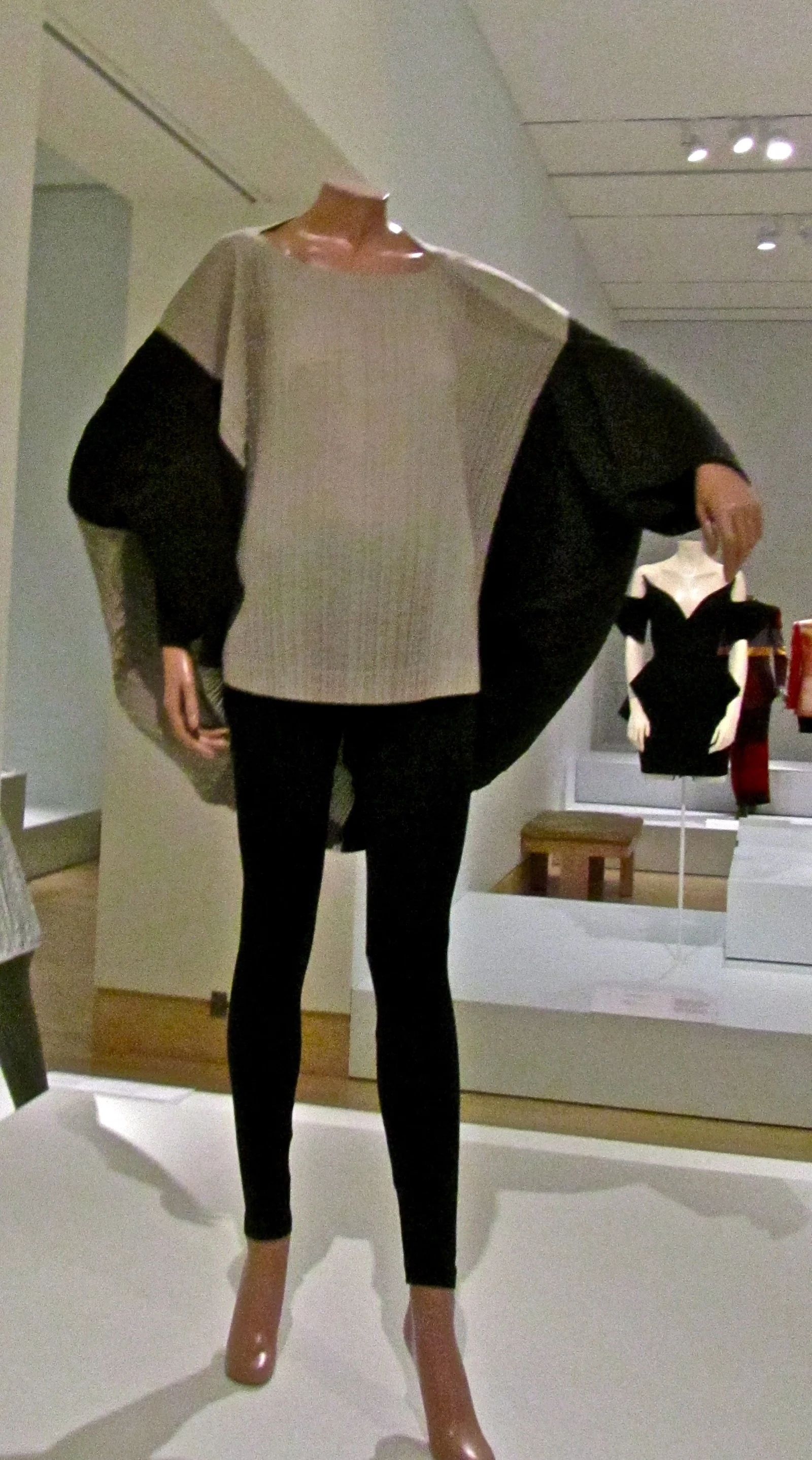
- Архивный наряд из коллекции Rhythm Pleats, осень/зима 1990 года. Фотография ellenm1 / Flickr, Викимедиа Коммонс, CC BY 2.0.
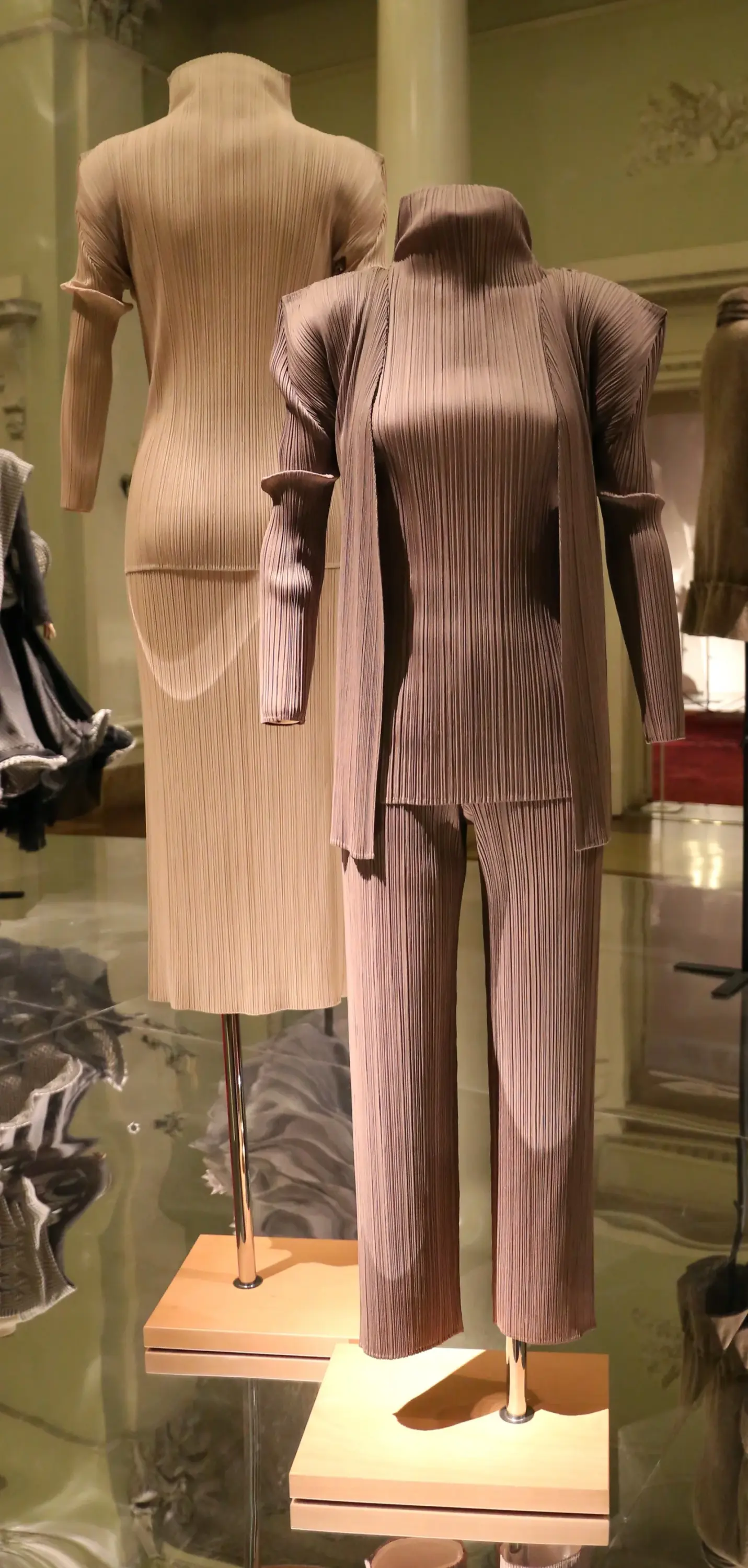
- Два ансамбля Pleats Please из микро-плиссированного полиэстера, 1995 год. Фотография Сайлко, Галерея костюма, Палаццо Питти, Флоренция, Викимедиа Коммонс, CC BY 3.0.