إيسي مياكي: الحركة، التكنولوجيا والطيّ
Issey Miyake never considered himself a couturier; he operated as an industrial designer whose raw medium happened to be cloth. While twentieth-century Parisian fashion clung to the aristocratic fantasy of hand-stitched exclusivity and corseted bodily discipline, Miyake looked toward the democratic utility of the assembly line, the chemistry of synthetic polymers, and the uninhibited mechanics of human motion. Emerging from postwar Tokyo after surviving the atomic destruction of Hiroshima at age seven, he carried an aversion to nostalgic mourning and decorative vanity. His laboratory in Tokyo dismantled the fundamental dogma of Western pattern cutting: the belief that flat fabric must be carved, darted, and forced against the skin into an idealized anatomical mold. Alongside contemporaries explored in our monograph on ثورة الموضة اليابانية في باريس, Issey Miyake overturned Eurocentric beauty standards. By inventing garment pleating in 1988, launching بليتس بليز in 1993, and engineering zero-waste digital weaving through A-POC in 1999, Miyake transformed synthetic polyester into high-technology architecture—proving that true avant-garde luxury liberates the body instead of constraining it.
Fashion houses manufacture obsolescence; Issey Miyake engineered infrastructure.
While European luxury conglomerates fixated on seasonal hemline fluctuations, gilded hardware, and status signifiers designed for museum vitrines, Issey Miyake treated the garment as an ergonomic interface. He wanted to know what happens when a body sprints across a room, sits cross-legged on a tatami mat, or packs a wardrobe into an overnight bag without summoning an iron.
His work demolished the foundational premise of Western sartorial construction. For three centuries, Parisian haute couture operated on an invasive, subtractive principle: tailor shears slashed flat textiles into geometric fragments, darting and stitching them over horsehair padding to force the soft contours of human flesh into a rigid, European anatomical silhouette. Miyake chose an alternate path. Steeped in traditional Japanese spatial mechanics, industrial chemistry, and mechanical engineering, he treated clothing as an uninterrupted continuum between cloth and movement. His garments do not dictate posture; they yield to the momentum of the wearer.
The revolt against haute couture: May 1968 and the democratic mandate
Miyake learned the rules of European dressmaking only to discard them. After graduating with a degree in graphic design from Tama Art University in Tokyo in 1964—where he staged his first exhibition, A Poem of Cloth and Stone—he moved to Paris in 1965 to enroll at the École de la Chambre Syndicale de la Couture Parisienne. He absorbed the rigorous craft of classical draping, serving as an assistant to Guy Laroche and subsequently drafting sketches in the quiet ateliers of Hubert de Givenchy. He watched aristocratic dowagers undergo three fittings for a single silk taffeta evening gown. The discipline was immaculate; the purpose felt dead.
The breaking point arrived in May 1968. Cobblestones flew across the Boulevard Saint-Michel as students and factory workers brought Paris to an economic standstill, occupying universities and demanding the dismantling of bourgeois hierarchies. Trapped inside his apartment, Miyake looked down from his window onto the barricades. The revelation struck with total clarity: haute couture was an archaic, decorative relic functioning for fewer than three thousand wealthy women worldwide. Outside, the real century was unfolding in blue jeans, workwear chore jackets, and cotton jerseys. Why design gilded cages when people needed clothes to run in?
He crossed the Atlantic to New York in 1969, taking a position with American ready-to-wear designer Geoffrey Beene on Seventh Avenue. There, he witnessed the industrial speed of automated cutting tables, synthetic fiber blends, and functional athletic garments. When he returned to Tokyo in 1970 to establish the Miyake Design Studio (MDS), his mandate was clear: he would not make fashion for elites. He would produce universal tools for living.
His inaugural presentations in New York in 1971 and Paris in 1973 signaled an immediate rupture. Instead of tailored jackets with stiff horsehair chest canvases, he sent out unlined coats cut from Japanese sashiko-stitched judo canvas, hand-dyed cottons, and utilitarian jumpsuits. The garments featured no buttons, no zippers, and no internal lining. Western critics, accustomed to the structured elegance of Yves Saint Laurent, struggled to categorize garments that resembled oversized kites until a human body activated their folds. Miyake had planted the seeds of an industrial revolt.
A Piece of Cloth (A-POC): The single-thread geometry of planar dress
European tailoring cuts fabric; Japanese dressmaking respects it. In the traditional kimono tradition, a garment is assembled from a single thirty-six-centimeter bolt of unbroken cloth (*tanmono*), cut strictly along straight geometric lines and sewn without curving seams or darting. Surplus fabric is folded into hem allowances rather than discarded on the workroom floor. The textile remains an autonomous plane; it wraps around the wearer, mediated by the empty air between skin and weave—the spatial interval known as "تدمير".
Miyake elevated this cultural philosophy into an industrial design doctrine termed A Piece of Cloth (A-POC). He formulated the premise with deceptive simplicity: start with a single thread, feed it into a machine, and emerge with a complete garment without cutting or stitching a seam. Conventional mass manufacture generates catastrophic waste, routinely discarding fifteen to twenty percent of woven yardage in cutting-room scraps. Miyake found this wastefulness intolerable. He wanted the loom to behave like an organic printer.
In 1999, working in close collaboration with textile engineer Dai Fujiwara, Miyake unveiled the commercial fruition of A-POC. Utilizing computer-controlled industrial jacquard looms, the MDS team programmed digital algorithms that interlaced warp and weft threads into continuous, double-layered tubular textiles. As the machine ran, it did not weave flat yardage; it wove finished jackets, skirts, gloves, and bags embedded directly inside the tubular structure, complete with finished hemlines and structural ribbing.
The consumer participated in the final manufacturing act. Rolls of red or black knit emerged from the loom like giant rolls of perforated paper towels. Using ordinary scissors, wearers cut along faint dotted outlines cast into the yarn to release their garments. Because the computer programmed the synthetic fibers to self-fuse at the boundary lines, the edges never frayed. No needle. No thread. No waste. A flat tubular scroll unspooled into an entire wardrobe, bridging ancient warp-and-weft logic with digital algorithmic production.
Garment-pleating technology: Chemical memory, craft paper, and 2.5x distortion
Pleating is ancient; garment pleating was Miyake’s invention. In Western decorative arts, accordion pleats trace back to Mariano Fortuny’s 1907 silk Delphos gowns and Parisian craft ateliers like Gérard Lognon. Yet traditional pleating suffered from a fatal industrial flaw: fabric was pleated *before* it was cut. Patternmakers had to slice into pre-pleated textiles, sew fragile seams that flattened under the presser foot, and instruct wealthy clients to ship their garments across continents for delicate dry cleaning. Water erased the folds instantly. Traditional pleats were high-maintenance luxuries.
Between 1988 and 1989, Miyake inverted the entire chronological sequence. Instead of pleating raw cloth, he decided to pleat the finished garment. The concept sounded absurd to traditional tailors: how do you run a three-dimensional shirt or pair of trousers through a flat rolling machine without crushing the armholes or blowing out the seams?
The industrial protocol required precise material chemistry and mechanical bravery. Miyake abandoned natural fibers, selecting a featherweight 100% monofilament polyester twill engineered by Japanese textile giants Toray and Teijin. Working inside his Tokyo research lab, technicians cut and assembled garments at nearly 2.5 to 3 times their intended finished human measurements. A shirt looked like a gigantic, clownish parachute with cavernous sleeves and elongated hemlines.
Next came the thermal transformation. Technicians hand-folded the oversized polyester garment, sandwiching it flat between two bespoke sheets of recycled Japanese craft paper. The paper-wrapped package was fed through a heated mechanical roller press running at exactly 200°C (392°F). Under intense heat and pneumatic pressure, thermoplastic physics took over: the synthetic polymer chains reached their glass transition point, melted slightly, and permanently rearranged their crystalline molecular lattice around the folds of the craft paper.
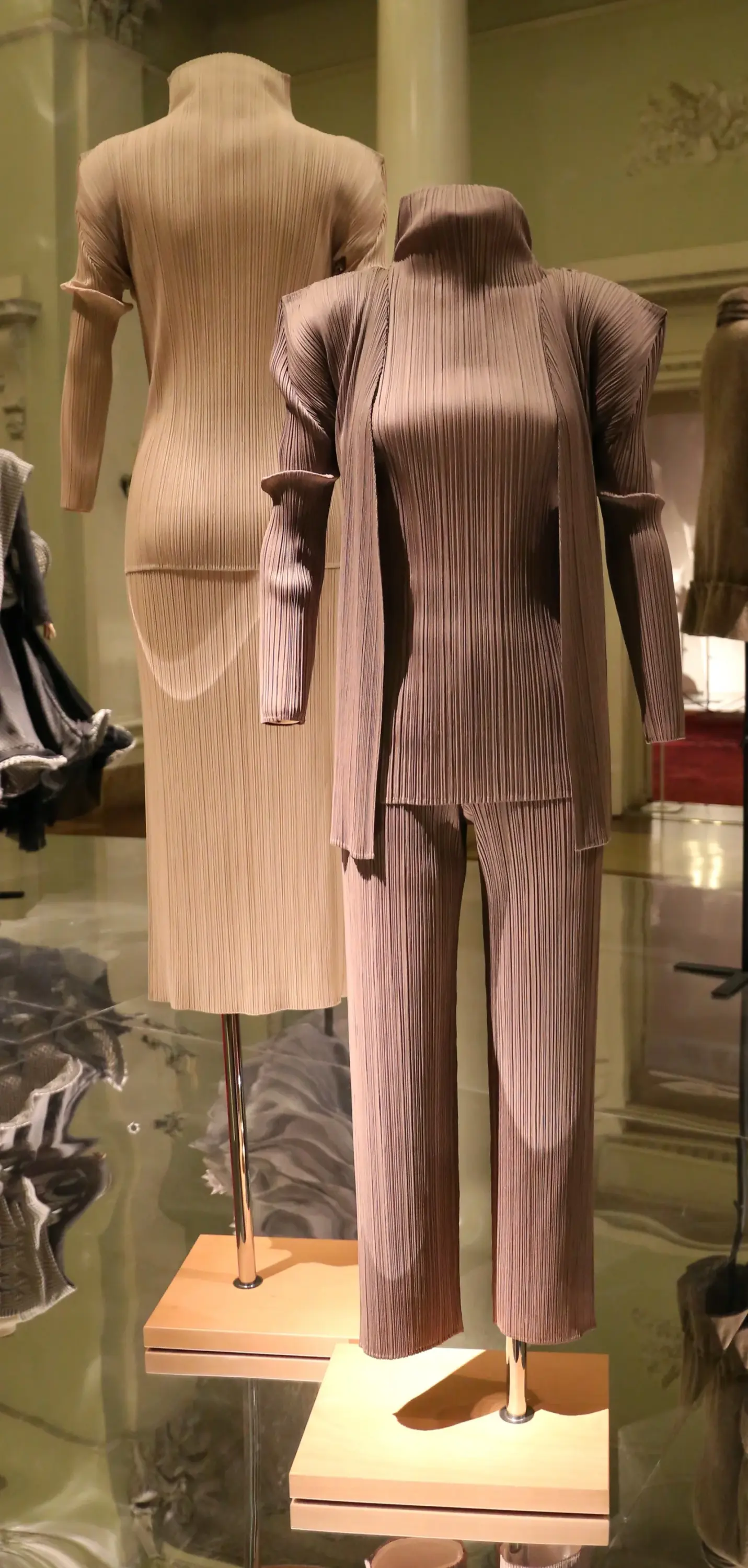
When the sandwich emerged from the rollers and cooled, technicians pulled away the paper like peeling a protective skin. The giant garment had contracted down to human proportions, stamped with permanent, razor-sharp architectural ridges. Synthetic memory was locked forever. Water could not unseat the folds; detergent could not relax them. The garment could be washed in a bathroom sink, hung over a shower rod to dry in twenty minutes, and rolled into a tight spiral doughnut inside a suitcase without taking a crease. The iron was obsolete.
Launched commercially in 1993, بليتس بليز democratized avant-garde dress. While peers like ري كاواكوبو و يوجي ياماموتو deployed black wool to construct protective intellectual armor, Miyake flooded the streets with brilliant cobalt blues, acid yellows, and vermilion pinks. His pleats moved with the velocity of modern life. Mothers, dancers, architects, and travelers adopted the line as an essential everyday tool, erasing the boundary between runway couture and daily domestic utility.
Kinetic choreography: William Forsythe, The Frankfurt Ballet, and kinetic friction
Cloth lives only when it moves. Miyake detested the static inertia of mannequins and runway models stalking catwalks with bored, wooden gaits. He understood that his pleats were kinetic instruments whose geometry could only be revealed through centrifugal force, acceleration, and bodily exhaustion.
In 1991, American choreographer William Forsythe invited Miyake to design the costumes for the Frankfurt Ballet’s production of The Loss of Small Detail. Forsythe was executing his own radical deconstruction of classical ballet, pushing dancers into extreme, off-axis hyperextensions, frantic floor work, and rapid athletic sprints. Traditional stage costumes—tutus, stiff doublets, and restrictive lycra leotards—tore under the strain or locked the pelvic joints.
Miyake delivered hundreds of custom pleated polyester tunics, leotards, and flared trousers. The stage rehearsal produced immediate shock. When dancers leaped and contorted across the Frankfurt stage, the micro-pleats expanded radially like accordion bellows, echoing the muscular torque of each limb before snapping instantly back against the skin. The fabric acted as an external respiratory system. Air rushed through the polyester ridges, catching stage lights and making speed visible to the audience in iridescent ripples.
Forsythe realized that Miyake’s garments did not merely clothe the choreography; they actively generated it. Dancers discovered that the centrifugal whip of pleated cuffs and flared hems provided tactile feedback, altering their balance and propelling them into turns. The Frankfurt collaboration cemented Miyake’s conviction that garment pleating was not a surface embellishment, but a dynamic architecture engineered for unencumbered kinetic freedom.
The sculptural lens: Irving Penn and the autonomous silhouette
Most fashion designers hover nervously over photographers, demanding flattering angles, commercial angles, and recognizable celebrity faces. Miyake did the opposite: he stayed away. For thirteen years, between 1983 and 1999, Miyake entrusted the visual documentation of his seasonal collections to legendary American photographer Irving Penn. Across more than forty editorial sessions in Penn’s Manhattan studio, Miyake never attended a single shoot. He gave Penn carte blanche.
كانت تبادلهم الإبداعي يتم بالكامل عبر البريد. مرتين في السنة، كان موظفو مياكي في باريس يحزمون صناديق الشحن بالملابس ويرسلونها عبر المحيط الأطلسي إلى استوديو بن في الجادة الخامسة. عمل بن مع مصمم أزياء واحد، جون كاناي، يرتدي الراقصين والمتحولين ضد لفات ورق بيضاء سلسة تحت ضوء التنجستن القاسي. لقد أزال جميع المشتتات السياقية - لا مجموعات، لا أدوات، لا خيال نمط الحياة.
من خلال كاميرا بن ذات 8×10، توقفت إبداعات مياكي عن الظهور كملابس تجارية. كانت الكورسيهات المصنوعة من الخيزران تشبه الدروع القبلية؛ كانت البسترات البلاستيكية المنحوتة تستحضر دروع الحشرات المستقبلية؛ كانت التونيكات البوليستر الكبيرة المجعدة تتدفق عبر الإطار مثل تشكيلات البازلت البركانية أو مخلوقات أعماق البحار البدائية. صور بن الملابس من زوايا صارمة، مما يبرز التوتر الهيكلي، والظل القاسي، والحجم غير المتوقع.
عندما وصلت أوراق الاتصال إلى طوكيو، درس مياكي الصور بذهول حقيقي. أظهر بن لمياكي إمكانيات داخل ملابسه الخاصة التي لم يكن المصمم قد تصورها بوعي أثناء الرسم على طاولة القص. كانت الصور تؤكد الفرضية الأساسية لمياكي: بمجرد قطعها من يدي المصمم، تعمل قطعة الملابس المبتكرة حقًا ككائن منحوت مستقل، قادر على توليد شعريته البصرية الخاصة عندما تواجه عدسة صارمة.
The industrial modernist uniform: Steve Jobs and the abolition of ornament
أكثر تجسيد نقي لفلسفة مياكي الصناعية ظهر ليس على منصة عرض الأزياء، ولكن في خزانة الملابس اليومية لأكثر الحداثيين دقة في وادي السيليكون. في أوائل الثمانينات، زار مؤسس آبل المشارك ستيف جوبز مقر سوني في شيناغاوا، طوكيو. أثناء جولة في طوابق التجميع بجانب رئيس سوني أكيو موريطا، لاحظ جوبز أن كل عامل - من جامعي التجميع في خط الإنتاج إلى كبار التنفيذيين - كانوا يرتدون جاكيتات داكنة متطابقة. عندما استفسر جوبز، أوضح موريطا أنه في اليابان بعد الحرب، كان لدى عمال المصانع ملابس قليلة لارتدائها؛ قامت سوني بتوظيف إيسي مياكي لتصميم زي موحد متين وعالي التقنية يوحد الموظفين ويقضي على الاحتكاك الاجتماعي.
كان جاكيت مياكي من سوني تحفة من التصميم الصناعي الوظيفي: مصنوع من نايلون مقاوم للتمزق مع أكمام قابلة للفك، انتقل بسلاسة من أرضيات المصنع الدافئة إلى التنقلات الخارجية الباردة. كان جوبز مفتونًا. عاد إلى كوبرتينو وطلب من موظفي آبل اعتماد زي موحد مصمم من قبل مياكي. تم السخرية من الاقتراح من قبل مهندسي وادي السيليكون الذين كانوا يعتزون بقمصانهم القطنية غير الرسمية وأحذيتهم الرياضية. كان الزي الموحد للشركة ميتًا.
تغير جوبز. إذا كانت آبل لن ترتدي زيًا موحدًا، فسيرتدي واحدًا بنفسه. تواصل مع مياكي مباشرة، طالبًا من المصمم إنتاج خزانة ملابس شخصية تحرره من قرارات الملابس اليومية وتعكس فلسفته التصميمية المستوحاة من باوهاوس. استجاب مياكي بإنتاج حوالي مئة قميص أسود متطابق، مصنوعة من حرير وقطن خفيف التهوية.
لبقية حياته، ارتدى جوبز ذلك القميص الأسود في كل عرض رئيسي، وإطلاق منتج، ومظهر عام. لم يكن الاختيار غريبًا من المشاهير؛ بل كان انضباطًا وظيفيًا بحتًا. مثل طيات مياكي، أزال القميص الأسود الدائري العبء المعرفي. كان يعمل كزي موحد للعمل الفكري، موائمًا الحد الأدنى الحاسوبي لوادي السيليكون مع مهمة مياكي مدى الحياة في إزالة الزينة التزيينية لصالح الفائدة الوظيفية المتينة.
Material alchemy: Washi paper, recycled PET, and the 132 5 mathematics
لم يتوقف مياكي أبدًا عن اعتبار الموضة كعلم المواد. في عام 2007، تراجع عن عروض الأزياء اليومية لتأسيس 21_21 DESIGN SIGHT - متحف بحث تصميم متعدد التخصصات في طوكيو صممه المعماري تاداو أندو - وأسس فريق Reality Lab البحثي. كانت المهمة واضحة: تطوير أنظمة تصنيع تجديدية تعالج الانهيار البيئي من خلال الرياضيات المتقدمة والمواد الصناعية المعاد تدويرها.
في خريف 2010، أطلق Reality Lab 132 5. إيسي مياكي. كانت الأرقام الغامضة ترمز إلى صيغة طوبولوجية دقيقة: قطعة واحدة من القماش (1) تأخذ شكلًا ثلاثي الأبعاد (3)، تُطوى تمامًا إلى بعدين (2)، وعندما يلتقطها المستخدم، تتوسع إلى بعد خامس (5) - بعد الزمن والحركة المعاشة. عمل الفريق مع عالم الحاسوب جون ميتاني، حيث طبقوا هندسة ثلاثية الأبعاد خوارزمية لطي الملابس بالكامل على طول تكسيرات هندسية مشروطة بالليزر، تمامًا مثل الأوريغامي الخوارزمي.
كان التركيب المادي راديكالي بنفس القدر. رفض مياكي الأقمشة الجديدة، متعاونًا مع تيجين لاستخدام Eco-circle الألياف - خيط بوليستر مغلق الحلقة معاد تدويره كيميائيًا من زجاجات البلاستيك المهملة وملابس صناعية ما بعد الاستهلاك. الأشكال الهندسية الناتجة تبقى ثنائية الأبعاد تمامًا على الطاولة؛ عندما يرفع المستخدم الياقة، ينفجر الشكل الهندسي المسطح بسهولة إلى تونيك منحوت، أو فستان، أو جاكيت دون الحاجة إلى هياكل داخلية أو فتحات ذراع مصممة.
كانت هذه الجرأة التكنولوجية متجذرة في جذور تاريخية عميقة. على مدار مسيرته، توازن مياكي بين البوليمرات الاصطناعية من عصر الفضاء والتقاليد الحرفية اليابانية القديمة. قضى عقودًا في التعاون مع الحرفيين الريفيين في توهوكو وكيوتو، يجمع بين ورق الوشي المصنوع يدويًا من التوت مع الكتان الخام، ويجرب صبغ الفينكا الطبيعي، وينسج راميه خشن على أنوال خشبية عمرها قرن. رفض أن يرى التكنولوجيا والحرف اليدوية كقوى متعارضة. بالنسبة لمياكي، كانت النول الخشبي المنحوت يدويًا ونول الجاكار الذي يتحكم فيه الكمبيوتر مجرد أدوات على نفس الاستمرارية غير المنقطعة للعبقرية البشرية.
توفي في أغسطس 2022، مما يمثل مغادرة أكثر تقنيي الموضة جرأة. ومع ذلك، لا يزال إرثه حيًا حيث يلتقي القماش بالطاقة الحركية. في صناعة لا تزال مسمومة بالاستغناء الموسمي، والضجيج الرقمي، والرفاهية السطحية، تقدم خمسة عقود من عمل مياكي بديلًا لا هوادة فيه: ملابس تحترم الأرض، تحتضن الآلة، وتحرر الجسم البشري للرقص.
استكشف قطع الأرشيف المنسقة والتحليلات التاريخية العميقة عبر الاستمرارية الطليعية: تصفح
أرشيف علامة يوجي يامamoto أرشيف علامة إيسي مياكي, استعرض مؤلفاتنا عن Comme des Garçons و يوجي ياماموتو, أو ادرس التحليلات التاريخية الأساسية بما في ذلك ثورة الموضة اليابانية في باريس, ري كاواكوبو وهندسة الغياب، و يوجي ياماموتو وشعر الأسود.
المراجع والمزيد من القراءة
- مؤسسة ويكيميديا - إيسي مياكي: السيرة الذاتية، فلسفة التصميم، والمجموعات الأرشيفية
- مؤسسة ويكيميديا - ويليام فورسايث: باليه فرانكفورت وتعاونات الأزياء
- مؤسسة ويكيميديا - إيرفينغ بن: ممارسة الاستوديو وصور تصاميم إيسي مياكي
- مؤسسة ويكيميديا - ستيف جوبز: الجماليات الحداثية وزي مياكي الموحد
- مؤسسة ويكيميديا - جامعة تاما للفنون: التاريخ والخريجون البارزون في التصميم الصناعي
- معهد كيوتو للأزياء (KCI) - الأرشيف الرقمي لمعهد كيوتو للأزياء: مجموعات الموضة اليابانية الطليعية
- WOWOW / 713 مجلة - إيسي مياكي "يتحرك" (وثائقي 1993)
حقوق الصورة
- إيسي مياكي يتحدث إلى الصحافة في المركز الوطني للفنون في طوكيو، مارس 2016. صورة بواسطة هسينهوي تشيو، ويكيميديا كومنز، CC BY-SA 4.0.
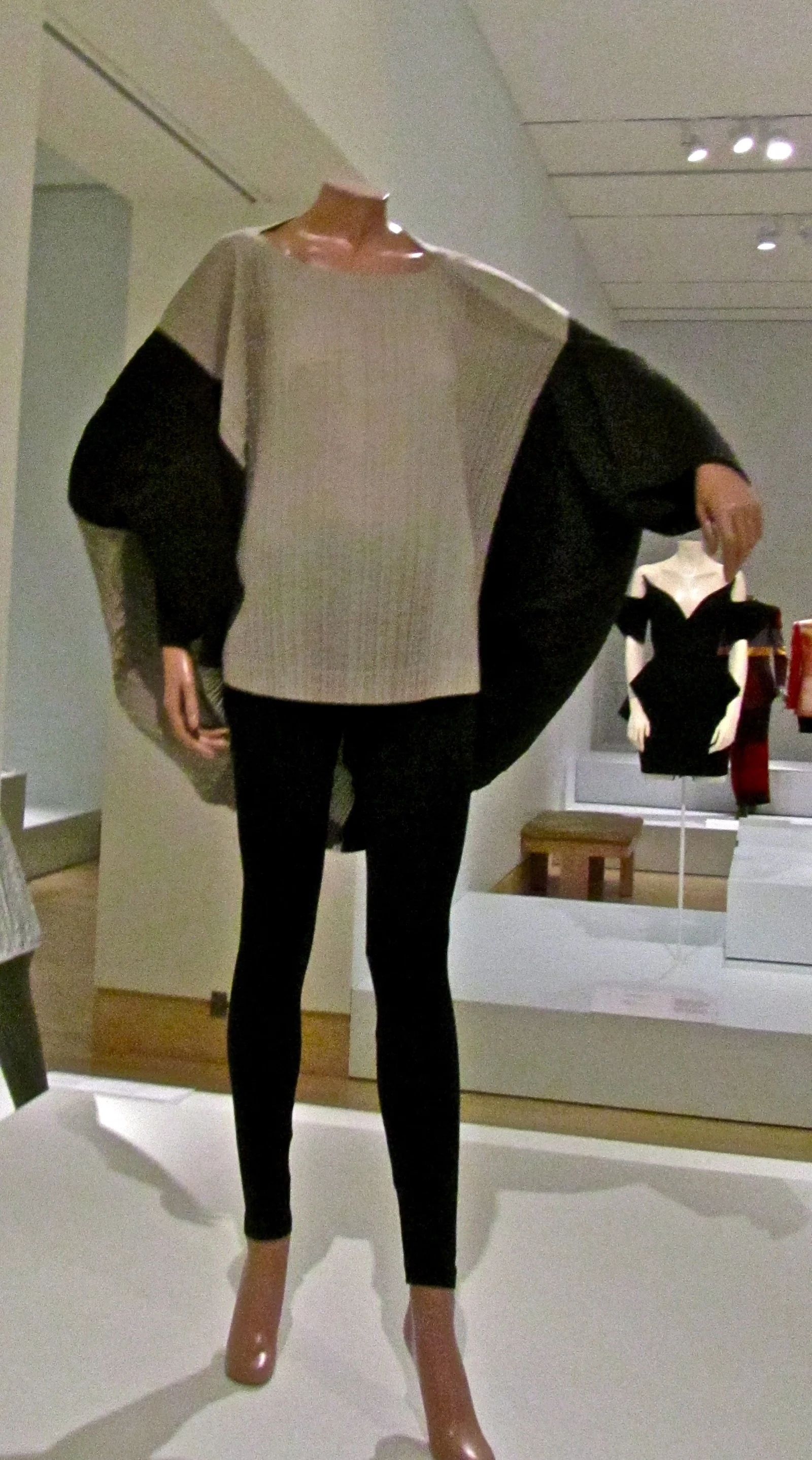
- قطعة أرشيفية من مجموعة طيات الإيقاع، خريف/شتاء 1990. صورة بواسطة ellenm1 / فليكر، ويكيميديا كومنز، CC BY 2.0.
- مجموعة من طيات من فضلك في بوليستر مجعد دقيق، 1995. صورة بواسطة سايلكو، غاليريا ديل كوستوم، قصر بيتي، فلورنسا، ويكيميديا كومنز، CC BY 3.0.