Issey Miyake: Movimento, Tecnologia e la Piegatura
Issey Miyake never considered himself a couturier; he operated as an industrial designer whose raw medium happened to be cloth. While twentieth-century Parisian fashion clung to the aristocratic fantasy of hand-stitched exclusivity and corseted bodily discipline, Miyake looked toward the democratic utility of the assembly line, the chemistry of synthetic polymers, and the uninhibited mechanics of human motion. Emerging from postwar Tokyo after surviving the atomic destruction of Hiroshima at age seven, he carried an aversion to nostalgic mourning and decorative vanity. His laboratory in Tokyo dismantled the fundamental dogma of Western pattern cutting: the belief that flat fabric must be carved, darted, and forced against the skin into an idealized anatomical mold. Alongside contemporaries explored in our monograph on Il Vuoto Spaziale (, Issey Miyake overturned Eurocentric beauty standards. By inventing garment pleating in 1988, launching Pleats Please in 1993, and engineering zero-waste digital weaving through A-POC in 1999, Miyake transformed synthetic polyester into high-technology architecture—proving that true avant-garde luxury liberates the body instead of constraining it.
Fashion houses manufacture obsolescence; Issey Miyake engineered infrastructure.
While European luxury conglomerates fixated on seasonal hemline fluctuations, gilded hardware, and status signifiers designed for museum vitrines, Issey Miyake treated the garment as an ergonomic interface. He wanted to know what happens when a body sprints across a room, sits cross-legged on a tatami mat, or packs a wardrobe into an overnight bag without summoning an iron.
His work demolished the foundational premise of Western sartorial construction. For three centuries, Parisian haute couture operated on an invasive, subtractive principle: tailor shears slashed flat textiles into geometric fragments, darting and stitching them over horsehair padding to force the soft contours of human flesh into a rigid, European anatomical silhouette. Miyake chose an alternate path. Steeped in traditional Japanese spatial mechanics, industrial chemistry, and mechanical engineering, he treated clothing as an uninterrupted continuum between cloth and movement. His garments do not dictate posture; they yield to the momentum of the wearer.
The revolt against haute couture: May 1968 and the democratic mandate
Miyake learned the rules of European dressmaking only to discard them. After graduating with a degree in graphic design from Tama Art University in Tokyo in 1964—where he staged his first exhibition, A Poem of Cloth and Stone—he moved to Paris in 1965 to enroll at the École de la Chambre Syndicale de la Couture Parisienne. He absorbed the rigorous craft of classical draping, serving as an assistant to Guy Laroche and subsequently drafting sketches in the quiet ateliers of Hubert de Givenchy. He watched aristocratic dowagers undergo three fittings for a single silk taffeta evening gown. The discipline was immaculate; the purpose felt dead.
The breaking point arrived in May 1968. Cobblestones flew across the Boulevard Saint-Michel as students and factory workers brought Paris to an economic standstill, occupying universities and demanding the dismantling of bourgeois hierarchies. Trapped inside his apartment, Miyake looked down from his window onto the barricades. The revelation struck with total clarity: haute couture was an archaic, decorative relic functioning for fewer than three thousand wealthy women worldwide. Outside, the real century was unfolding in blue jeans, workwear chore jackets, and cotton jerseys. Why design gilded cages when people needed clothes to run in?
He crossed the Atlantic to New York in 1969, taking a position with American ready-to-wear designer Geoffrey Beene on Seventh Avenue. There, he witnessed the industrial speed of automated cutting tables, synthetic fiber blends, and functional athletic garments. When he returned to Tokyo in 1970 to establish the Miyake Design Studio (MDS), his mandate was clear: he would not make fashion for elites. He would produce universal tools for living.
His inaugural presentations in New York in 1971 and Paris in 1973 signaled an immediate rupture. Instead of tailored jackets with stiff horsehair chest canvases, he sent out unlined coats cut from Japanese sashiko-stitched judo canvas, hand-dyed cottons, and utilitarian jumpsuits. The garments featured no buttons, no zippers, and no internal lining. Western critics, accustomed to the structured elegance of Yves Saint Laurent, struggled to categorize garments that resembled oversized kites until a human body activated their folds. Miyake had planted the seeds of an industrial revolt.
A Piece of Cloth (A-POC): The single-thread geometry of planar dress
European tailoring cuts fabric; Japanese dressmaking respects it. In the traditional kimono tradition, a garment is assembled from a single thirty-six-centimeter bolt of unbroken cloth (*tanmono*), cut strictly along straight geometric lines and sewn without curving seams or darting. Surplus fabric is folded into hem allowances rather than discarded on the workroom floor. The textile remains an autonomous plane; it wraps around the wearer, mediated by the empty air between skin and weave—the spatial interval known as Kawakubo ha intenzionalmente allentato le viti dei telai industriali per produrre maglieria piena di punti caduti asimmetrici e buchi aperti, esemplificata dalla sua leggendaria collezione del 1982.
Miyake elevated this cultural philosophy into an industrial design doctrine termed A Piece of Cloth (A-POC). He formulated the premise with deceptive simplicity: start with a single thread, feed it into a machine, and emerge with a complete garment without cutting or stitching a seam. Conventional mass manufacture generates catastrophic waste, routinely discarding fifteen to twenty percent of woven yardage in cutting-room scraps. Miyake found this wastefulness intolerable. He wanted the loom to behave like an organic printer.
In 1999, working in close collaboration with textile engineer Dai Fujiwara, Miyake unveiled the commercial fruition of A-POC. Utilizing computer-controlled industrial jacquard looms, the MDS team programmed digital algorithms that interlaced warp and weft threads into continuous, double-layered tubular textiles. As the machine ran, it did not weave flat yardage; it wove finished jackets, skirts, gloves, and bags embedded directly inside the tubular structure, complete with finished hemlines and structural ribbing.
The consumer participated in the final manufacturing act. Rolls of red or black knit emerged from the loom like giant rolls of perforated paper towels. Using ordinary scissors, wearers cut along faint dotted outlines cast into the yarn to release their garments. Because the computer programmed the synthetic fibers to self-fuse at the boundary lines, the edges never frayed. No needle. No thread. No waste. A flat tubular scroll unspooled into an entire wardrobe, bridging ancient warp-and-weft logic with digital algorithmic production.
Garment-pleating technology: Chemical memory, craft paper, and 2.5x distortion
Pleating is ancient; garment pleating was Miyake’s invention. In Western decorative arts, accordion pleats trace back to Mariano Fortuny’s 1907 silk Delphos gowns and Parisian craft ateliers like Gérard Lognon. Yet traditional pleating suffered from a fatal industrial flaw: fabric was pleated *before* it was cut. Patternmakers had to slice into pre-pleated textiles, sew fragile seams that flattened under the presser foot, and instruct wealthy clients to ship their garments across continents for delicate dry cleaning. Water erased the folds instantly. Traditional pleats were high-maintenance luxuries.
Between 1988 and 1989, Miyake inverted the entire chronological sequence. Instead of pleating raw cloth, he decided to pleat the finished garment. The concept sounded absurd to traditional tailors: how do you run a three-dimensional shirt or pair of trousers through a flat rolling machine without crushing the armholes or blowing out the seams?
The industrial protocol required precise material chemistry and mechanical bravery. Miyake abandoned natural fibers, selecting a featherweight 100% monofilament polyester twill engineered by Japanese textile giants Toray and Teijin. Working inside his Tokyo research lab, technicians cut and assembled garments at nearly 2.5 to 3 times their intended finished human measurements. A shirt looked like a gigantic, clownish parachute with cavernous sleeves and elongated hemlines.
Next came the thermal transformation. Technicians hand-folded the oversized polyester garment, sandwiching it flat between two bespoke sheets of recycled Japanese craft paper. The paper-wrapped package was fed through a heated mechanical roller press running at exactly 200°C (392°F). Under intense heat and pneumatic pressure, thermoplastic physics took over: the synthetic polymer chains reached their glass transition point, melted slightly, and permanently rearranged their crystalline molecular lattice around the folds of the craft paper.
When the sandwich emerged from the rollers and cooled, technicians pulled away the paper like peeling a protective skin. The giant garment had contracted down to human proportions, stamped with permanent, razor-sharp architectural ridges. Synthetic memory was locked forever. Water could not unseat the folds; detergent could not relax them. The garment could be washed in a bathroom sink, hung over a shower rod to dry in twenty minutes, and rolled into a tight spiral doughnut inside a suitcase without taking a crease. The iron was obsolete.
Launched commercially in 1993, Pleats Please democratized avant-garde dress. While peers like Rei Kawakubo e Yohji Yamamoto deployed black wool to construct protective intellectual armor, Miyake flooded the streets with brilliant cobalt blues, acid yellows, and vermilion pinks. His pleats moved with the velocity of modern life. Mothers, dancers, architects, and travelers adopted the line as an essential everyday tool, erasing the boundary between runway couture and daily domestic utility.
Kinetic choreography: William Forsythe, The Frankfurt Ballet, and kinetic friction
Cloth lives only when it moves. Miyake detested the static inertia of mannequins and runway models stalking catwalks with bored, wooden gaits. He understood that his pleats were kinetic instruments whose geometry could only be revealed through centrifugal force, acceleration, and bodily exhaustion.
In 1991, American choreographer William Forsythe invited Miyake to design the costumes for the Frankfurt Ballet’s production of The Loss of Small Detail. Forsythe was executing his own radical deconstruction of classical ballet, pushing dancers into extreme, off-axis hyperextensions, frantic floor work, and rapid athletic sprints. Traditional stage costumes—tutus, stiff doublets, and restrictive lycra leotards—tore under the strain or locked the pelvic joints.
Miyake delivered hundreds of custom pleated polyester tunics, leotards, and flared trousers. The stage rehearsal produced immediate shock. When dancers leaped and contorted across the Frankfurt stage, the micro-pleats expanded radially like accordion bellows, echoing the muscular torque of each limb before snapping instantly back against the skin. The fabric acted as an external respiratory system. Air rushed through the polyester ridges, catching stage lights and making speed visible to the audience in iridescent ripples.
Forsythe realized that Miyake’s garments did not merely clothe the choreography; they actively generated it. Dancers discovered that the centrifugal whip of pleated cuffs and flared hems provided tactile feedback, altering their balance and propelling them into turns. The Frankfurt collaboration cemented Miyake’s conviction that garment pleating was not a surface embellishment, but a dynamic architecture engineered for unencumbered kinetic freedom.
The sculptural lens: Irving Penn and the autonomous silhouette
Most fashion designers hover nervously over photographers, demanding flattering angles, commercial angles, and recognizable celebrity faces. Miyake did the opposite: he stayed away. For thirteen years, between 1983 and 1999, Miyake entrusted the visual documentation of his seasonal collections to legendary American photographer Irving Penn. Across more than forty editorial sessions in Penn’s Manhattan studio, Miyake never attended a single shoot. He gave Penn carte blanche.
Il loro scambio creativo avveniva interamente per posta. Due volte all'anno, il personale di Miyake a Parigi riempiva dei bauli di spedizione con abiti e li inviava attraverso l'Atlantico allo studio di Penn sulla Fifth Avenue. Penn lavorava con un unico stilista, Jun Kanai, vestendo ballerini e contorsionisti contro rotoli di carta bianca senza cuciture sotto una luce tungsteno dura e radente. Ha rimosso tutte le distrazioni contestuali: niente scenografie, niente oggetti di scena, niente fantasie di stile di vita.
Attraverso la macchina fotografica a grande formato 8×10 di Penn, le creazioni di Miyake smettevano di sembrare abbigliamento commerciale. I corsetti in rattan assomigliavano a scudi tribali; i bustier in plastica modellata evocavano esoscheletri futuristici di insetti; le tuniche in poliestere plissettato oversize si muovevano nel fotogramma come formazioni basaltiche vulcaniche o creature primordiali degli abissi marini. Penn fotografava gli abiti da profili severi, enfatizzando la tensione strutturale, le ombre nette e il volume inaspettato.
Quando le lastre di contatto arrivarono a Tokyo, Miyake le studiò con autentica meraviglia. Penn mostrò a Miyake possibilità all'interno dei suoi stessi abiti che il designer non aveva mai concepito consapevolmente mentre disegnava al tavolo da taglio. Le immagini convalidarono il presupposto fondamentale di Miyake: una volta staccato dalle mani del designer, un abito veramente innovativo funziona come un oggetto scultoreo autonomo, capace di generare la propria poesia visiva quando affrontato da un obiettivo inflessibile.
The industrial modernist uniform: Steve Jobs and the abolition of ornament
La realizzazione più pura della filosofia industriale di Miyake emerse non su una passerella, ma nell'armadio quotidiano del modernista più esigente della Silicon Valley. Nei primi anni '80, il cofondatore di Apple Steve Jobs visitò la sede della Sony a Shinagawa, Tokyo. Durante il tour dei reparti di assemblaggio insieme al presidente della Sony, Akio Morita, Jobs notò che ogni lavoratore—dagli assemblatori della catena di montaggio ai dirigenti senior—indossava giacche scure identiche. Quando Jobs chiese spiegazioni, Morita spiegò che nel Giappone del dopoguerra, i lavoratori delle fabbriche avevano pochi vestiti da indossare; la Sony aveva assunto Issey Miyake per progettare un'uniforme durevole e high-tech che unisse i dipendenti ed eliminasse le frizioni sociali.
La giacca di Miyake per la Sony era un capolavoro di design industriale utilitaristico: realizzata in nylon ripstop con maniche staccabili, si adattava perfettamente dai caldi pavimenti delle fabbriche ai freddi spostamenti all'aperto. Jobs ne rimase affascinato. Tornò a Cupertino e convinse i dipendenti di Apple ad adottare un'uniforme aziendale progettata da Miyake. La proposta venne derisa dai tecnici della Silicon Valley che tenevano ai loro comodi camicie di flanella e sneakers. L'uniforme aziendale era morta.
Jobs cambiò strategia. Se Apple non avrebbe indossato un'uniforme, l'avrebbe indossata lui stesso. Contattò direttamente Miyake, chiedendo al designer di produrre un guardaroba personale che lo liberasse dalle decisioni quotidiane sull'abbigliamento e riflettesse il suo austero ethos di design ispirato al Bauhaus. Miyake rispose producendo circa cento maglioni neri a collo alto, realizzati in una maglia di seta e cotone traspirante e fine.
Per il resto della sua vita, Jobs indossò quel maglione nero a collo alto in ogni presentazione principale, lancio di prodotto e apparizione pubblica. La scelta non era eccentricità da celebrità; era pura disciplina funzionalista. Come le pieghe di Miyake, il maglione nero a collo alto eliminava il peso cognitivo. Serviva come un'uniforme per il lavoro intellettuale, allineando il minimalismo computazionale della Silicon Valley con la missione di tutta la vita di Miyake di rimuovere la vanità decorativa a favore di un'utilità durevole e funzionale.
Material alchemy: Washi paper, recycled PET, and the 132 5 mathematics
Miyake non ha mai smesso di trattare la moda come scienza dei materiali. Nel 2007, si ritirò dalle presentazioni quotidiane in passerella per fondare 21_21 DESIGN SIGHT—un museo di ricerca sul design multidisciplinare a Tokyo progettato dall'architetto Tadao Ando—e fondò il Reality Lab team di ricerca. La missione era esplicita: sviluppare sistemi di produzione rigenerativa che affrontassero il collasso ambientale attraverso la matematica avanzata e materiali industriali riciclati.
Nell'autunno del 2010, il Reality Lab lanciò 132 5. ISSEY MIYAKE. I numeri enigmatici codificavano una formula topologica precisa: un singolo pezzo di stoffa (1) assume una forma tridimensionale (3), viene piegato completamente piatto in due dimensioni (2), e quando viene sollevato dal portatore, si espande in una quinta dimensione (5)—la dimensione del tempo vissuto e del movimento. Lavorando con il informatico Jun Mitani, il team applicò geometria 3D algoritmica per piegare completamente gli abiti piatti lungo tessellazioni geometriche laser-crease, esattamente come l'origami algoritmico.
La composizione materiale era altrettanto radicale. Miyake rifiutò i tessuti vergini, collaborando con Teijin per utilizzare Eco-circle fibre—un filato di poliestere a ciclo chiuso chimicamente riciclato da bottiglie di plastica scartate e abiti sintetici post-consumo. I poligoni geometrici risultanti giacciono interamente bidimensionali su un tavolo; quando il portatore solleva il colletto, il poligono origami piatto si solleva senza sforzo in una tunica scultorea, un vestito o una giacca senza richiedere strutture interne o fori per le braccia su misura.
Questo audace approccio tecnologico era radicato in profonde radici storiche. Nel corso della sua carriera, Miyake bilanciò polimeri sintetici dell'era spaziale con antiche tradizioni artigianali giapponesi. Trascorse decenni collaborando con artigiani rurali a Tohoku e Kyoto, combinando carta washi di gelso fatta a mano con lino grezzo, sperimentando con la tintura naturale all'indaco e tessendo ramie grezza su telai in legno centenari. Rifiutò di considerare la tecnologia e l'artigianato come forze opposte. Per Miyake, un telaio in legno intagliato a mano e un telaio jacquard controllato da computer erano semplicemente strumenti lungo lo stesso continuum ininterrotto dell'ingegnosità umana.
La sua scomparsa nell'agosto 2022 segnò la partenza del tecnologo della moda più audace. Eppure la sua eredità rimane viva ovunque il tessuto incontra l'energia cinetica. In un'industria ancora intossicata dalla disabilità stagionale, dal clamore digitale e dal lusso superficiale, i cinquant'anni di lavoro di Miyake offrono un'alternativa intransigente: abbigliamento che rispetta la terra, abbraccia la macchina e libera il corpo umano per danzare.
Archivi di Brand Correlati & Monografie Storiche
Esplora pezzi d'archivio curati e profonde analisi storiche lungo il continuum dell'avanguardia: sfoglia il curato Archivio del marchio Issey Miyake, esamina i nostri monografie su Comme des Garçons e Yohji Yamamoto, o studia le analisi storiche fondamentali, tra cui La rivoluzione della moda giapponese a Parigi, Rei Kawakubo e l'Architettura dell'Assenza, e Yohji Yamamoto e la poesia del nero.
Riferimenti e letture ulteriori
- Wikimedia Foundation — Issey Miyake: Biografia, Filosofia del Design e Collezioni Archiviali
- Wikimedia Foundation — William Forsythe: Ballett Frankfurt e Collaborazioni per Costumi
- Wikimedia Foundation — Irving Penn: Pratica di Studio e Fotografie dei Design di Issey Miyake
- Wikimedia Foundation — Steve Jobs: Estetiche Moderniste e l'Uniforme di Miyake
- Wikimedia Foundation — Tama Art University: Storia e Alumni Notabili nel Design Industriale
- Kyoto Costume Institute (KCI) — Archivi Digitali del Kyoto Costume Institute: Collezioni di Moda Giapponese Avanguardista
- WOWOW / 713 Magazine — Issey Miyake "Moves" (Documentario del 1993)
Crediti immagine
- Issey Miyake che parla con la stampa al National Art Center di Tokyo, marzo 2016. Fotografia di Hsinhuei Chiou, Wikimedia Commons, CC BY-SA 4.0.
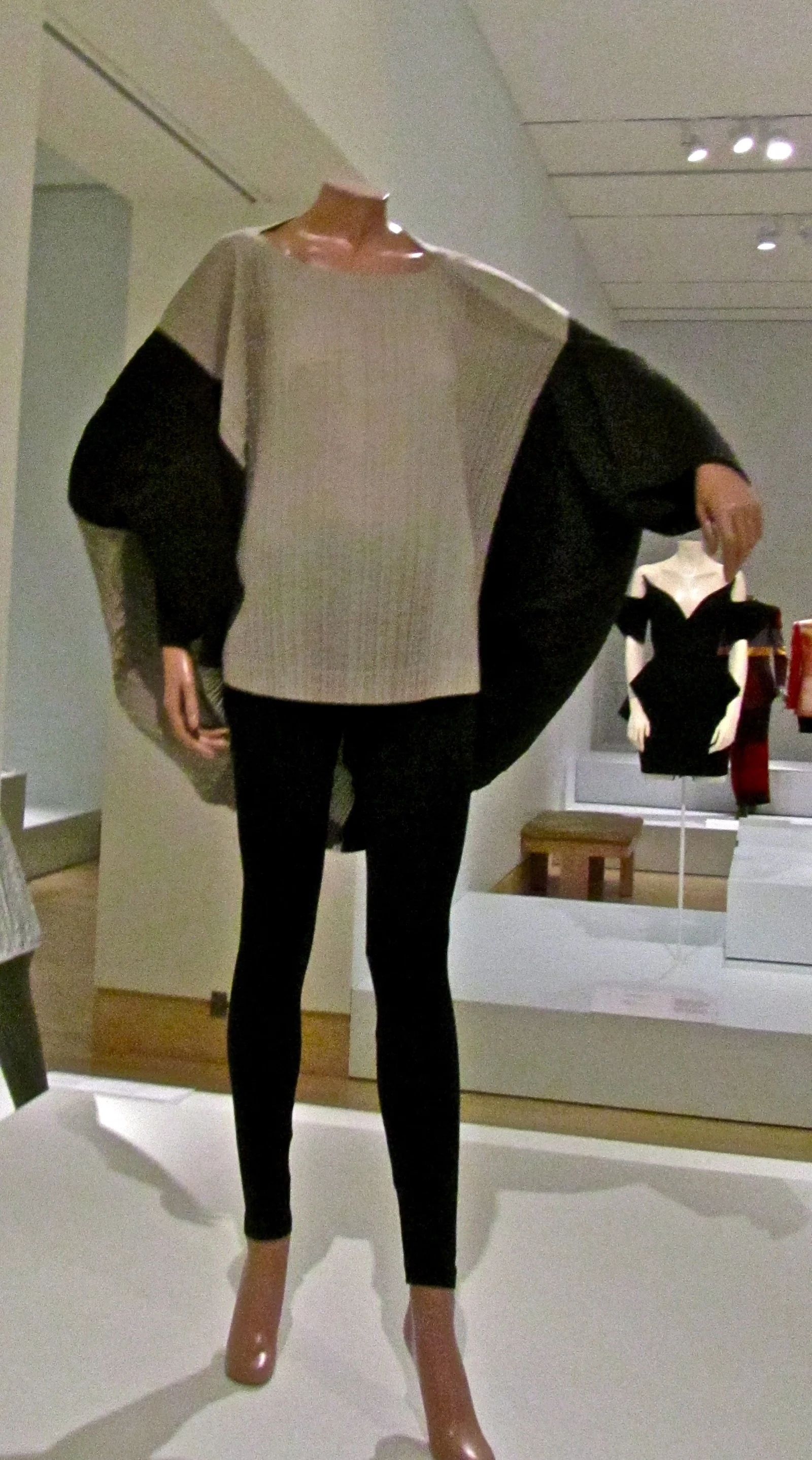
- Abito d'archivio della collezione Rhythm Pleats, Autunno/Inverno 1990. Fotografia di ellenm1 / Flickr, Wikimedia Commons, CC BY 2.0.
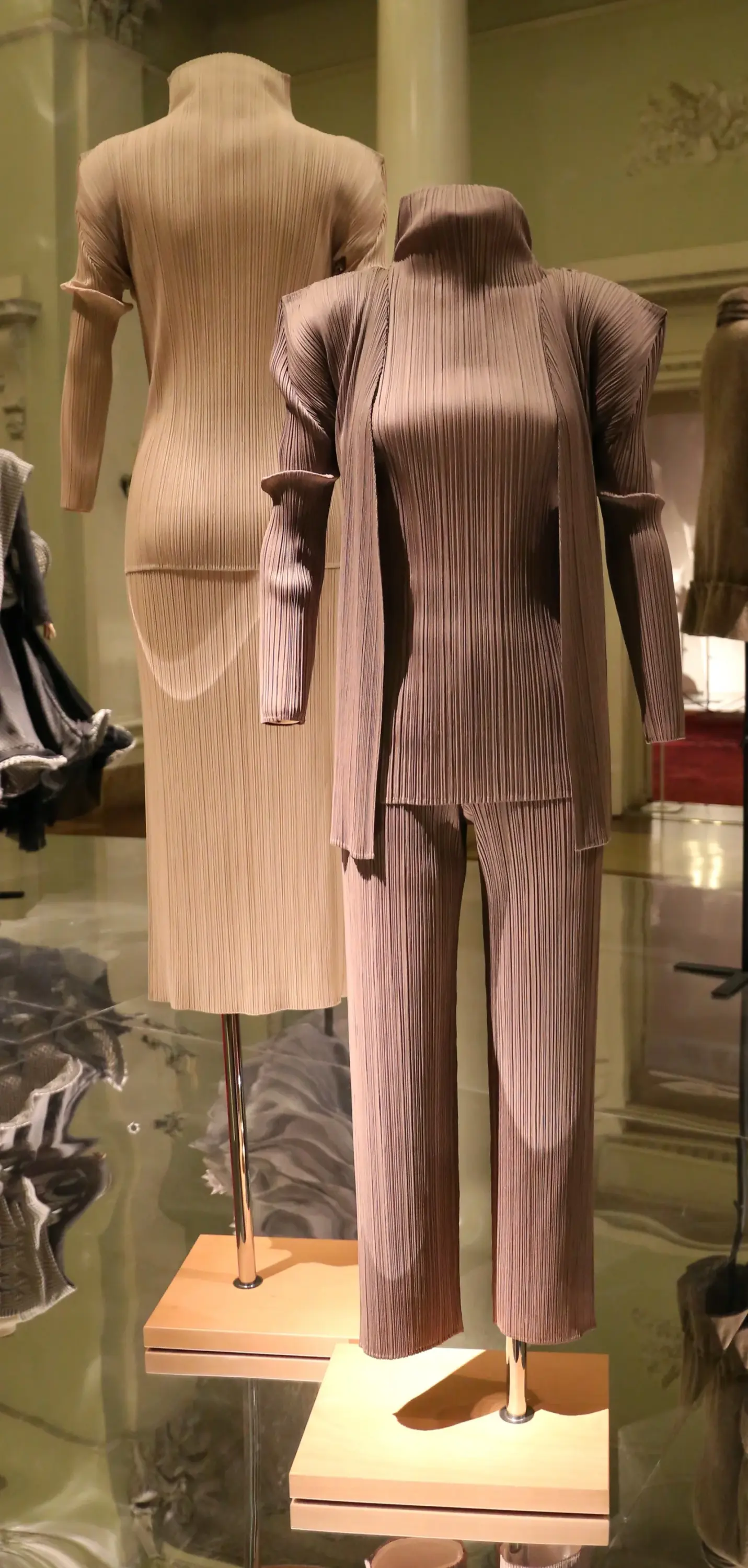
- Due ensemble Pleats Please in poliestere micro-plissettato, 1995. Fotografia di Sailko, Galleria del Costume, Palazzo Pitti, Firenze, Wikimedia Commons, CC BY 3.0.