Issey Miyake:运动、科技与褶皱
Issey Miyake never considered himself a couturier; he operated as an industrial designer whose raw medium happened to be cloth. While twentieth-century Parisian fashion clung to the aristocratic fantasy of hand-stitched exclusivity and corseted bodily discipline, Miyake looked toward the democratic utility of the assembly line, the chemistry of synthetic polymers, and the uninhibited mechanics of human motion. Emerging from postwar Tokyo after surviving the atomic destruction of Hiroshima at age seven, he carried an aversion to nostalgic mourning and decorative vanity. His laboratory in Tokyo dismantled the fundamental dogma of Western pattern cutting: the belief that flat fabric must be carved, darted, and forced against the skin into an idealized anatomical mold. Alongside contemporaries explored in our monograph on 随着日本革命展示了黑色可以拆解西方裁剪,安特卫普和伦敦的设计师在1980年代末和1990年代将这一运动带入了诗意和戏剧性的领域。, Issey Miyake overturned Eurocentric beauty standards. By inventing garment pleating in 1988, launching Pleats Please in 1993, and engineering zero-waste digital weaving through A-POC in 1999, Miyake transformed synthetic polyester into high-technology architecture—proving that true avant-garde luxury liberates the body instead of constraining it.
Fashion houses manufacture obsolescence; Issey Miyake engineered infrastructure.
While European luxury conglomerates fixated on seasonal hemline fluctuations, gilded hardware, and status signifiers designed for museum vitrines, Issey Miyake treated the garment as an ergonomic interface. He wanted to know what happens when a body sprints across a room, sits cross-legged on a tatami mat, or packs a wardrobe into an overnight bag without summoning an iron.
His work demolished the foundational premise of Western sartorial construction. For three centuries, Parisian haute couture operated on an invasive, subtractive principle: tailor shears slashed flat textiles into geometric fragments, darting and stitching them over horsehair padding to force the soft contours of human flesh into a rigid, European anatomical silhouette. Miyake chose an alternate path. Steeped in traditional Japanese spatial mechanics, industrial chemistry, and mechanical engineering, he treated clothing as an uninterrupted continuum between cloth and movement. His garments do not dictate posture; they yield to the momentum of the wearer.
The revolt against haute couture: May 1968 and the democratic mandate
Miyake learned the rules of European dressmaking only to discard them. After graduating with a degree in graphic design from Tama Art University in Tokyo in 1964—where he staged his first exhibition, A Poem of Cloth and Stone—he moved to Paris in 1965 to enroll at the École de la Chambre Syndicale de la Couture Parisienne. He absorbed the rigorous craft of classical draping, serving as an assistant to Guy Laroche and subsequently drafting sketches in the quiet ateliers of Hubert de Givenchy. He watched aristocratic dowagers undergo three fittings for a single silk taffeta evening gown. The discipline was immaculate; the purpose felt dead.
The breaking point arrived in May 1968. Cobblestones flew across the Boulevard Saint-Michel as students and factory workers brought Paris to an economic standstill, occupying universities and demanding the dismantling of bourgeois hierarchies. Trapped inside his apartment, Miyake looked down from his window onto the barricades. The revelation struck with total clarity: haute couture was an archaic, decorative relic functioning for fewer than three thousand wealthy women worldwide. Outside, the real century was unfolding in blue jeans, workwear chore jackets, and cotton jerseys. Why design gilded cages when people needed clothes to run in?
He crossed the Atlantic to New York in 1969, taking a position with American ready-to-wear designer Geoffrey Beene on Seventh Avenue. There, he witnessed the industrial speed of automated cutting tables, synthetic fiber blends, and functional athletic garments. When he returned to Tokyo in 1970 to establish the Miyake Design Studio (MDS), his mandate was clear: he would not make fashion for elites. He would produce universal tools for living.
His inaugural presentations in New York in 1971 and Paris in 1973 signaled an immediate rupture. Instead of tailored jackets with stiff horsehair chest canvases, he sent out unlined coats cut from Japanese sashiko-stitched judo canvas, hand-dyed cottons, and utilitarian jumpsuits. The garments featured no buttons, no zippers, and no internal lining. Western critics, accustomed to the structured elegance of Yves Saint Laurent, struggled to categorize garments that resembled oversized kites until a human body activated their folds. Miyake had planted the seeds of an industrial revolt.
A Piece of Cloth (A-POC): The single-thread geometry of planar dress
European tailoring cuts fabric; Japanese dressmaking respects it. In the traditional kimono tradition, a garment is assembled from a single thirty-six-centimeter bolt of unbroken cloth (*tanmono*), cut strictly along straight geometric lines and sewn without curving seams or darting. Surplus fabric is folded into hem allowances rather than discarded on the workroom floor. The textile remains an autonomous plane; it wraps around the wearer, mediated by the empty air between skin and weave—the spatial interval known as 流动的中性:.
Miyake elevated this cultural philosophy into an industrial design doctrine termed A Piece of Cloth (A-POC). He formulated the premise with deceptive simplicity: start with a single thread, feed it into a machine, and emerge with a complete garment without cutting or stitching a seam. Conventional mass manufacture generates catastrophic waste, routinely discarding fifteen to twenty percent of woven yardage in cutting-room scraps. Miyake found this wastefulness intolerable. He wanted the loom to behave like an organic printer.
In 1999, working in close collaboration with textile engineer Dai Fujiwara, Miyake unveiled the commercial fruition of A-POC. Utilizing computer-controlled industrial jacquard looms, the MDS team programmed digital algorithms that interlaced warp and weft threads into continuous, double-layered tubular textiles. As the machine ran, it did not weave flat yardage; it wove finished jackets, skirts, gloves, and bags embedded directly inside the tubular structure, complete with finished hemlines and structural ribbing.
The consumer participated in the final manufacturing act. Rolls of red or black knit emerged from the loom like giant rolls of perforated paper towels. Using ordinary scissors, wearers cut along faint dotted outlines cast into the yarn to release their garments. Because the computer programmed the synthetic fibers to self-fuse at the boundary lines, the edges never frayed. No needle. No thread. No waste. A flat tubular scroll unspooled into an entire wardrobe, bridging ancient warp-and-weft logic with digital algorithmic production.
Garment-pleating technology: Chemical memory, craft paper, and 2.5x distortion
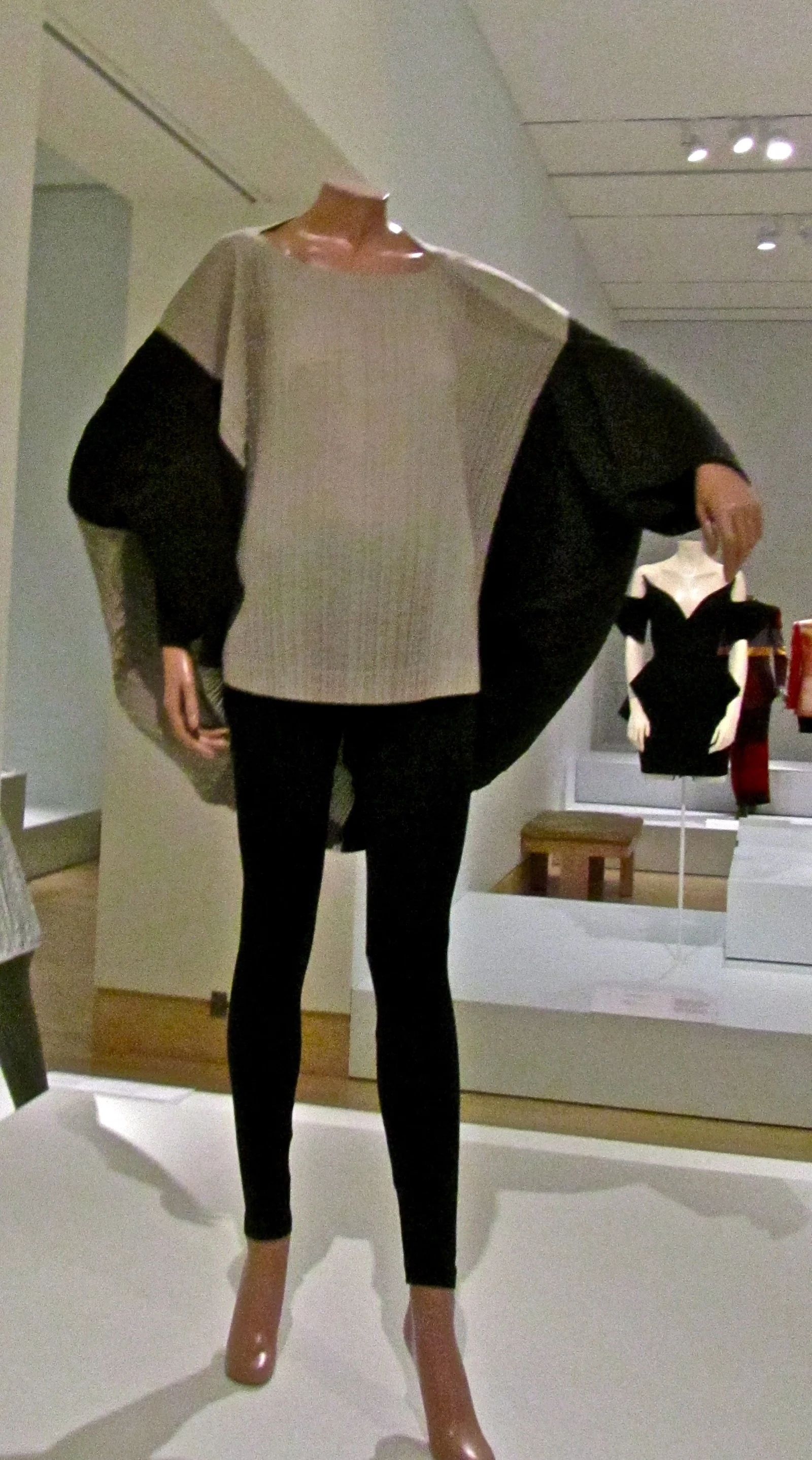
Pleating is ancient; garment pleating was Miyake’s invention. In Western decorative arts, accordion pleats trace back to Mariano Fortuny’s 1907 silk Delphos gowns and Parisian craft ateliers like Gérard Lognon. Yet traditional pleating suffered from a fatal industrial flaw: fabric was pleated *before* it was cut. Patternmakers had to slice into pre-pleated textiles, sew fragile seams that flattened under the presser foot, and instruct wealthy clients to ship their garments across continents for delicate dry cleaning. Water erased the folds instantly. Traditional pleats were high-maintenance luxuries.
Between 1988 and 1989, Miyake inverted the entire chronological sequence. Instead of pleating raw cloth, he decided to pleat the finished garment. The concept sounded absurd to traditional tailors: how do you run a three-dimensional shirt or pair of trousers through a flat rolling machine without crushing the armholes or blowing out the seams?
The industrial protocol required precise material chemistry and mechanical bravery. Miyake abandoned natural fibers, selecting a featherweight 100% monofilament polyester twill engineered by Japanese textile giants Toray and Teijin. Working inside his Tokyo research lab, technicians cut and assembled garments at nearly 2.5 to 3 times their intended finished human measurements. A shirt looked like a gigantic, clownish parachute with cavernous sleeves and elongated hemlines.
Next came the thermal transformation. Technicians hand-folded the oversized polyester garment, sandwiching it flat between two bespoke sheets of recycled Japanese craft paper. The paper-wrapped package was fed through a heated mechanical roller press running at exactly 200°C (392°F). Under intense heat and pneumatic pressure, thermoplastic physics took over: the synthetic polymer chains reached their glass transition point, melted slightly, and permanently rearranged their crystalline molecular lattice around the folds of the craft paper.
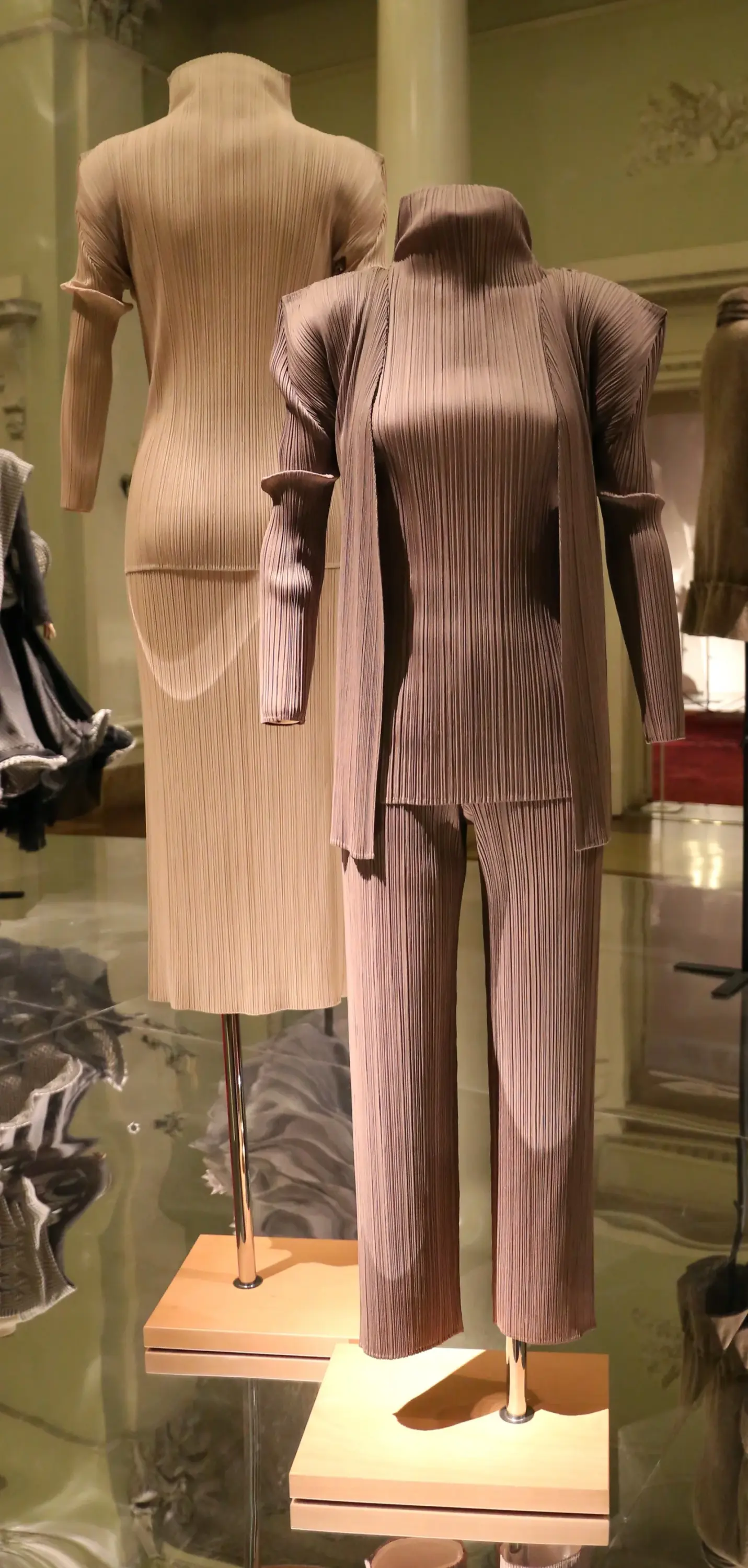
When the sandwich emerged from the rollers and cooled, technicians pulled away the paper like peeling a protective skin. The giant garment had contracted down to human proportions, stamped with permanent, razor-sharp architectural ridges. Synthetic memory was locked forever. Water could not unseat the folds; detergent could not relax them. The garment could be washed in a bathroom sink, hung over a shower rod to dry in twenty minutes, and rolled into a tight spiral doughnut inside a suitcase without taking a crease. The iron was obsolete.
Launched commercially in 1993, Pleats Please democratized avant-garde dress. While peers like 川久保玲 和 Yohji Yamamoto deployed black wool to construct protective intellectual armor, Miyake flooded the streets with brilliant cobalt blues, acid yellows, and vermilion pinks. His pleats moved with the velocity of modern life. Mothers, dancers, architects, and travelers adopted the line as an essential everyday tool, erasing the boundary between runway couture and daily domestic utility.
Kinetic choreography: William Forsythe, The Frankfurt Ballet, and kinetic friction
Cloth lives only when it moves. Miyake detested the static inertia of mannequins and runway models stalking catwalks with bored, wooden gaits. He understood that his pleats were kinetic instruments whose geometry could only be revealed through centrifugal force, acceleration, and bodily exhaustion.
In 1991, American choreographer William Forsythe invited Miyake to design the costumes for the Frankfurt Ballet’s production of The Loss of Small Detail. Forsythe was executing his own radical deconstruction of classical ballet, pushing dancers into extreme, off-axis hyperextensions, frantic floor work, and rapid athletic sprints. Traditional stage costumes—tutus, stiff doublets, and restrictive lycra leotards—tore under the strain or locked the pelvic joints.
Miyake delivered hundreds of custom pleated polyester tunics, leotards, and flared trousers. The stage rehearsal produced immediate shock. When dancers leaped and contorted across the Frankfurt stage, the micro-pleats expanded radially like accordion bellows, echoing the muscular torque of each limb before snapping instantly back against the skin. The fabric acted as an external respiratory system. Air rushed through the polyester ridges, catching stage lights and making speed visible to the audience in iridescent ripples.
Forsythe realized that Miyake’s garments did not merely clothe the choreography; they actively generated it. Dancers discovered that the centrifugal whip of pleated cuffs and flared hems provided tactile feedback, altering their balance and propelling them into turns. The Frankfurt collaboration cemented Miyake’s conviction that garment pleating was not a surface embellishment, but a dynamic architecture engineered for unencumbered kinetic freedom.
The sculptural lens: Irving Penn and the autonomous silhouette
Most fashion designers hover nervously over photographers, demanding flattering angles, commercial angles, and recognizable celebrity faces. Miyake did the opposite: he stayed away. For thirteen years, between 1983 and 1999, Miyake entrusted the visual documentation of his seasonal collections to legendary American photographer Irving Penn. Across more than forty editorial sessions in Penn’s Manhattan studio, Miyake never attended a single shoot. He gave Penn carte blanche.
他们的创意交流完全通过邮件进行。每年两次,三宅一生的巴黎团队将装满衣物的运输箱打包,运送到位于第五大道的佩恩工作室。佩恩与唯一的造型师金井俊合作,在严酷的钨光灯下,将舞者和杂技演员穿着在无缝的白色纸卷前。为了去除所有的背景干扰——没有布景,没有道具,没有生活方式的幻想。.
通过佩恩的8×10大画幅相机,三宅一生的作品不再看起来像商业服装。藤制紧身衣像部落的盾牌;模压塑料胸衣唤起未来主义的昆虫外壳;超大褶皱聚酯上衣在画面中如火山玄武岩的形成或原始深海生物般涌动。佩恩从严峻的侧面拍摄这些服装,强调结构张力、强烈阴影和意想不到的体积。.
当接触片在东京到达时,三宅一生惊讶地研究它们。佩恩向三宅展示了他自己服装中的可能性,而设计师在裁剪台上从未有意识地构思过。这些图像验证了三宅的核心前提:一旦脱离设计师的手,一件真正创新的服装就能作为一个自主的雕塑对象存在,当面对无情的镜头时,能够生成自己的视觉诗意。.
The industrial modernist uniform: Steve Jobs and the abolition of ornament
三宅一生的工业哲学最纯粹的体现并不是在T台上,而是在硅谷最挑剔的现代人的日常衣橱中。在1980年代初,苹果公司的联合创始人 史蒂夫·乔布斯 访问了位于东京品川的索尼总部。在与索尼董事长盛田昭夫一起参观组装车间时,乔布斯注意到每位工人——从生产线的组装工到高级管理人员——都穿着相同的深色夹克。当乔布斯询问时,盛田解释说,在战后日本,工人们的衣服很少;索尼聘请了三宅一生设计一种耐用的高科技制服,以团结员工并消除社会摩擦。.
三宅的索尼夹克是一件实用工业设计的杰作:采用防撕裂尼龙制成,带有可拆卸的袖子,能够无缝地从温暖的工厂车间过渡到寒冷的户外通勤。乔布斯被深深吸引。他回到库比蒂诺,游说苹果员工采用三宅设计的公司制服。这个提议被珍视休闲法兰绒衬衫和运动鞋的硅谷工程师们嘲笑着拒绝了。公司制服已经死了。.
乔布斯转变了。如果苹果不穿制服,他自己就穿。他直接联系三宅,请求设计师制作一套个人衣橱,让他摆脱每天的穿衣决策,并反映他严谨的、受包豪斯启发的设计理念。三宅回应,制作了大约一百件相同的黑色假高领衫,采用透气的细针织丝绸和棉混纺材料。.
在他余生中,乔布斯在每次主题演讲、产品发布和公开露面时都穿着那件黑色高领衫。这个选择并不是名人的怪癖;而是一种纯粹的功能主义纪律。就像三宅的褶皱一样,黑色假高领衫消除了认知负担。它成为知识劳动的制服,将硅谷的计算最小主义与三宅一生一生致力于去除装饰性虚荣、追求耐用、功能性实用的使命对齐。.
Material alchemy: Washi paper, recycled PET, and the 132 5 mathematics
三宅从未停止将时尚视为材料科学。2007年,他从日常的T台展示中退下,成立了21_21 DESIGN SIGHT——一个由建筑师安藤忠雄设计的多学科设计研究博物馆,并创立了 现实实验室 研究团队。使命很明确:开发再生制造系统,通过先进的数学和回收工业材料来应对环境崩溃。.
在2010年秋季,现实实验室推出了 132 5. ISSEY MIYAKE. 。这些神秘的数字编码了一个精确的拓扑公式:一块布料(1)呈现出三维形状(3),完全折叠成二维(2),当被穿戴者拾起时,扩展到第五维(5)——生活时间和运动的维度。与计算机科学家三谷纯合作,团队应用算法3D几何将服装完全折叠成激光压痕的几何镶嵌,就像算法折纸一样。.
材料成分同样激进。三宅拒绝使用原材料,与帝人合作利用 生态圈 纤维——一种从废弃塑料瓶和消费后合成服装中化学回收的闭环聚酯纱线。最终的几何多边形在桌子上完全是二维的;当穿戴者抬起领子时,平坦的折纸多边形轻松弹起,变成雕塑般的上衣、裙子或夹克,而无需内部骨架或定制的袖孔。.
这种技术上的大胆根植于深厚的历史根基。在他的职业生涯中,三宅平衡了太空时代的合成聚合物与古老的日本工艺传统。他花了几十年与东北和京都的乡村工匠合作,将手工制作的桑树和纸与原料亚麻结合,实验天然靛蓝染料,使用百年古老的木质梭织机编织粗麻。他拒绝将技术和手工艺视为对立的力量。对三宅而言,手工雕刻的木梭和计算机控制的提花织机只是人类智慧同一不间断连续体上的工具。.
他于2022年8月的去世标志着时尚界最无畏的技术专家的离去。然而,他的遗产在布料与动能相遇的地方依然活着。在一个仍然沉醉于季节性易耗、数字炒作和表面奢华的行业中,三宅五十年的工作提供了一种不妥协的替代方案:尊重地球、拥抱机器,并让人类身体自由舞动的服装。.
相关品牌档案与历史专著
探索策划的档案作品和深度历史分析,穿越先锋的连续体:浏览策划的 三宅一生品牌档案, ,查看我们关于 Comme des Garçons 和 Yohji Yamamoto, 的专著,或研究包括 巴黎的日本时尚革命, 川久保玲与缺席的建筑和 山本耀司与黑色的诗意.