Issey Miyake: Bewegung, Technologie und die Falten
Issey Miyake never considered himself a couturier; he operated as an industrial designer whose raw medium happened to be cloth. While twentieth-century Parisian fashion clung to the aristocratic fantasy of hand-stitched exclusivity and corseted bodily discipline, Miyake looked toward the democratic utility of the assembly line, the chemistry of synthetic polymers, and the uninhibited mechanics of human motion. Emerging from postwar Tokyo after surviving the atomic destruction of Hiroshima at age seven, he carried an aversion to nostalgic mourning and decorative vanity. His laboratory in Tokyo dismantled the fundamental dogma of Western pattern cutting: the belief that flat fabric must be carved, darted, and forced against the skin into an idealized anatomical mold. Alongside contemporaries explored in our monograph on die japanische Mode-Revolution in Paris, Issey Miyake overturned Eurocentric beauty standards. By inventing garment pleating in 1988, launching Pleats Please in 1993, and engineering zero-waste digital weaving through A-POC in 1999, Miyake transformed synthetic polyester into high-technology architecture—proving that true avant-garde luxury liberates the body instead of constraining it.
Fashion houses manufacture obsolescence; Issey Miyake engineered infrastructure.
While European luxury conglomerates fixated on seasonal hemline fluctuations, gilded hardware, and status signifiers designed for museum vitrines, Issey Miyake treated the garment as an ergonomic interface. He wanted to know what happens when a body sprints across a room, sits cross-legged on a tatami mat, or packs a wardrobe into an overnight bag without summoning an iron.
His work demolished the foundational premise of Western sartorial construction. For three centuries, Parisian haute couture operated on an invasive, subtractive principle: tailor shears slashed flat textiles into geometric fragments, darting and stitching them over horsehair padding to force the soft contours of human flesh into a rigid, European anatomical silhouette. Miyake chose an alternate path. Steeped in traditional Japanese spatial mechanics, industrial chemistry, and mechanical engineering, he treated clothing as an uninterrupted continuum between cloth and movement. His garments do not dictate posture; they yield to the momentum of the wearer.
The revolt against haute couture: May 1968 and the democratic mandate
Miyake learned the rules of European dressmaking only to discard them. After graduating with a degree in graphic design from Tama Art University in Tokyo in 1964—where he staged his first exhibition, A Poem of Cloth and Stone—he moved to Paris in 1965 to enroll at the École de la Chambre Syndicale de la Couture Parisienne. He absorbed the rigorous craft of classical draping, serving as an assistant to Guy Laroche and subsequently drafting sketches in the quiet ateliers of Hubert de Givenchy. He watched aristocratic dowagers undergo three fittings for a single silk taffeta evening gown. The discipline was immaculate; the purpose felt dead.
The breaking point arrived in May 1968. Cobblestones flew across the Boulevard Saint-Michel as students and factory workers brought Paris to an economic standstill, occupying universities and demanding the dismantling of bourgeois hierarchies. Trapped inside his apartment, Miyake looked down from his window onto the barricades. The revelation struck with total clarity: haute couture was an archaic, decorative relic functioning for fewer than three thousand wealthy women worldwide. Outside, the real century was unfolding in blue jeans, workwear chore jackets, and cotton jerseys. Why design gilded cages when people needed clothes to run in?
He crossed the Atlantic to New York in 1969, taking a position with American ready-to-wear designer Geoffrey Beene on Seventh Avenue. There, he witnessed the industrial speed of automated cutting tables, synthetic fiber blends, and functional athletic garments. When he returned to Tokyo in 1970 to establish the Miyake Design Studio (MDS), his mandate was clear: he would not make fashion for elites. He would produce universal tools for living.
His inaugural presentations in New York in 1971 and Paris in 1973 signaled an immediate rupture. Instead of tailored jackets with stiff horsehair chest canvases, he sent out unlined coats cut from Japanese sashiko-stitched judo canvas, hand-dyed cottons, and utilitarian jumpsuits. The garments featured no buttons, no zippers, and no internal lining. Western critics, accustomed to the structured elegance of Yves Saint Laurent, struggled to categorize garments that resembled oversized kites until a human body activated their folds. Miyake had planted the seeds of an industrial revolt.
A Piece of Cloth (A-POC): The single-thread geometry of planar dress
European tailoring cuts fabric; Japanese dressmaking respects it. In the traditional kimono tradition, a garment is assembled from a single thirty-six-centimeter bolt of unbroken cloth (*tanmono*), cut strictly along straight geometric lines and sewn without curving seams or darting. Surplus fabric is folded into hem allowances rather than discarded on the workroom floor. The textile remains an autonomous plane; it wraps around the wearer, mediated by the empty air between skin and weave—the spatial interval known as Ma.
Miyake elevated this cultural philosophy into an industrial design doctrine termed A Piece of Cloth (A-POC). He formulated the premise with deceptive simplicity: start with a single thread, feed it into a machine, and emerge with a complete garment without cutting or stitching a seam. Conventional mass manufacture generates catastrophic waste, routinely discarding fifteen to twenty percent of woven yardage in cutting-room scraps. Miyake found this wastefulness intolerable. He wanted the loom to behave like an organic printer.
In 1999, working in close collaboration with textile engineer Dai Fujiwara, Miyake unveiled the commercial fruition of A-POC. Utilizing computer-controlled industrial jacquard looms, the MDS team programmed digital algorithms that interlaced warp and weft threads into continuous, double-layered tubular textiles. As the machine ran, it did not weave flat yardage; it wove finished jackets, skirts, gloves, and bags embedded directly inside the tubular structure, complete with finished hemlines and structural ribbing.
The consumer participated in the final manufacturing act. Rolls of red or black knit emerged from the loom like giant rolls of perforated paper towels. Using ordinary scissors, wearers cut along faint dotted outlines cast into the yarn to release their garments. Because the computer programmed the synthetic fibers to self-fuse at the boundary lines, the edges never frayed. No needle. No thread. No waste. A flat tubular scroll unspooled into an entire wardrobe, bridging ancient warp-and-weft logic with digital algorithmic production.
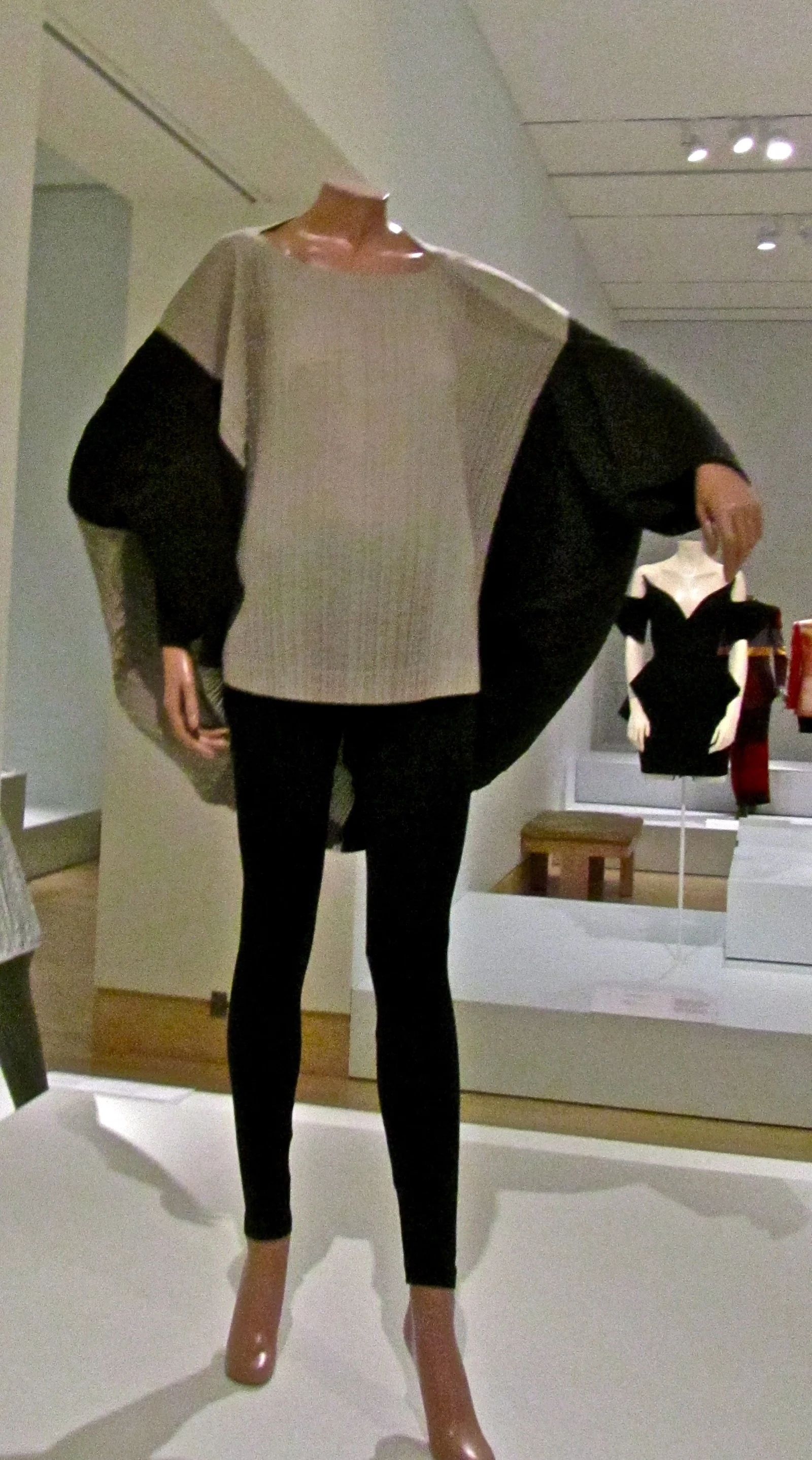
Garment-pleating technology: Chemical memory, craft paper, and 2.5x distortion
Pleating is ancient; garment pleating was Miyake’s invention. In Western decorative arts, accordion pleats trace back to Mariano Fortuny’s 1907 silk Delphos gowns and Parisian craft ateliers like Gérard Lognon. Yet traditional pleating suffered from a fatal industrial flaw: fabric was pleated *before* it was cut. Patternmakers had to slice into pre-pleated textiles, sew fragile seams that flattened under the presser foot, and instruct wealthy clients to ship their garments across continents for delicate dry cleaning. Water erased the folds instantly. Traditional pleats were high-maintenance luxuries.
Between 1988 and 1989, Miyake inverted the entire chronological sequence. Instead of pleating raw cloth, he decided to pleat the finished garment. The concept sounded absurd to traditional tailors: how do you run a three-dimensional shirt or pair of trousers through a flat rolling machine without crushing the armholes or blowing out the seams?
The industrial protocol required precise material chemistry and mechanical bravery. Miyake abandoned natural fibers, selecting a featherweight 100% monofilament polyester twill engineered by Japanese textile giants Toray and Teijin. Working inside his Tokyo research lab, technicians cut and assembled garments at nearly 2.5 to 3 times their intended finished human measurements. A shirt looked like a gigantic, clownish parachute with cavernous sleeves and elongated hemlines.
Next came the thermal transformation. Technicians hand-folded the oversized polyester garment, sandwiching it flat between two bespoke sheets of recycled Japanese craft paper. The paper-wrapped package was fed through a heated mechanical roller press running at exactly 200°C (392°F). Under intense heat and pneumatic pressure, thermoplastic physics took over: the synthetic polymer chains reached their glass transition point, melted slightly, and permanently rearranged their crystalline molecular lattice around the folds of the craft paper.
When the sandwich emerged from the rollers and cooled, technicians pulled away the paper like peeling a protective skin. The giant garment had contracted down to human proportions, stamped with permanent, razor-sharp architectural ridges. Synthetic memory was locked forever. Water could not unseat the folds; detergent could not relax them. The garment could be washed in a bathroom sink, hung over a shower rod to dry in twenty minutes, and rolled into a tight spiral doughnut inside a suitcase without taking a crease. The iron was obsolete.
Launched commercially in 1993, Pleats Please democratized avant-garde dress. While peers like Rei Kawakubo und Yohji Yamamoto deployed black wool to construct protective intellectual armor, Miyake flooded the streets with brilliant cobalt blues, acid yellows, and vermilion pinks. His pleats moved with the velocity of modern life. Mothers, dancers, architects, and travelers adopted the line as an essential everyday tool, erasing the boundary between runway couture and daily domestic utility.
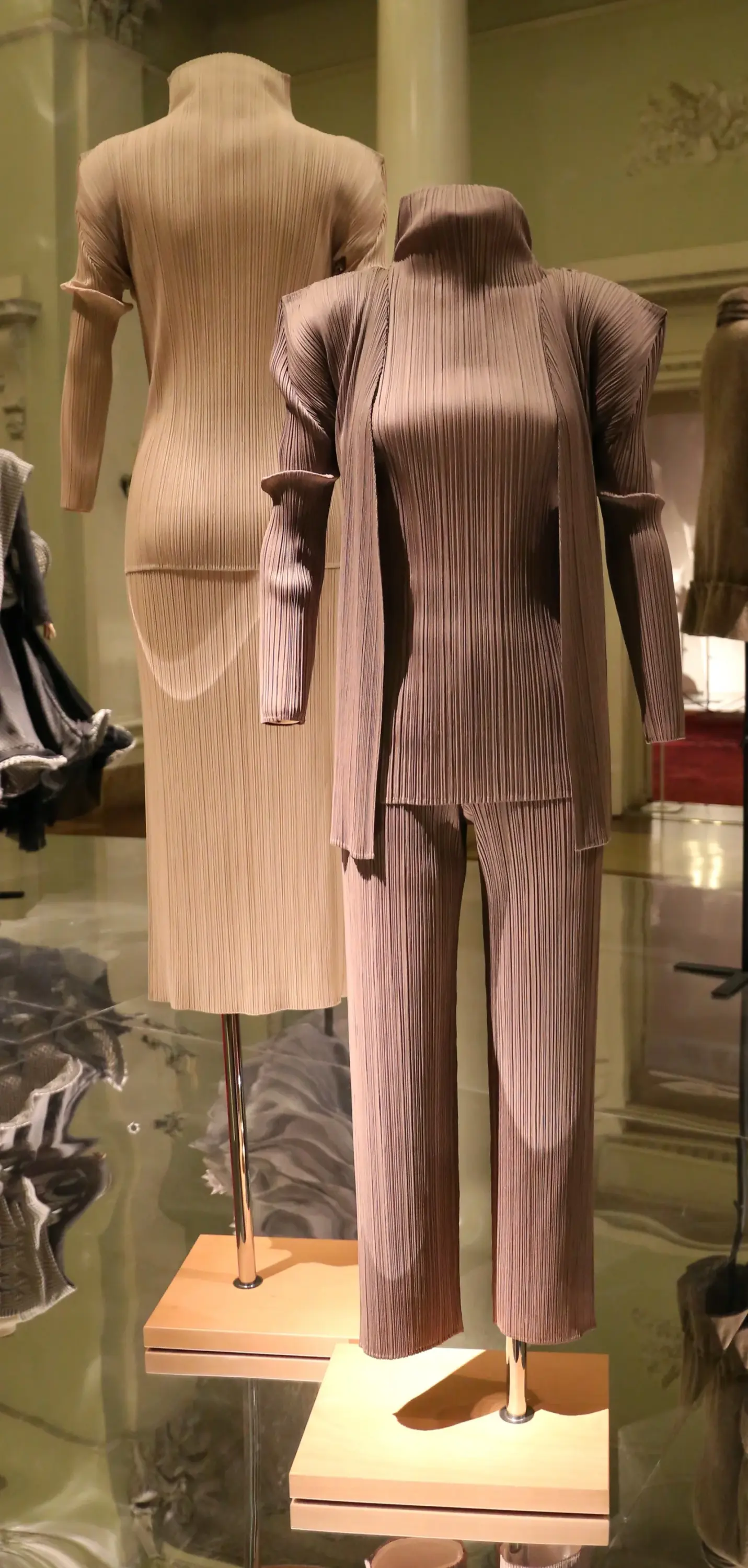
Kinetic choreography: William Forsythe, The Frankfurt Ballet, and kinetic friction
Cloth lives only when it moves. Miyake detested the static inertia of mannequins and runway models stalking catwalks with bored, wooden gaits. He understood that his pleats were kinetic instruments whose geometry could only be revealed through centrifugal force, acceleration, and bodily exhaustion.
In 1991, American choreographer William Forsythe invited Miyake to design the costumes for the Frankfurt Ballet’s production of The Loss of Small Detail. Forsythe was executing his own radical deconstruction of classical ballet, pushing dancers into extreme, off-axis hyperextensions, frantic floor work, and rapid athletic sprints. Traditional stage costumes—tutus, stiff doublets, and restrictive lycra leotards—tore under the strain or locked the pelvic joints.
Miyake delivered hundreds of custom pleated polyester tunics, leotards, and flared trousers. The stage rehearsal produced immediate shock. When dancers leaped and contorted across the Frankfurt stage, the micro-pleats expanded radially like accordion bellows, echoing the muscular torque of each limb before snapping instantly back against the skin. The fabric acted as an external respiratory system. Air rushed through the polyester ridges, catching stage lights and making speed visible to the audience in iridescent ripples.
Forsythe realized that Miyake’s garments did not merely clothe the choreography; they actively generated it. Dancers discovered that the centrifugal whip of pleated cuffs and flared hems provided tactile feedback, altering their balance and propelling them into turns. The Frankfurt collaboration cemented Miyake’s conviction that garment pleating was not a surface embellishment, but a dynamic architecture engineered for unencumbered kinetic freedom.
The sculptural lens: Irving Penn and the autonomous silhouette
Most fashion designers hover nervously over photographers, demanding flattering angles, commercial angles, and recognizable celebrity faces. Miyake did the opposite: he stayed away. For thirteen years, between 1983 and 1999, Miyake entrusted the visual documentation of his seasonal collections to legendary American photographer Irving Penn. Across more than forty editorial sessions in Penn’s Manhattan studio, Miyake never attended a single shoot. He gave Penn carte blanche.
Ihr kreativer Austausch fand komplett per Post statt. Zweimal im Jahr packte das Pariser Team von Miyake Versandkoffer mit Kleidungsstücken und schickte sie über den Atlantik zu Penns Studio an der Fifth Avenue. Penn arbeitete mit einem einzigen Stylisten, Jun Kanai, der Tänzer und Kontorsionisten vor nahtlosen weißen Papierrollen unter hartem, schrägem Tungstenlicht kleidete. Er entfernte alle kontextuellen Ablenkungen – keine Kulissen, keine Requisiten, keine Lifestyle-Fantasie.
Durch Penns 8×10 Großformatkamera hörten Miyakes Kreationen auf, wie kommerzielle Kleidung auszusehen. Rattan-Korsetts ähnelten Stammes-Schilden; geformte Kunststoff-Bustiers erinnerten an futuristische Insektenpanzer; übergroße, plissierte Polyester-Tuniken schossen wie vulkanische Basaltformationen oder urzeitliche Tiefsee-Kreaturen über den Rahmen. Penn fotografierte die Kleidungsstücke aus strengen Profilen und betonte strukturelle Spannung, harte Schatten und unerwartetes Volumen.
Als die Kontaktabzüge in Tokyo ankamen, studierte Miyake sie mit echtem Staunen. Penn zeigte Miyake Möglichkeiten innerhalb seiner eigenen Kleidungsstücke, die der Designer nie bewusst beim Entwerfen am Zuschneidetisch in Betracht gezogen hatte. Die Bilder bestätigten Miyakes zentrale Prämisse: Ein wirklich innovatives Kleidungsstück funktioniert als autonomes skulpturales Objekt, das in der Lage ist, seine eigene visuelle Poesie zu erzeugen, wenn es von einem kompromisslosen Objektiv betrachtet wird.
The industrial modernist uniform: Steve Jobs and the abolition of ornament
Die reinste Verwirklichung von Miyakes industrieller Philosophie entstand nicht auf dem Laufsteg, sondern in der Alltagsgarderobe von Silicon Valleys anspruchsvollstem Modernisten. In den frühen 1980er Jahren besuchte Apple-Mitbegründer Steve Jobs die Sony-Zentrale in Shinagawa, Tokyo. Während er mit Sony-Vorsitzenden Akio Morita die Montagehallen besichtigte, fiel Jobs auf, dass jeder Arbeiter – von den Montagearbeitern bis zu den Führungskräften – identische dunkle Jacken trug. Als Jobs nachfragte, erklärte Morita, dass die Fabrikarbeiter im Nachkriegsjapan nur wenige Kleider hatten; Sony hatte Issey Miyake beauftragt, eine langlebige, hochmoderne Uniform zu entwerfen, die die Mitarbeiter vereinte und soziale Reibung beseitigte.
Miyakes Sony-Jacke war ein Meisterwerk utilitaristischen Industriedesigns: aus Ripstop-Nylon mit abnehmbaren Ärmeln gefertigt, wechselte sie nahtlos von warmen Fabrikböden zu kühlen Outdoor-Wegen. Jobs war fasziniert. Er kehrte nach Cupertino zurück und drängte die Apple-Mitarbeiter, eine von Miyake entworfene Unternehmensuniform zu übernehmen. Der Vorschlag wurde von den Ingenieuren in Silicon Valley, die ihre lässigen Flanellhemden und Sneakers schätzten, ausgelacht. Die Unternehmensuniform war tot.
Jobs drehte sich um. Wenn Apple keine Uniform tragen wollte, würde er selbst eine tragen. Er wandte sich direkt an Miyake und bat den Designer, eine persönliche Garderobe zu produzieren, die ihn von täglichen Kleidungsentscheidungen befreien und seinen strengen, vom Bauhaus inspirierten Designethos widerspiegeln würde. Miyake antwortete, indem er ungefähr einhundert identische schwarze Stehkragenpullover aus einem atmungsaktiven, feinen Seiden- und Baumwollstrick produzierte.
Für den Rest seines Lebens trug Jobs diesen schwarzen Rollkragenpullover bei jeder Keynote-Präsentation, Produkteinführung und öffentlichen Auftritt. Die Wahl war keine Exzentrizität eines Promis; es war pure funktionalistische Disziplin. Wie Miyakes Falten beseitigte der schwarze Stehkragenpullover kognitive Belastung. Er diente als Uniform für intellektuelle Arbeit und verband den minimalistischen Computereinsatz von Silicon Valley mit Miyakes lebenslanger Mission, dekorative Eitelkeit zugunsten von langlebiger, funktionaler Nützlichkeit abzubauen.
Material alchemy: Washi paper, recycled PET, and the 132 5 mathematics
Miyake hörte nie auf, Mode als Materialwissenschaft zu betrachten. 2007 zog er sich von täglichen Laufstegpräsentationen zurück, um 21_21 DESIGN SIGHT zu gründen – ein multidisziplinäres Designforschungsmuseum in Tokyo, entworfen von Architekt Tadao Ando – und gründete das Reality Lab Forschungsteam. Die Mission war klar: regenerative Fertigungssysteme entwickeln, die den ökologischen Zusammenbruch durch fortgeschrittene Mathematik und recycelte industrielle Materialien angehen.
Im Herbst 2010 startete das Reality Lab 132 5. ISSEY MIYAKE. Die rätselhaften Zahlen kodierten eine präzise topologische Formel: Ein einzelnes Stück Stoff (1) nimmt eine dreidimensionale Form (3) an, wird vollständig flach in zwei Dimensionen (2) gefaltet und wenn es vom Träger aufgehoben wird, dehnt es sich in eine fünfte Dimension (5) aus – die Dimension der gelebten Zeit und Bewegung. In Zusammenarbeit mit dem Informatiker Jun Mitani wandte das Team algorithmische 3D-Geometrie an, um Kleidungsstücke vollständig flach entlang lasergeprägter geometrischer Tessellationen zu falten, genau wie algorithmisches Origami.
Die Materialzusammensetzung war ebenso radikal. Miyake wies Jungtextilien zurück und arbeitete mit Teijin zusammen, um Eco-circle Fasern zu nutzen – ein geschlossener Polyester-Garn, der chemisch aus weggeworfenen Plastikflaschen und post-consumer synthetischen Kleidungsstücken recycelt wurde. Die resultierenden geometrischen Polygone liegen vollständig zweidimensional auf einem Tisch; wenn der Träger den Kragen anhebt, springt das flache Origami-Polygon mühelos in eine skulpturale Tunika, ein Kleid oder eine Jacke, ohne interne Knochenstrukturen oder maßgeschneiderte Armausschnitte zu benötigen.
Dieser technologische Wagemut war in tiefen historischen Wurzeln verankert. Während seiner Karriere balancierte Miyake raumfahrtsynthetische Polymere mit alten japanischen Handwerkstraditionen. Er verbrachte Jahrzehnte damit, mit ländlichen Handwerkern in Tohoku und Kyoto zusammenzuarbeiten, handgefertigtes Maulbeer-Washi-Papier mit rohem Leinen zu kombinieren, mit natürlichem Indigo-Färben zu experimentieren und grobe Ramie auf jahrhundertealten Holzwebstühlen zu weben. Er weigerte sich, Technologie und Handwerk als gegensätzliche Kräfte zu betrachten. Für Miyake waren ein handgeschnitzter Holzschuttle und ein computergesteuertes Jacquard-Webgerät einfach Werkzeuge entlang des gleichen ununterbrochenen Kontinuums menschlicher Genialität.
Sein Tod im August 2022 markierte den Abschied von Modens größtem furchtlosen Technologen. Doch sein Erbe bleibt lebendig, wo immer Stoff auf kinetische Energie trifft. In einer Branche, die immer noch von saisonaler Wegwerfmentalität, digitalem Hype und oberflächlichem Luxus berauscht ist, bieten Miyakes fünf Jahrzehnte Arbeit eine kompromisslose Alternative: Kleidung, die die Erde respektiert, die Maschine umarmt und den menschlichen Körper zum Tanzen befreit.
Verwandte Markenarchive & Historische Monographien
Entdecke kuratierte Archivstücke und tiefgehende historische Analysen über den avantgardistischen Kontinuum: durchstöbere die kuratierten Issey Miyake Markenarchiv, schau dir unsere Monografien über Comme des Garçons und Yohji Yamamoto, oder studiere grundlegende historische Analysen, darunter Die japanische Mode-Revolution in Paris, Rei Kawakubo und die Architektur der Abwesenheit, und Yohji Yamamoto und die Poesie von Schwarz.
Literaturverzeichnis und weiterführende Lektüre
- Wikimedia Foundation – Issey Miyake: Biografie, Designphilosophie und Archivsammlungen
- Wikimedia Foundation – William Forsythe: Ballett Frankfurt und Kostüm-Kooperationen
- Wikimedia Foundation – Irving Penn: Studio-Praxis und Fotografien von Issey Miyake Designs
- Wikimedia Foundation – Steve Jobs: Modernistische Ästhetik und die Miyake-Uniform
- Wikimedia Foundation – Tama Art University: Geschichte und bemerkenswerte Alumni im Industriedesign
- Kyoto Costume Institute (KCI) – Kyoto Costume Institute Digitale Archive: Japanische Avantgarde-Modekollektionen
- WOWOW / 713 Magazine – Issey Miyake "Moves" (1993 Dokumentarfilm)
Bildnachweise
- Issey Miyake spricht mit der Presse im National Art Center in Tokyo, März 2016. Foto von Hsinhuei Chiou, Wikimedia Commons, CC BY-SA 4.0.
- Archiv-Kleidungsstück aus der Rhythm Pleats Kollektion, Herbst/Winter 1990. Foto von ellenm1 / Flickr, Wikimedia Commons, CC BY 2.0.
- Zwei Pleats Please Ensembles aus mikro-geplissiertem Polyester, 1995. Foto von Sailko, Galleria del Costume, Palazzo Pitti, Florenz, Wikimedia Commons, CC BY 3.0.