From Subculture to Luxury: Avant-Garde Fashion Today
The contemporary avant-garde exists in a state of profound structural tension: caught between its historic imperative as an oppositional subcultural weapon and its lucrative absorption into the financialized apparatus of global luxury conglomerates. Over four decades, the radical methodologies forged by the Japanese fashion revolution, the Antwerp Six, and the Italian artisanal leather workshops—raw hems, deliberate distress, anatomical asymmetry, non-Euclidean draping, and radical upcycling—have migrated from Parisian squats and subterranean cult spaces into the boardrooms of LVMH, Kering, and Renzo Rosso’s OTB Group. Today, the signifiers of anti-establishment dissent are manufactured at multi-thousand-piece industrial scale, packaged as high-margin luxury signifiers, and traded as speculative assets on secondary resale markets. Yet, parallel to this corporate co-optation, an unyielding vanguard of independent ateliers—anchored by Carol Christian Poell, m.a+ (Maurizio Amadei), Paul Harnden, Elena Dawson, and Boris Bidjan Saberi—wages a silent war of resistance through slow manual labor, biological aging, seasonal disobedience, and uncompromising autonomy.
The dialectic of subversion and absorption: cultural capital and the commodity form
To analyze the trajectory of avant-garde fashion over the past forty years is to witness a textbook enactment of cultural recuperation. In his foundational sociological treatise Subculture: The Meaning of Style (1979), cultural theorist Dick Hebdige traced how radical youth subcultures construct sartorial semiotic systems designed specifically to shock, alienate, and disrupt the bourgeois social order. Yet, as Hebdige observed, capitalism inevitably responds through two complementary mechanisms: the ideological form (in which the media and institutions pathologize or spectacularize the subculture) and the commodity form (in which subcultural signifiers are codified, detached from their original political antagonism, manufactured into mass consumer commodities, and sold back to the public).
In fashion, this recuperative cycle has accelerated exponentially. The early shock tactics of anti-fashion—the blackened, shredded wools of Rei Kawakubo and Yohji Yamamoto in 1981, the exposed linings and seam basting of deconstruction in fashion, the biological stains and distressing of Maurizio Altieri at Carpe Diem, and the severe gothic brutalism of 2000s darkwear—were initially greeted by the international fashion press with intense hostility. Mainstream critics dismissed Kawakubo’s work as “Hiroshima chic” or “post-atomic rags” and derided Belgian deconstruction as unwearable, unwashed nihilism.
However, within the framework of sociologist Pierre Bourdieu’s theory of cultural capital, the very illegibility and difficulty of these garments endowed them with immense symbolic value. To wear a garment with unraveled hems, missing collar points, or an unlined back vent in 1992 signaled not poverty, but an elite, initiated command over contemporary aesthetic theory. As corporate luxury conglomerates expanded aggressively throughout the 1990s and 2000s, this scarce symbolic capital was identified as the ultimate commercial growth engine. The challenge for modern mass luxury became how to mass-produce the sensation of underground radicalism without its actual operational risks.
Deconstruction at scale: the conglomerate apparatus (LVMH, Kering, OTB)
The contemporary luxury landscape is dominated by corporate mega-entities whose primary business model relies on high-volume, high-margin consumables: luxury leather handbags, footwear, licensed eyewear, and synthetic cosmetics. For entities such as LVMH Moët Hennessy Louis Vuitton, Kering, and Only The Brave (OTB), seasonal runway collections operate primarily as narrative marketing engines designed to harvest attention, validate cultural relevance, and drive foot traffic toward accessories.
Over the past twenty-five years, these conglomerates systematically annexed the subcultural aesthetics developed by the independent avant-garde:
- The Sanitization of Deconstruction: The technical grammar of Jacques Derrida’s philosophy—applied to patternmaking by Martin Margiela, Ann Demeulemeester, and Dries Van Noten as documented in our study of Belgian deconstruction after the Antwerp Six—was stripped of its structural critique. Rather than questioning the social construction of the garment or exposing labor exploitation, conglomerate labels translated deconstruction into superficial cosmetic details: pre-frayed denim hems, decorative faux-basting threads, trompe-l’œil print simulations of vintage wear, and laser-distressed sweaters sold at four-figure retail price points.
- The Corporate Irony of “Poverty Chic”: Under Demna at Balenciaga (Kering), the underground post-Soviet anti-bourgeois aesthetics pioneered by Vetements in Parisian underground gay clubs were institutionalized as hyper-expensive corporate theater. Destroyed sneakers coated in faux factory mud, leather tote bags replicating disposable plastic convenience store sacks, and oversized construction worker uniforms were commodified into the ultimate status emblems for the ultra-wealthy—converting working-class and subcultural utilitarian signifiers into cynical, self-referential luxury commodities.
- The Industrialization of Street Subcultures: Conglomerates recruited designers steeped in youth subcultural codes—such as Raf Simons at Jil Sander, Christian Dior, and Calvin Klein, Kim Jones at Louis Vuitton and Dior Men, and the late Virgil Abloh at Louis Vuitton—to channel the raw kinetic energy of rave, skate, punk, and architectural techwear directly into historic European heritage houses. In each case, the subcultural community that birthed the movement remained excluded from the multi-billion-dollar corporate profit apparatus.
The Maison Margiela paradigm: from flea-market upcycling to industrialized luxury
No corporate transition illustrates the tensions of avant-garde absorption more acutely than the history of Maison Margiela. Founded in 1988 by Belgian designer Martin Margiela and businesswoman Jenny Meirens, the house operated as the absolute structural negation of conventional fashion industry excess. Margiela gave no spoken interviews, refused to be photographed, stamped four simple white basting stitches on blank cotton garment tags, cast non-professional models from Parisian streets, and held historic runway presentations in derelict subway stations, overgrown children’s playgrounds, and abandoned parking lots.
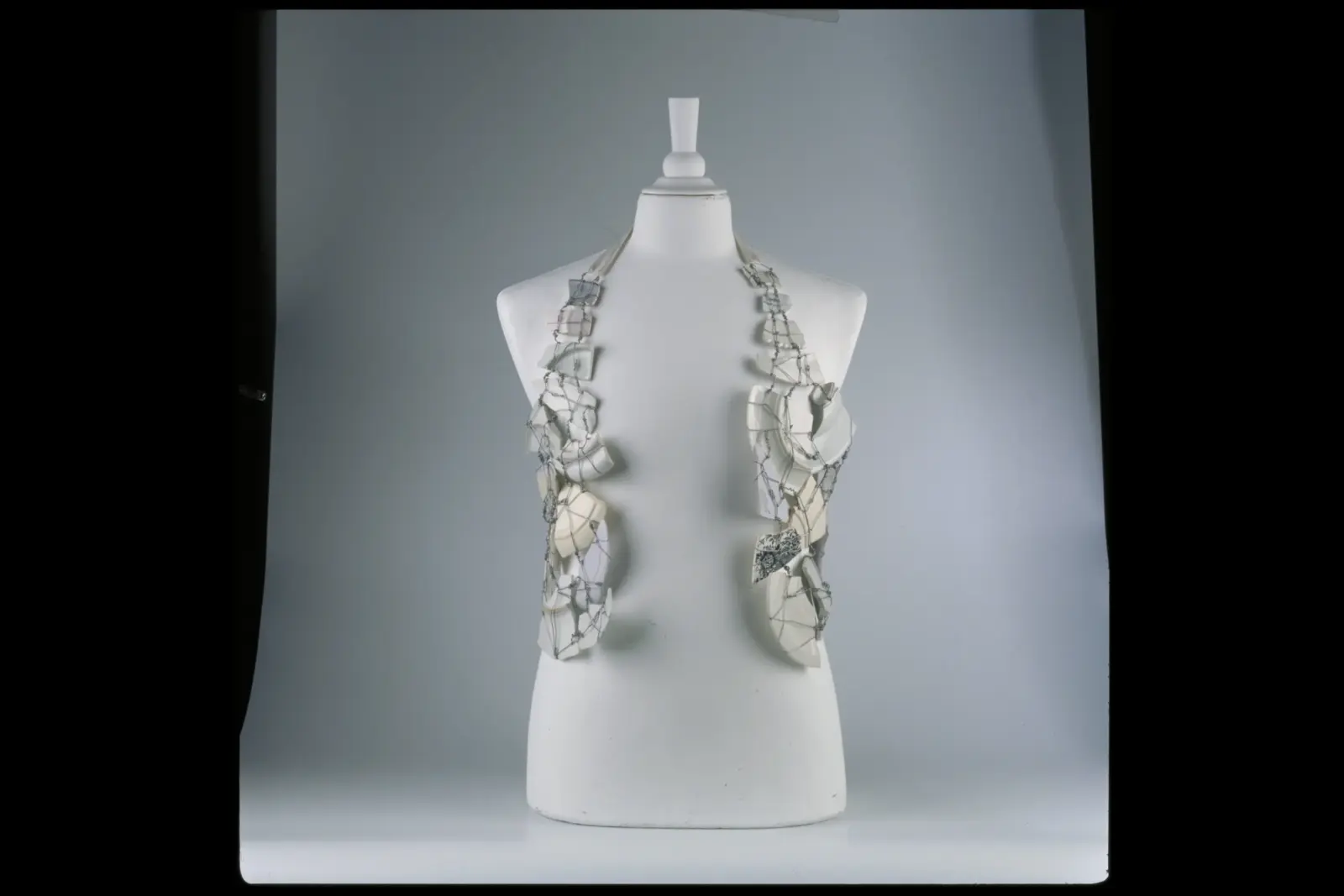
The house’s most radical laboratory was its Line 0 “Artisanal” collection. Margiela and his small atelier team personally scoured European flea markets and vintage warehouses to salvage antique leather gloves, cracked porcelain dinner plates, broken cork champagne stoppers, vintage woolen socks, and discarded army parachutes. These discarded artifacts were painstakingly disassembled by hand and reconstructed into complex sculptural garments, such as the iconic 1989 Broken Porcelain Vest. Because every foundational material was unique, Line 0 garments were irreproducible, labor-intensive, and inherently resistant to industrial mass production.
However, by 2002, the financial burdens of independent distribution, global boutique expansion, and the rising costs of raw textile procurement forced the house to seek corporate capital. In 2002, Italian fashion entrepreneur Renzo Rosso’s Only The Brave (OTB) holding group acquired a majority stake in Maison Martin Margiela. While Rosso’s capital injected crucial liquidity and modernized the house’s global retail supply chain, it inevitably shifted the operational balance:
- The Commercialization of the Tabi: Originally introduced in Margiela’s 1989 inaugural runway—where models stepped in red paint to print their split-toed hoof prints across raw cotton runway runners—the Tabi boot was conceived as an alienating subcultural provocation derived from fifteenth-century Japanese work socks. Under corporate scaling, the Tabi was systematically diversified into thousands of mass-market iterations: ballet flats, ankle boots, rubber slides, vulcanized sneakers, and metallic keychains, evolving into OTB’s highest-grossing signature luxury footwear line.
- Industrializing the “Replica” Concept: Margiela’s original Line 14 “Replica” project involved hand-curating vintage pieces and reproducing them stitch-for-stitch with historical provenance labels indicating origin, period, and fabric. Under conglomerate governance, the Replica line was scaled into mass-market luxury consumer goods—most notably the German Army Trainer (GAT) sneaker, produced continuously across commercial Italian assembly lines in dozens of seasonal colorways.
- The Galliano Transformation and Haute Couture Rebranding: Following Martin Margiela’s quiet retirement from the label in 2009, OTB appointed British couturier John Galliano as creative director in 2014, formally dropping “Martin” from the brand name. Galliano transformed the house from Margiela’s understated, forensic architectural deconstruction into a hyper-theatrical, maximalist spectacle of modern Haute Couture. While Galliano’s collections—such as the widely acclaimed Spring 2024 Artisanal collection—garnered historic critical praise for poetic tailoring and silicone-encased corsetry, they completed the house’s transition from an anti-fashion subcultural collective into a flagship jewel of an international luxury empire.
The Japanese vanguard and institutional sovereignty: Comme des Garçons and Dover Street Market
Against the relentless tide of conglomerate acquisition, Rei Kawakubo’s Comme des Garçons stands as an unprecedented triumph of corporate sovereignty and structural autonomy. While contemporaries such as Yohji Yamamoto flirted with bankruptcy during the 2008 global financial crisis before restructuring, and Helmut Lang lost control of his eponymous label after selling to the Prada Group in 1999, Kawakubo and her husband, Comme des Garçons CEO Adrian Joffe, engineered an unassailable financial fortress.
Kawakubo achieved this sovereignty through a calculated two-tiered economic architecture:
- Mass-Market Accessibility as an Armor for High Art: Kawakubo understood that pure avant-garde runway experimentation—such as her historic 1997 “Dress Meets Body, Body Meets Dress” collection featuring grotesque polyurethane pads creating hunchbacked silhouettes, or the monumental felted sculptures exhibited in the 2017 Met exhibition—is financially unviable on its own. To protect her runway uncompromisingness, Comme des Garçons established dozens of profitable commercial diffusion lines: CDG Play (featuring the ubiquitous red heart logo designed by Filip Pagowski), CDG Shirt, Wallets, and an extensive portfolio of experimental fragrances. The immense, stable profit margins generated by these accessible luxury products directly fund Kawakubo’s unrestricted artistic research on the Paris runway, insulating her from external corporate interference.
- Dover Street Market as Decentralized Curatorial Power: Rather than relying on traditional multi-brand department stores (such as Saks Fifth Avenue, Neiman Marcus, or Harrods) that enforce conservative commercial merchandising guidelines, Kawakubo and Joffe established Dover Street Market in London in 2004 (subsequently expanding to Tokyo, New York, Singapore, Beijing, and Paris). Conceived as an ever-evolving, chaotic retail bazaar where high-luxury couture sits alongside emerging underground streetwear, DSM inverted the power dynamic between fashion house and retailer. DSM grants young, radical independent designers—including Elena Dawson, Craig Green, Kiko Kostadinov, and Marine Serre—complete spatial freedom to curate their own installations without commercial censorship, fostering an autonomous ecosystem that rivals conglomerate dominance.
Alongside Kawakubo, Rick Owens established a remarkably resilient independent business model. Operating out of his own factory in Concordia sulla Secchia, Italy (Owenscorp), Owens avoided conglomerate ownership by self-manufacturing, maintaining majority equity, and creating a tightly controlled lifestyle universe centered on sculptural furniture, monolithic leathercraft, and architectural brutalism that commands cult devotion worldwide.

The artisanal resistance: radical autonomy, manual slow craft, and seasonal refusal
While conglomerates industrialized the visual signifiers of deconstruction, an uncompromising clandestine network of independent ateliers chose complete withdrawal from the mainstream fashion machine. Originating in the intellectual laboratory of Maurizio Altieri’s Carpe Diem (analyzed in our study on the Italian artisanal fashion movement), these designers rejected the seasonal fashion week calendar, fashion advertising, mass manufacturing, and wholesale scaling in favor of radical, slow artisanal resistance:
1. Carol Christian Poell: Forensic Anatomy and Biological Endurance
Operating from a discrete studio in the industrial outskirts of Milan, Austrian-born cordwainer and master tailor Carol Christian Poell represents the absolute pinnacle of independent technical obstinacy. Poell has systematically undermined every conventional commercial practice in the fashion industry:
- Rejection of the Fashion Calendar: Poell abandoned the six-month seasonal show cycle decades ago, releasing monumental collections only when his structural and material research is fully resolved (such as 2004’s “Mainstream-Downstream”, where models were cast into the waters of the Naviglio Grande canal, and 2010’s “Dead-End”).
- Material Extremism: Poell engineers garments using transparent calf and horse leathers treated in hydrogen peroxide baths, hides tanned with polyethylene coatings, garments embedded with surgical titanium prosthetic plates, and pig iron knuckles. His iconic “Drip” sneakers and boots feature liquid rubber soles allowed to coagulate upside down through gravity, creating stalactite-like spikes that wearers physically grind down against urban pavement.
- Order-to-Deliver Mechanics: CCP refuses to hold wholesale inventory. Pieces are manufactured exclusively upon confirmed client order through a tiny global network of authorized stockists (such as Darklands in Berlin, Eastern Market in Melbourne, and Lift in Tokyo), ensuring zero unsold inventory and rendering corporate obsolescence meaningless.
2. Maurizio Amadei (m.a+): Origami Geometry and Non-Linear Tailoring
Following the dissolution of Carpe Diem in 2006, former head patternmaker Maurizio Amadei established m.a+. Amadei abandoned conventional rectangular pattern drafting in favor of mathematical origami construction. His signature jackets, trousers, and leather boots are cut from a single, uninterrupted hide of reverse vacchetta or dense handwoven linen, folded around the three-dimensional human body with minimal stitching. Instead of exterior fabric labels or graphic branding, Amadei signatures his garments exclusively with discreet, hand-hammered 925 sterling silver crosses placed at stress points—an emblem of pure artisanal fidelity that resists logo-driven luxury consumerism.
3. Paul Harnden Shoppers and Elena Dawson: Nineteenth-Century Agrarian Resistance
Based in the English countryside, Canadian-born shoemaker Paul Harnden operates Paul Harnden Shoppers with an almost monastic devotion to pre-industrial craftsmanship. Harnden refuses all email, phone inquiries, digital lookbooks, and runway presentations. His garments—constructed from heavy, unwashed tweeds, stiff Ventile cottons, crumpled silks, and hand-lasted calf boots—recreate the austere, battered silhouettes of nineteenth-century agrarian laborers, Civil War infantrymen, and Dickensian travelers.
Similarly, former Harnden collaborator Elena Dawson cuts garments from unbleached calico, heavy British wools, and frayed vintage laces. Dawson deliberately leaves seam allowances raw, allowing threads to unravel, fray, and decompose organically with wear. Dawson sews garments with her own hands in rural England, packaging pieces in handwritten boxes and refusing the digital gaze of social media algorithms. For Harnden and Dawson, clothing is an intimate, living physical relic whose value resides entirely in the irreversible, temporal patina of the wearer’s life.
4. Boris Bidjan Saberi and the Dark Alchemy of Barcelona
From his cavernous atelier in Poblenou, Barcelona, German-Persian designer Boris Bidjan Saberi synthesizes high-performance athletic functionality with ancient nomadic draping and raw biological chemistry. Saberi subjects vegetable-tanned kangaroo, horse, and bull hides to blood baths, iron-rust oxidations, and wax dips, reinforcing garments with his proprietary “Object Dyecord” tensioning systems. Alongside Saberi, master leather cordwainers like Guidi in Pescia, Luca Laurini at Label Under Construction, Alessio Zero at Layer-0, and Geoffrey B. Small continue to demonstrate that the true soul of avant-garde dress cannot be automated or franchised.
The archival turn and digital resale: the financialization of subcultural memory
Parallel to the corporate absorption of runway fashion, the digital era has witnessed a profound transformation in how avant-garde garments are collected, circulated, and valued. What was once an underground trade conducted through word-of-mouth in Tokyo back-alleys, specialized Japanese auction boards (Yahoo Auctions Japan), and subterranean internet forums (StyleZeitgeist, Superfuture) has matured into a multi-million-dollar global secondary market.
Platforms such as Grailed (launched in 2013), Vestiaire Collective, The RealReal, and traditional auction houses like Sotheby’s and Christie’s transformed avant-garde garments from wearable articles of countercultural resistance into speculative financial assets:
- The Canonization of the “Grail”: Archival culture established a rigid, hyper-curated historical canon centered on specific vintage collections that predate the total conglomerate takeover. Pieces such as Helmut Lang’s 1999 Astro Biker and Ballistic Parkas, Raf Simons’ Autumn/Winter 2001 “Riot Riot Riot” oversized bomber jackets (one of which sold privately for over $40,000 after being worn by hip-hop luminaries), Undercover’s 2003 “Scab” seditionary crust-punk tailoring, and early 1990s Maison Martin Margiela Line 0 artisanal vests became the blue-chip assets of a new generation of digital collectors.
- The Aestheticization of Degradation: Unlike traditional luxury collector markets (such as vintage Rolex watches or pristine Hermès Birkin bags) which penalize physical wear, the avant-garde secondary market actively valorizes degradation. The presence of oxidized leather, cracked polyurethane coats, threadbare fraying, and sweat patinas—what the Japanese tradition of wabi-sabi celebrates as the beauty of transience—is parsed as proof of historical authenticity, commanding steep price premiums over modern reissues.
- The Paradox of Commodification: This secondary financialization produces a staggering ideological contradiction. Garments originally constructed to dismantle the commodity fetishism of the 1980s and 1990s fashion machine have themselves become the ultimate fetishized commodities. Younger generations of digital fashion enthusiasts often experience avant-garde garments not as physical garments worn to navigate urban space, but as digital screenshots, portfolio valuations, and status tokens traded on smartphone interfaces—subordinating tactile artisanal craft to virtual liquidity.
Comparative taxonomy: corporate luxury conglomerates vs authentic artisanal ateliers
To navigate the contemporary sartorial landscape requires a precise critical taxonomy that distinguishes between conglomerate mass luxury and genuine artisanal avant-garde production:
| Operational Dimension | Corporate Luxury Conglomerate (LVMH, Kering, OTB) | Independent Artisanal Atelier (CCP, m.a+, Harnden, Dawson) |
|---|---|---|
| Primary Business Model | High-margin consumables (handbags, cosmetics, sneakers, licensed eyewear) funded by runway spectacle | Direct apparel and cordwaining sales; zero licensing, zero cosmetic lines, zero speculative expansion |
| Production Methodology | Automated assembly-line production in industrial sub-contracted factories; outsourced supply chains | Small-scale in-house atelier production; direct hand-cutting, manual cordwaining, hand-sewn buttonholes |
| Pattern Drafting & Construction | Conventional industrial sizing blocks adapted for global retail uniformity; faux deconstructive trims | Non-linear, non-Euclidean anatomical drafting; single-piece origami folding; bespoke sculptural lasts |
| Relationship to Temporality | Strict enforcement of the 6-month seasonal calendar; planned aesthetic obsolescence and rapid clearance cycles | Total seasonal refusal; continuous multi-year developmental cycles; garments made-to-order without deadlines |
| Material Philosophy | Pre-dyed commercial textiles, synthetic blends, superficial enzyme washing and cosmetic distressing | Vegetable-tanned full-grain equine and bovine hides; unwashed artisan linens; biological bath dyes; silver hardware |
| Retail & Distribution Architecture | Ubiquitous airport boutiques, franchised department store corners, aggressive algorithm-driven e-commerce | Clandestine stockist networks (5 to 15 global stores); no direct webshops; private in-person appointments only |
| Branding & Cultural Capital | Aggressive celebrity endorsements, influencer gifting, red-carpet dressing, high-visibility corporate logos | Complete public anonymity; refusal of press interviews and digital marketing; discreet silver cross or basting markers |
The future horizon: the perpetual guerrilla cycle of avant-garde dissent
Has avant-garde fashion reached a historical dead end, permanently subsumed under the total hegemony of global luxury capital? While the industrial capacity of conglomerates to instantly co-opt and financialize any new underground style is unprecedented, the history of dress proves that the avant-garde is not a static aesthetic style, but a dynamic, adversarial process.
As corporate luxury becomes increasingly homogenized, algorithmically generated, and environmentally catastrophic, the hunger for authentic, slow, material dissent deepens. A new vanguard of young radical practitioners—operating in regional subterranean micro-scenes from Seoul and Taipei to Berlin, London, and Brooklyn—is reviving the radical ethos of early Margiela and Carpe Diem. By experimenting with post-consumer waste upcycling, deadstock domestic textiles, bio-fabricated mycelium leathers, open-source geometric pattern releases, and decentralized localized tailoring collectives, they demonstrate that whenever the mainstream luxury market completes the absorption of one avant-garde language, a new underground vanguard quietly retreats into the shadows, cutting the threads of the next sartorial revolution.
Further reading: The Italian Artisanal Vanguard
For an exhaustive examination of the manual cordwaining, biological leather aging, and anti-industrial atelier practices that underpin modern artisanal resistance, explore our dedicated monograph on The Italian Artisanal Fashion Movement.
References and further reading
- Routledge / Internet Archive — Subculture: The Meaning of Style
- Wikimedia Foundation — Forms of Capital and the Field of Cultural Production
- Wikimedia Foundation — OTB Group: Luxury Conglomerate Structure and Brand Portfolio
- Wikimedia Foundation — Maison Margiela: From Artisanal Radicalism to Commercial Luxury
- Wikimedia Foundation — Dover Street Market: Multi-Brand Retailing and Curated Fashion Ecosystems
- Wikimedia Foundation — Rick Owens: Subcultural Brutalism, Corporate Independence, and Luxury Market Convergence
- Kyoto Costume Institute (KCI) — Kyoto Costume Institute Digital Archives: Twentieth-Century and Contemporary Avant-Garde Dress
- Victoria and Albert Museum — Victoria and Albert Museum: Contemporary Fashion and Deconstruction Search Collections
Image credits
- Martin Margiela, Broken Porcelain Vest (Gilet en morceaux d'assiettes en faïence), Fall/Winter 1989–1990. Photograph by Museum Boijmans Van Beuningen, Wikimedia Commons, CC BY-SA 3.0.
- Garments on display in the exhibition Rei Kawakubo/Comme des Garçons: Art of the In-Between at the Metropolitan Museum of Art, New York (2017). Photograph by Sarah Stierch, Wikimedia Commons, CC BY 4.0.