Rei Kawakubo e l'Architettura dell'Assenza
Rei Kawakubo’s creative output across more than five decades does not merely challenge fashion; it destabilizes the ontological foundations of Western bodily representation. Founding Comme des Garçons in Tokyo in 1969 without formal garment-making or technical patternmaking training, Kawakubo approached cloth not as a decorative sheath tailored to flatter and sexualize the anatomical figure, but as an autonomous, architectural medium that operates in direct dialogue with space, time, and void. When she presented her Paris runway debut in April 1981 alongside Yohji Yamamoto, international critics recoiled in horror—denouncing the monochromatic blackness, intentional moth-eaten perforations, and asymmetrical draping as “Hiroshima chic” and “post-atomic rags.” Yet that historic rupture initiated an irreversible paradigm shift analyzed in our study of Il Vuoto Spaziale (. By transplanting traditional Japanese aesthetics—most critically Kawakubo ha intenzionalmente allentato le viti dei telai industriali per produrre maglieria piena di punti caduti asimmetrici e buchi aperti, esemplificata dalla sua leggendaria collezione del 1982 (the active negative interval between body and garment) and —trovando una bellezza sublime nell'impermanenza, nella decadenza, nell'erosione e nell'asimmetria. (the transience of imperfect matter)—into the heart of Western haute couture, Kawakubo forged a radical architecture of absence. From the anatomical heresy of the 1997 “Body Meets Dress, Dress Meets Body” bumps collection to the decentralized retail laboratory of Dover Street Market, Kawakubo remains the supreme sovereign of modern anti-moda: an unyielding architect who creates clothing out of nothingness.
The metaphysics of absence: Ma, the void, and Japanese spatial ontology
To comprehend Rei Kawakubo’s revolution requires abandoning the Eurocentric epistemological framework that has dominated Western dressmaking since the Renaissance. In Western sartorial tradition, clothing functions primarily as an externalized second skin engineered to accentuate, cinch, or sculpt the anatomical figure. Pattern cutting from Paris to Savile Row is fundamentally Euclidean: three-dimensional body forms (bust, waist, hips) are measured, divided, and translated into tailored panels that hug anatomical contours through darts, armscyes, and bone-stiff corsetry.
Kawakubo rejected this entire anatomical paradigm from the outset. Rather than designing for a pre-existing body, she conceived the garment as an autonomous, three-dimensional architectural environment. This philosophy is rooted in the traditional Japanese spatial concept of Kawakubo ha intenzionalmente allentato le viti dei telai industriali per produrre maglieria piena di punti caduti asimmetrici e buchi aperti, esemplificata dalla sua leggendaria collezione del 1982 (間)—an untranslatable term designating the negative interval, void, or pause between physical entities. In classical Japanese tea architecture, Noh theatre, and calligraphy, Kawakubo ha intenzionalmente allentato le viti dei telai industriali per produrre maglieria piena di punti caduti asimmetrici e buchi aperti, esemplificata dalla sua leggendaria collezione del 1982 is not an empty vacuum waiting to be filled; it is the charged, living interval that gives form, resonance, and meaning to physical existence.
Translated to garment construction, Kawakubo ha intenzionalmente allentato le viti dei telai industriali per produrre maglieria piena di punti caduti asimmetrici e buchi aperti, esemplificata dalla sua leggendaria collezione del 1982 manifests as the dynamic space between the surface of the moving human flesh and the textile itself. Traditional Japanese garments like the kimono do not contour the body; they are constructed from straight bolts of woven cloth that wrap loosely around the torso, establishing an undefined zone of negative volume where air, shadow, and movement circulate uninhibited. Kawakubo radicalized this concept by deliberately decoupling the garment from anatomical symmetry. In her atelier, the empty space within the garment is as critical a design component as the woven wool or bonded nylon that encloses it. By refusing to sculpt the female figure to satisfy the sexualized bourgeois gaze, Kawakubo converted the absence of contour into an uncompromising declaration of intellectual autonomy.
April 1981: The “Hiroshima chic” shock and the war on Western symmetry
The institutional confrontation occurred in April 1981 at the Hôtel InterContinental during Paris Fashion Week. At that historic moment, European prêt-à-porter and haute couture were dominated by the glossy, hyper-chromatic, and aggressively athletic excess of the early 1980s: Claude Montana’s razor-sharp padded shoulders, Thierry Mugler’s metallic gynoid corsetry, and Yves Saint Laurent’s opulent jewel-toned satins. Western fashion celebrated unapologetic wealth, geometric perfection, and high-gloss glamour.
Onto this gilded Parisian runway stepped models cast by Rei Kawakubo and her contemporary Yohji Yamamoto. The presentation delivered an unprecedented aesthetic shockwave that stunned the international fashion press into disbelief:
- Monochromatic Blackness: At a time when European runways exploded with neon fuchsias, golds, and royal purples, Kawakubo presented an unyielding sea of pitch black, charcoal, and soot. When asked about her monochromatic obsession, Kawakubo famously replied that she worked in “thirty shades of black”—treating black not as a morbid absence of color, but as an infinite, primordial medium that stripped away superficial visual noise to reveal pure sculptural silhouette.
- The Post-Atomic Media Backlash: Horrified by the deliberate lack of makeup, disheveled hair, flat androgynous shoes, and oversized cocoon shapes, conservative French and American fashion journalists reacted with intense venom. Critics famously branded the collection “Hiroshima chic”, “post-holocaust rags”, and “the bag lady look”—accusing Kawakubo of glorifying nuclear fallout and destitution.
- The Inversion of Luxury: Mainstream critics failed to recognize that Kawakubo’s provocation was a calculated philosophical critique of Western consumerism and bourgeois luxury. By presenting garments that appeared frayed, asymmetrical, and weathered, Kawakubo imported the Zen Buddhist philosophy of —trovando una bellezza sublime nell'impermanenza, nella decadenza, nell'erosione e nell'asimmetria.—the celebration of impermanence, incompleteness, and aged austerity—directly into the capital of global luxury, sparking the seismic movement analyzed in what is anti-fashion.
Far from destroying Comme des Garçons, the scandal instantly galvanized an avant-garde subculture of intellectuals, architects, and artists. To wear Kawakubo’s black garments in 1982 signaled a deliberate, philosophical refusal to participate in the patriarchal spectacle of decorative femininity.
Destabilizing the silhouette: non-Euclidean draping, unraveled warps, and the “lace” sweater
Kawakubo’s subversion was not merely ideological; it was executed through breathtaking technical violence against traditional textile manufacturing and pattern drafting. Unlike couturiers who begin with classical design sketches, Kawakubo routinely presents her patternmakers with verbal riddles, crumpled sheets of paper, or abstract sculptures, commanding them to draft patterns for shapes that have never existed.
Her technical methodology systematically broke every rule of Western garment manufacturing:
- Sabotaging the Loom: In her Autumn/Winter 1982–1983 collection, Kawakubo instructed Japanese textile mill technicians to loosen the tension screws on industrial computer-programmed knitting machines and remove select gears. When the looms operated out of calibration, the machines dropped stitches unpredictably, producing a loose, hole-riddled black wool pullover that became known as the legendary “Holes” or “Lace” sweater. When horrified technicians protested that the machinery was malfunctioning, Kawakubo asserted that the random machine errors and uneven gaps were the design. The perforations transformed the sweater into negative space—a knitted void that revealed the skin beneath while exposing the industrial vulnerability of the textile itself.
- Non-Euclidean Pattern Drafting: While conventional patternmaking relies on symmetrical bilateral halves, Kawakubo engineered asymmetrical pattern pieces with three armholes, displaced collars that drifted halfway down the shoulder blade, and spiral seams that forced the fabric to twist around the limbs. Garments featured superfluous flaps of cloth that could not be fastened, or twisted hemlines that deliberately hung crookedly, challenging the wearer to discover their own kinetic relationship with the cloth.
- Raw Hems and Industrial Finishes: Decades before decostruzione nella moda became an institutionalized styling trope across European houses, Kawakubo abandoned internal interfacings, shoulder pads, and clean rolled hems. Seam allowances were left raw and unoverlocked, allowing edges to fray and unravel over time. By exposing the warp and weft threads of high-density Japanese wools, Kawakubo rendered the labor of fabrication visible, stripping the garment of its bourgeois illusion of permanence.
These structural innovations permanently dissolved the boundary between clothing and sculpture, inspiring the first wave of Belgian designers examined in our historical survey of the Antwerp Six and the rise of Belgian fashion.
“Body Meets Dress, Dress Meets Body” (1997): sculptural dysmorphia and Merce Cunningham’s Scenario
If Kawakubo’s early 1980s collections explored the void between garment and body, her Spring/Summer 1997 collection—officially titled “Body Meets Dress, Dress Meets Body” (colloquially remembered as the “Lumps and Bumps” collection)—launched a devastating frontal assault on biological anatomy itself. It stands today as one of the most intellectually radical collections in twentieth-century fashion history.
Constructed from lightweight, hyper-elastic stretch nylon and gingham check fabrics, the garments incorporated bulbous, asymmetrical pads stuffed with goose down and polyurethane foam. Crucially, Kawakubo did not place these pads where Western fashion had historically placed padding (shoulders, bust, or hips to exaggerate hourglass sexual dimorphism). Instead, the grotesque bulges sprouted from the upper spine, the small of the back, the collarbone, the belly, and the side of the thigh:
- The Rejection of Bodily Truth: The collection demolished the fundamental fashion premise that clothing should adapt to the natural body. Instead, the garment imposed an entirely new, mutant anatomy upon the wearer. The grotesque swellings evoked tumors, hunchbacks, pregnancy, and alien prosthetics, challenging societal definitions of beauty, health, and physical perfection.
- Choreographic Radicalism in Scenario: Recognizing the profound kinesiologic implications of the collection, legendary American avant-garde choreographer Merce Cunningham invited Kawakubo to design the sets and costumes for his 1997 Brooklyn Academy of Music production Scenario. Set to an abrasive electronic score by Takehisa Kosugi, Cunningham’s dancers performed wearing Kawakubo’s padded gingham garments. The asymmetrical lumps drastically altered the dancers’ center of gravity, forcing them to reinvent basic choreographic movements—leaps, partnering, and floor work—as their bodies collided with the unpredictable foam volumes.
- The Bodily Void: In Scenario, the body and the dress became inseparable. The padding created an artificial architecture that existed neither purely as garment nor purely as body, occupying the uncanny, indeterminate zone that the Metropolitan Museum of Art later canonized in its 2017 monographic exhibition Art of the In-Between.
Through “Body Meets Dress”, Kawakubo demonstrated that the human body is not a fixed, sacred biological truth, but an infinitely malleable sculptural canvas awaiting architectural re-engineering.
The retail monastery: spatial disruption, anti-commercial merchandising, and Dover Street Market
Kawakubo understood early that her radical garment architecture would be completely neutralized if sold within the sterile, standardized environments of corporate luxury retail. A radical dress displayed in a conventional gilded boutique with marble floors and deferential sales clerks is immediately reduced to a bourgeois commodity. To preserve the shock of her garments, Kawakubo extended her architecture of absence into physical retail space.
Throughout the 1970s and 1980s, Comme des Garçons boutiques in Tokyo’s Aoyama district, Paris, and New York’s SoHo operated more like brutalist contemporary art galleries or monastic sanctuaries than retail stores:
- Spatial Vacancy and Hidden Merchandise: Kawakubo eliminated mannequins, sales counters, decorative display racks, and mirrors from sales floors. Vast expanses of bare concrete, unpainted plaster, and raw industrial steel were left completely vacant. Garments were hung sparsely—often hidden inside freestanding curved steel tunnels or concealed behind concrete partitions—forcing customers to actively hunt for clothing rather than passively consume it. Mirrors were deliberately withheld from changing areas to compel wearers to judge clothing by how it felt against their skin rather than how they appeared to others.
- The Guerrilla Store Experiment: In 2004, Kawakubo and her husband, Comme des Garçons CEO Adrian Joffe, launched the pioneering “Guerrilla Store” initiative. Bypassing global luxury shopping capitals, Comme des Garçons opened clandestine pop-up stores in unexpected, peripheral cities—including Berlin, Warsaw, Singapore, Ljubljana, and Reykjavik. Occupying disused butcher shops, abandoned pharmacies, and post-Soviet warehouses, these stores operated on minimal budgets (under $2,000 for renovations) and were bound by a strict rule: every store closed permanently after exactly one year, regardless of commercial profitability. The Guerrilla Stores directly challenged the extractive, permanent expansionism of global luxury conglomerates.
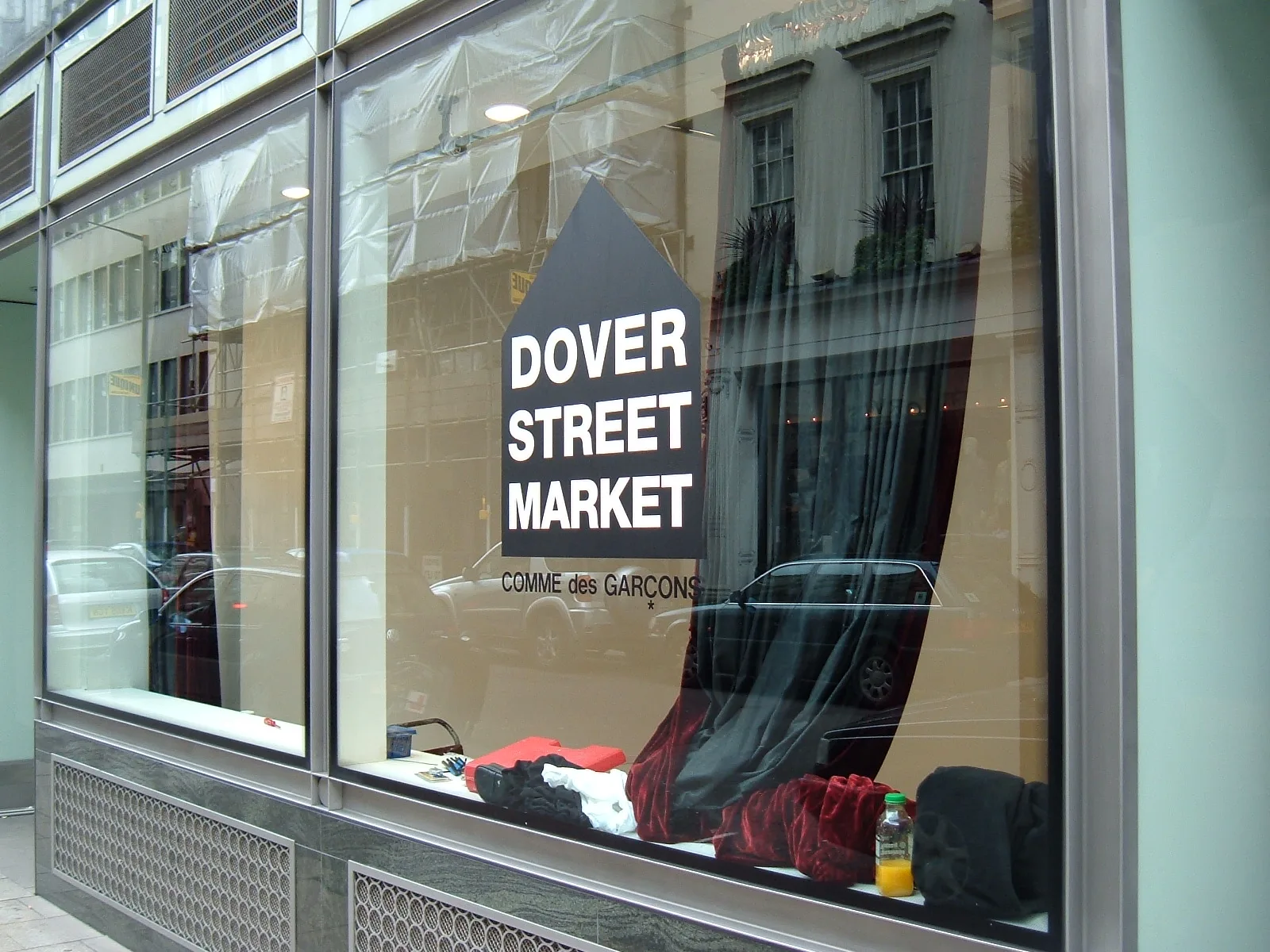
- Dover Street Market (2004–Present): In October 2004, Kawakubo and Joffe codified this retail philosophy on a monumental scale by founding Dover Street Market at 17–18 Dover Street in London’s Mayfair. Conceived as a modern incarnation of London’s historic Kensington Market, DSM brought together haute couture, street subcultures, and experimental design under one roof in “beautiful chaos.” Rather than imposing corporate retail guidelines, Kawakubo invited guest designers—from emerging independent creators like Elena Dawson, Kiko Kostadinov, and Craig Green to established luxury houses like Gucci and Balenciaga—granting them total spatial freedom to construct their own ephemeral installations without commercial censorship.
Through Dover Street Market, Kawakubo dismantled the passive consumer experience, converting retail into a living, ever-shifting exhibition where spatial void and architectural chaos amplify the garment’s subversive power.
The architecture of corporate sovereignty: commercial diffusion as a fortress for pure art
The history of avant-garde fashion is littered with the tragic bankruptcies and corporate absorptions of visionary designers. Contemporary titans who dared to challenge the status quo—such as Helmut Lang, Martin Margiela, and Christian Lacroix—eventually succumbed to financial exhaustion, selling majority equity to luxury conglomerates like Prada Group and OTB, only to see their founding visions diluted or their personal authorship stripped away, as analyzed in our study from subculture to luxury: avant-garde fashion today.
Rei Kawakubo achieved what no other living avant-garde designer has matched: total, uncompromised artistic and financial sovereignty. Comme des Garçons remains 100% privately owned, with Kawakubo serving as majority owner and sole artistic director, and Adrian Joffe presiding as CEO. She answers to no board of directors, no private equity investors, and no conglomerate shareholders.
This extraordinary independence was engineered through an ingenious, multi-tiered economic model:
- Commercial Diffusion as Artistic Armor: Kawakubo recognized that her monumental runway creations—increasingly resembling uninhabitable fabric sculptures of bonded felt, industrial foam, and crumpled metal—could never sustain a commercial apparel business. Rather than compromising her runway work to make it wearable or salable, she established dozens of targeted commercial diffusion lines: Comme des Garçons Play (anchored by the ubiquitous bug-eyed red heart graphic created by Polish artist Filip Pagowski), Comme des Garçons SHIRT, Comme des Garçons Wallet, and an extensive portfolio of revolutionary niche fragrances (such as Odeur 53, composed of inorganic notes like burnt rubber, nail polish, and hot lightbulbs).
- The Redistribution of Capital: The astronomical, steady profits generated by CDG Play t-shirts, leather zip wallets, and Dover Street Market sneaker collaborations are funneled directly into the main Comme des Garçons Paris runway presentations. The accessible commercial lines serve as an impenetrable financial moat, shielding Kawakubo’s high-concept research from the ruthless sales quotas that plague corporate creative directors.
- Anti-Advertising Marketing: Comme des Garçons famously spends almost zero budget on conventional fashion magazine advertising or celebrity gifting campaigns. Instead, Kawakubo channeled marketing capital into artistic publications (such as the legendary Six biannual magazine published between 1988 and 1991, celebrating the “sixth sense”) and artist collaborations with Cindy Sherman, Bruce Weber, and Ai Weiwei—maintaining an aura of monastic cultural integrity that money cannot buy.
By mastering the economics of modern retail while maintaining an unyielding firewall between commerce and art, Kawakubo demonstrated that absolute creative autonomy is possible only when supported by ruthless financial pragmatism.
The enduring legacy: Kawakubo’s disciples and the genealogy of radical reduction
Rei Kawakubo’s influence extends far beyond the garments carrying the Comme des Garçons label. Her Tokyo atelier has served as the premier incubator for the most influential Japanese fashion designers of the twenty-first century, fostering a distinct pedagogical lineage characterized by structural discipline, textile experimentation, and independent authorship:
- Junya Watanabe: Entering Comme des Garçons as a patternmaker in 1984, Junya Watanabe quickly rose to head the Tricot line before launching his eponymous label under the CDG corporate umbrella in 1992. Watanabe inherited Kawakubo’s rigorous architectural drafting, pushing it into complex techno-mathematical origami, synthetic solar-panel outerwear, and hyper-constructed trench coats that deconstruct workwear tropes with staggering geometric precision.
- Tao Kurihara: Joining the company in 1997, Kurihara designed the beloved Tao Comme des Garçons line from 2005 to 2011, executing entire collections out of hand-knitted paper yarns, lingerie deconstructions, and vintage tea towels, before taking creative helm of Tricot (rebranded as TAO in 2021).
- Fumito Ganryu and Kei Ninomiya: Former CDG patternmaker Kei Ninomiya launched Noir Kei Ninomiya in 2012, pushing Kawakubo’s monochromatic black philosophy to unprecedented heights of manual labor. Ninomiya famously constructs monumental ballgowns and coats entirely without sewing machines—assembling laser-cut faux leathers, tulle ribbons, and metal rings exclusively through industrial rivets, grommets, and intricate interlocking knots.
- Chitose Abe (Sacai) and Junichi Abe (kolor): Having trained for eight years as a patternmaker under Kawakubo and Watanabe, Chitose Abe established Sacai in 1999. Applying Kawakubo’s principle of hybridity, Abe pioneered the modern syntax of sartorial collage—splicing classic MA-1 bomber jackets with pleated chiffon evening skirts and knit cardigans, revolutionizing contemporary street luxury worldwide.
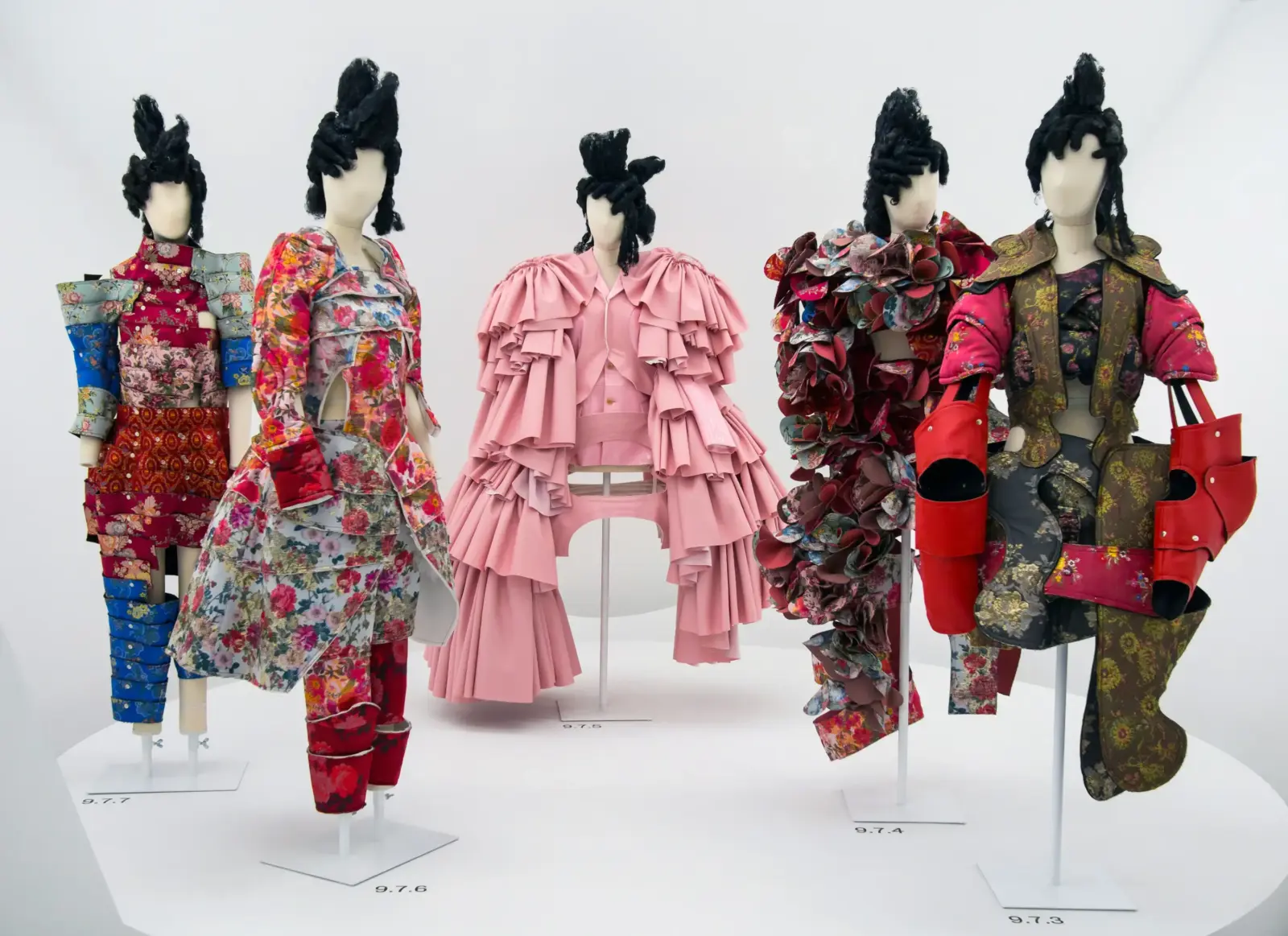
In 2017, the Metropolitan Museum of Art honored Rei Kawakubo with a monographic exhibition at the Costume Institute—making her only the second living designer in museum history, after Yves Saint Laurent in 1983, to receive a solo retrospective. Yet true to her philosophy of absence, Kawakubo refused to allow wall texts, historical timelines, or curatorial interpretations inside the white pavilions, forcing viewers to confront the clothing in absolute silence.
Rei Kawakubo’s enduring triumph is that she never sought to beautify the world or accommodate its desires. By constructing an architecture of absence out of shredded wool, negative space, and uncompromised autonomy, she proved that clothing can be something far greater than an ornament: an existential instrument that interrogates who we are, what we conceal, and the vast voids we inhabit.
Related Brand Archives & Historical Monographs
Explore our curated archival pieces and deep historical analyses across the avant-garde continuum: browse the curated Comme des Garçons brand archive, discover Junya Watanabe e Yohji Yamamoto, or examine our foundational historical essay on La rivoluzione della moda giapponese a Parigi.
Riferimenti e letture ulteriori
- The Metropolitan Museum of Art / Yale University Press — Rei Kawakubo/Comme des Garçons: Art of the In-Between
- Wikimedia Foundation — Rei Kawakubo: Biography, Design Philosophy, and Comme des Garçons
- Wikimedia Foundation — Comme des Garçons: History, Corporate Evolution, and Diffusion Lines
- Wikimedia Foundation — Ma: Negative Space, Void, and Interval in Japanese Aesthetics
- Wikimedia Foundation — Wabi-sabi: Impermanence, Asymmetry, and Imperfect Beauty
- Wikimedia Foundation — Deconstruction: Philosophical Origins and Application to Fashion
- Wikimedia Foundation — Dover Street Market: Conceptual Retail and Spatial Curation
- Wikimedia Foundation — Merce Cunningham: Scenario (1997) Collaboration with Rei Kawakubo
- Kyoto Costume Institute (KCI) — Kyoto Costume Institute Digital Archives: Japanese Avant-Garde Fashion Collections
Crediti immagine
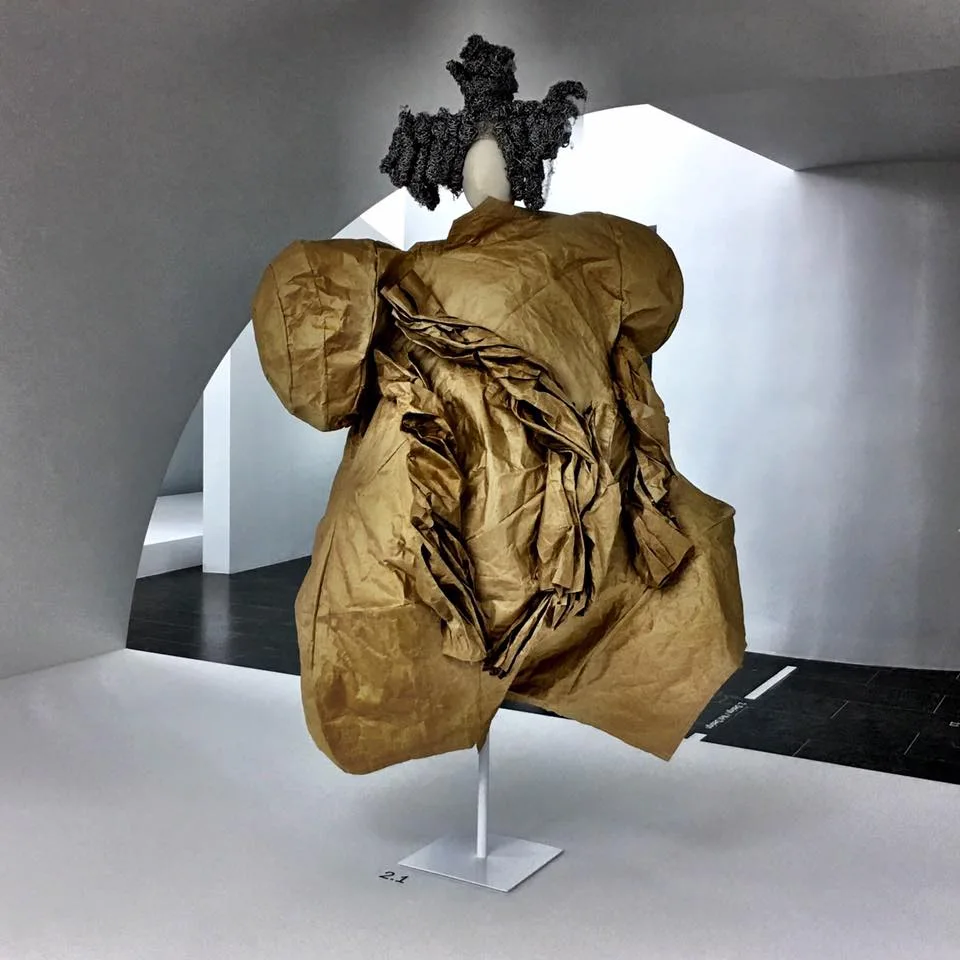
- Rei Kawakubo / Comme des Garçons architectural dresses on display in the exhibition Rei Kawakubo/Comme des Garçons: Art of the In-Between at the Metropolitan Museum of Art, New York (2017). Photograph by Sarah Stierch, Wikimedia Commons, CC BY 4.0.
- Installation view of the Comme des Garçons exhibition at the Metropolitan Museum of Art (2017). Photograph by Sharon Mollerus, Wikimedia Commons, CC BY 2.0.
- Dover Street Market at 17–18 Dover Street, Mayfair, London. Photograph by Wayland Smith, Wikimedia Commons, CC BY-SA 2.0.