Hussein Chalayan: Fashion, Technology and Transformation
Fashion manufactures seasonal fantasy; Hussein Chalayan engineered tectonic displacement. While the European runway across the 1990s and early 2000s oscillated between heritage romanticism and polished commercial minimalism, Chalayan operated as an architect of exile, velocity, and biological transmutation. Born in Nicosia in 1970 and navigating the physical partition of Cyprus during childhood, he approached the dressed body not as a clothes horse for bourgeois vanity, but as a site of crisis and shelter. Alongside contemporaries explored across our archives—from Александр Маккуин и Issey Miyake to Мартин Маржела и Хельмут Ланг—Chalayan dismantled conventional dressmaking. Through our study of the Hussein Chalayan oeuvre, we examine a radical continuum: exhuming silk garments buried in backyard soil to register geological decay, converting domestic living room furniture into telescopic refugee clothing, deploying aerospace servomotors to trigger autonomous animatronic transformations, and testing the financial boundaries of fashion commerce.
Fashion manufactures seasonal fantasy; Hussein Chalayan engineered tectonic displacement.
Runway fashion often operates as an elaborate diversion. It trades in surface glitter, ephemeral nostalgia, and industrial speed, asking audiences to forget the violent geopolitical and technological shifts reshaping the physical planet. Hussein Chalayan rejected that narcotic comfort outright. To him, garments were never decorative shells designed to flatter the client in a candlelit salon. They were speculative protective instruments.
He saw clothing as an exterior nervous system. Situated between vulnerable human anatomy and an aggressive environment, dress had to register trauma, speed, and flight. Where his Central Saint Martins peer Alexander McQueen filtered psychological trauma through nineteenth-century Gothic melodrama and historical bloodlines, Chalayan looked forward into composite materials, aeronautics, and cybernetic mechanics. His methodology was forensic. He interrogated how human bodies navigate hostile checkpoints, pressurized aircraft cabins, and digital surveillance grids.
The result was clothing that refused to sit quietly on a hanger. Jackets sprouted articulated wings; slipcovers unbuttoned into tailored overcoats; silk dresses weathered months of underground burial like archaeological strata. Chalayan proved that modern garments could function as rigorous philosophical treatises without surrendering technical tailoring precision.
The Nicosia fault line and The Tangent Flows: Soil burial, geological decay, and Joan Burstein
Geopolitical displacement was not an abstract design theory for Chalayan; it was childhood reality. Born in Nicosia in 1970 to Turkish-Cypriot parents, he witnessed the 1974 partition of Cyprus firsthand. He remembered families fleeing their houses with minutes to spare, packing their lives into hastily bundled tablecloths, carrying heirloom spoons and birth certificates in coat pockets, and encountering militarized green lines dividing streets they had walked for generations. That profound spatial rupture never left his consciousness. It instilled a lifelong suspicion of permanent dwellings and fixed national borders.
After moving to England in 1978 and completing his foundation training at Warwickshire College of Art, Chalayan entered Central Saint Martins in London. His 1993 graduate collection, titled The Tangent Flows, sent immediate shockwaves through the European fashion circuit. Rather than cutting pristine runway dresses from fresh rolls of organza, Chalayan altered the timeline of textile fabrication. He took heavy raw silk dresses, combined them with iron filings and chemical compounds, and buried them deep underground in a friend’s suburban garden. He left them in the soil for months, exposed to earthworms, micro-organisms, groundwater, and seasonal rot.
When he exhumed the garments weeks before his graduation presentation, the earth had rewritten their surfaces. The buried silk was stained in deep ochre, rust-brown, and mineral gray. Portions of the weave had dissolved into fragile lace; oxidized metal shavings had rusted directly into the fabric grain, leaving petrified rings and brittle crystalline crusts. The dresses looked like artifacts salvaged from an archaeological dig or clothing exhumed from a prehistoric tomb.
The fashion industry recognized their significance instantly. Joan Burstein, the legendary visionary behind the influential London retailer Browns, purchased the graduate collection in its entirety. She installed the oxidized, soil-encrusted garments directly into the boutique’s prestigious South Molton Street windows. At twenty-three, Chalayan had bypassed the conventional junior-assistant hierarchy, establishing himself as a formidable intellectual voice in contemporary fashion.
Afterwords and portable architecture: Living room upholstery and the telescopic coffee table
Seven years after his graduation, Chalayan staged what remains one of the defining moments in modern performance art: his Autumn/Winter 2000 collection, Afterwords, presented at the Sadler’s Wells Theatre in London. The runway had no glossy catwalk. Instead, the stage was configured as an austere mid-century living room, complete with five slipcovered armchairs, a central mahogany coffee table, and minimalist domestic silence.
The presentation addressed the plight of Kosovar refugees fleeing ethnic cleansing in the late 1990s. Chalayan considered how displaced civilians, facing imminent bombardment or eviction, had to disguise their assets and carry their homes on their backs. Models walked onto the domestic stage in muted, tailored undergarments. Methodically, without haste or theatrical pantomime, they approached the living room furniture.
The choreography was mesmerizing. Models unfastened the heavy upholstery covers from the armchairs, pulling hidden cords to transform the seat padding into tailored wool-crepe tunic coats, dresses, and capes. Next, they folded down the bare wooden chair frames, latching the hinged limbs into compact leather-trimmed suitcases that could be carried in hand. Domestic space was physically packed away in real time.
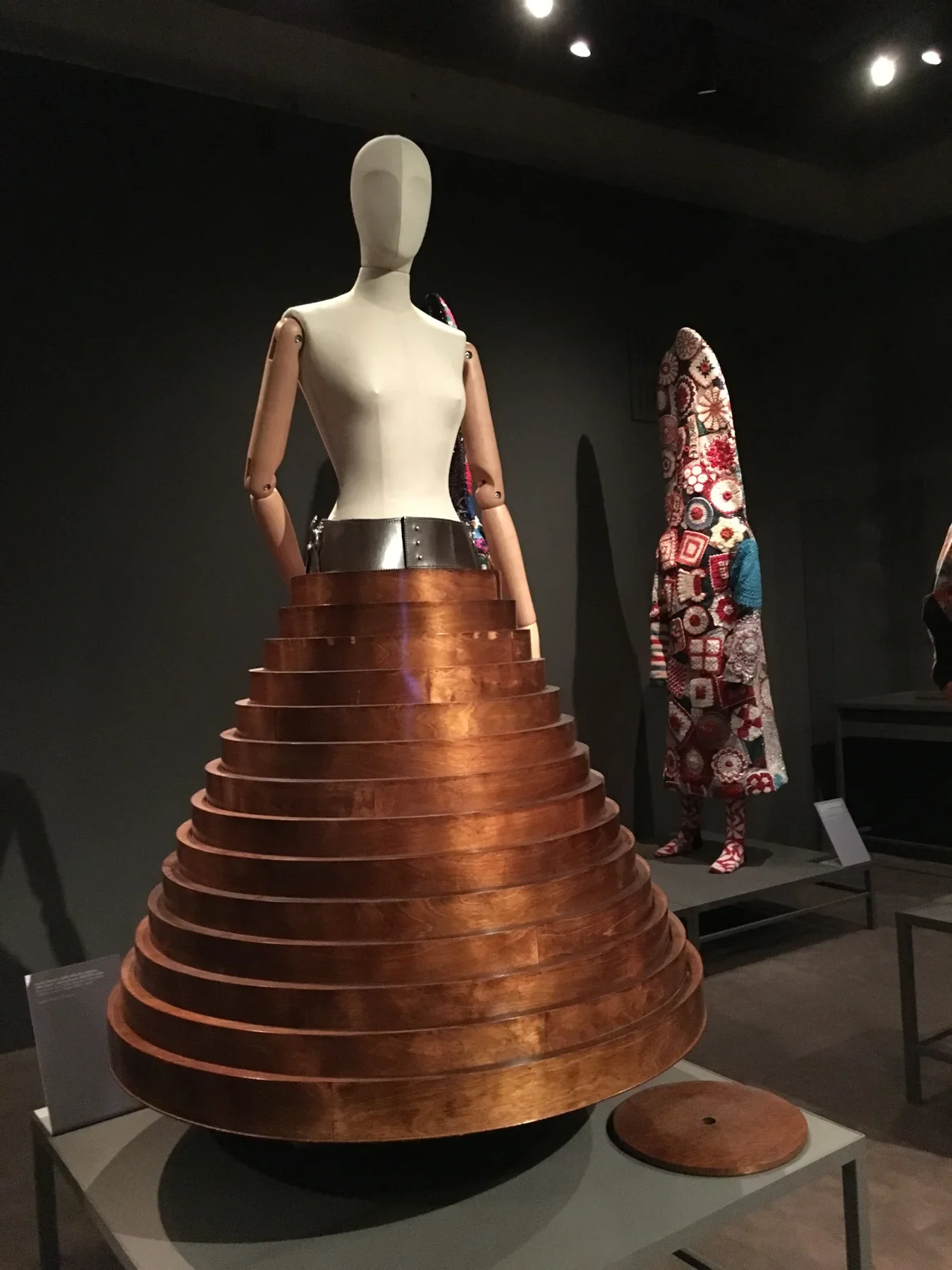
Then arrived the climactic finale. Model Natalia Semanova walked to the center of the stage, approached the round mahogany coffee table, and stepped inside its hollow central well. Reaching down, she unlocked the interior bracket. She pulled upward. Concentric tiers of polished timber lifted smoothly around her torso, rising like an architectural accordion skirt. After securing the wooden hoops around her waist, she stepped forward and walked the perimeter of the stage, wearing the living room table as an articulated garment. Through pure kinetic invention, Chalayan had synthesized clothing, portable shelter, and the heartbreaking weight of forced migration into a single indelible image.
Aerodynamic fuselages and synthetic flight: Before Minus Now and the Echoform carapace
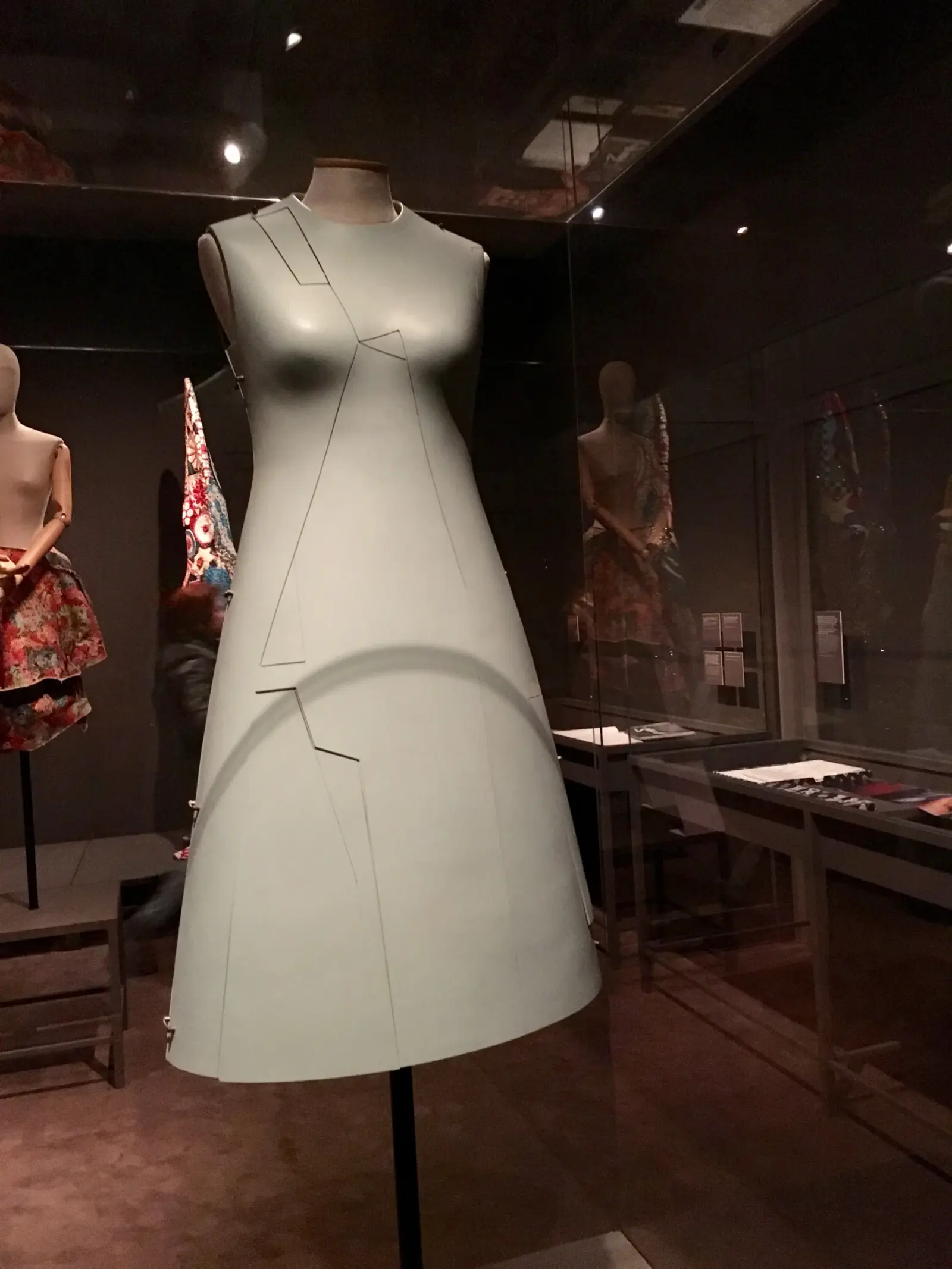
Having explored domestic displacement, Chalayan turned his focus to industrial velocity and aviation science. In his Spring/Summer 2000 collection, titled Before Minus Now, he abandoned traditional needle-and-thread patternmaking to collaborate with aeronautical engineers and automotive modelers. The centerpiece was the legendary composite airplane dress.
The garment was molded from rigid composite resin, fiberglass, and polyester polymers, finished in automotive high-gloss white paint. It did not hug the organic curves of the feminine torso. Instead, it formed a monocoque aerodynamic shell resembling the sleek fuselage of a supersonic passenger jet or the front wing of a Formula One racer. Concealed beneath the fiberglass skin was a network of micro-servomotors, battery packs, and articulated mechanical hinges.
On the runway, a young boy holding a wireless radio transmitter stood at the edge of the catwalk. As the model strode forward, the transmitter sent radio-frequency signals to the dress. Micro-motors hummed to life. Smooth panels on the side and rear of the composite shell slid open, revealing layers of soft pink and white tulle beneath, mimicking the trailing-edge flaps deployed on aircraft wings during landing approaches. Fashion had discarded passive drape to become an active mechanical vehicle.
This aerodynamic trajectory deepened in his Autumn/Winter 1999 presentation, Echoform. Here, Chalayan worked with aircraft technicians to construct rigid carbon-fiber and leather body carapaces modeled on cockpit ergonomics. Padded neck rolls, aerodynamic fairings, and molded composite chest plates encased the body, forcing the wearer to adopt the rigid posture of a pilot enduring high gravitational loads. As explored in our historical surveys on avant-garde fashion and techwear и деконструкции в моде, Chalayan demonstrated that technical clothing was not merely about waterproof nylon membranes, but about reconfiguring the ergonomic boundary between flesh and industrial technology.
One Hundred and Eleven: Mechanical servomotors, pulleys, and robotic sartorial history
By Spring/Summer 2007, Chalayan’s kinetic ambition reached its mechanical zenith with the collection One Hundred and Eleven. Staged in Paris, the runway explored the preceding 111 years of Western fashion history, charting social emancipation and technological shifts from the late Victorian era in 1895 through to 2006. Rather than presenting static historical retrospectives, Chalayan built mechanical animatronics directly into the garments.
He collaborated with mechanical design studio 2D3D and engineer Sean Jeating. Inside the corsetry and linings of six bespoke dresses, they concealed complex networks of micro-servomotors, tiny pulleys, tensioned aircraft cables, and computer-controlled microchips. The show was an exercise in pure temporal compression.
A model paused at the center of the stage wearing a high-collared, long-sleeved Victorian gown with an expansive crinoline skirt. Suddenly, without human touch, the garment began to twitch and whirr. Micro-motors spun miniature spools, reeling in the hidden cables. The heavy Victorian hemline gathered upward, drawing the floor-length skirt up to mid-calf; the high neckline parted and retracted into the shoulders; interior panels shifted sideways. Within sixty seconds, the Victorian crinoline had autonomously collapsed into a dropped-waist, beaded 1920s flapper dress.
In subsequent looks, an hourglass 1950s ballgown pulled its own volume inward to reveal a sleek 1960s Paco Rabanne-style metallic mini-shift, while a high-tech geodesic headpiece opened and closed like a mechanical lotus blossom. Chalayan compressed a century of stylistic evolution into ninety seconds of robotic movement. He laid bare the relentless, mechanical obsolescence at the heart of the fashion cycle: each historical era cannibalizing its predecessor through the push of an unseen switch.
Airborne optics: 15,000 Swarovski crystals, video dresses, and ephemeral illumination
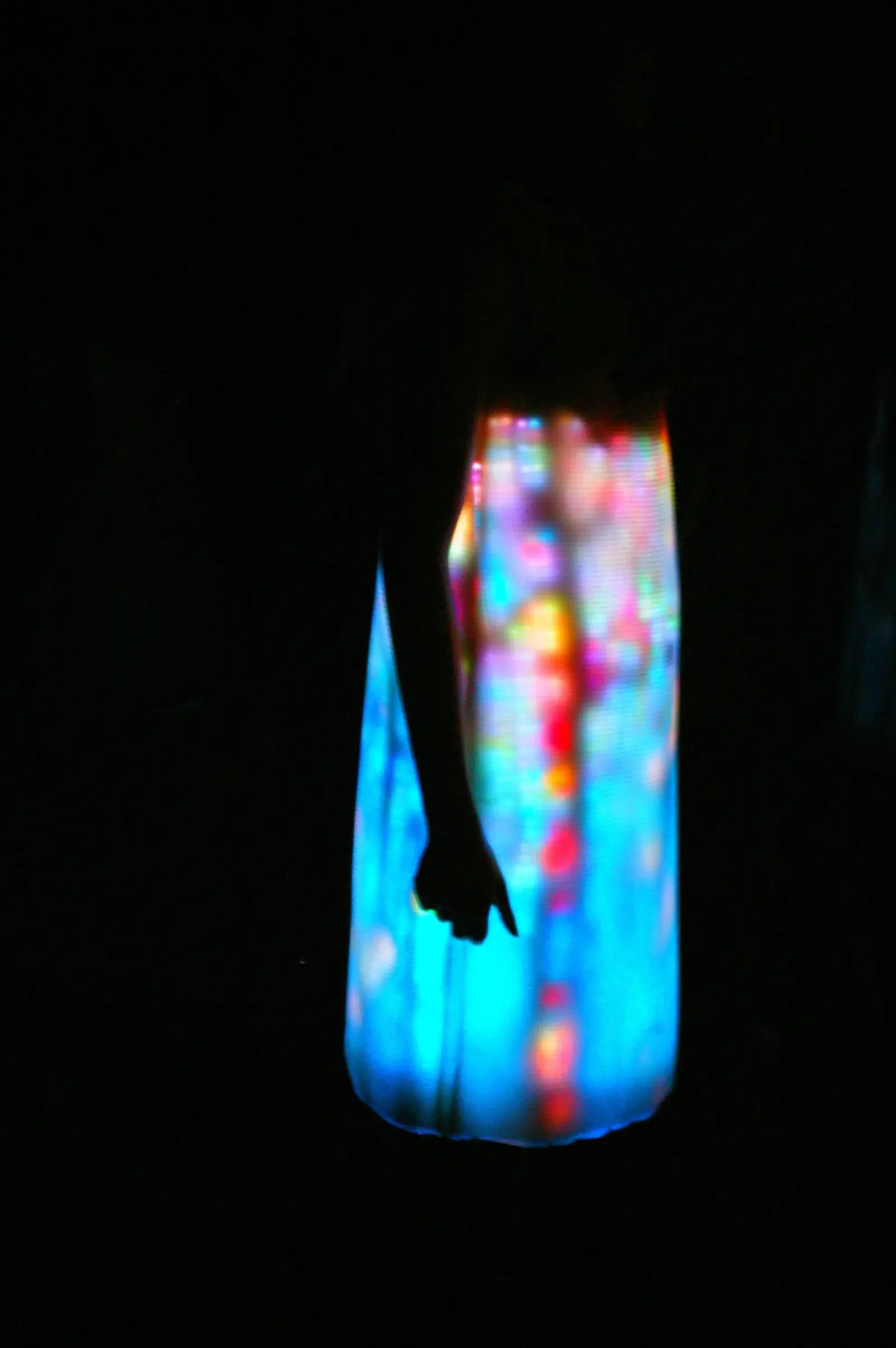
Following his exploration of mechanical gears and pulleys, Chalayan pivoted from kinetic hardware to digital optoelectronics. For his Autumn/Winter 2007 collection, Airborne, he partnered with London-based tech pioneer Moritz Waldemeyer and crystal house Swarovski to produce garments that functioned as dynamic video display screens.
The construction was technically staggering. Waldemeyer developed flexible circuit boards populated with 15,000 individually addressable micro-LEDs, which were engineered to flex with the movement of the fabric without snapping solder joints. Over each microscopic light diode, technicians mounted precision-cut Swarovski crystal lenses. These faceted crystals diffused the sharp digital points of light into soft, luminous photographic pixels.
On the dimmed runway, the dresses flickered to life. Rather than flashing crude electronic graphics or commercial logos, the garments displayed cinematic, low-resolution video loops of blooming roses, wilting petals, and seasonal weather patterns flowing directly across the fabric. As the model moved, the digital light warped across the curves of the body, creating an uncanny illusion of living, glowing skin.
He pushed optical experimentation even further in Spring/Summer 2008 with Readings. In this collection, dresses were studded with two hundred movable laser diodes paired with miniature pivoting mirrors. As models walked through artificial stage fog, brilliant red laser beams shot outward from their bodies in sharp geometric cones, piercing the darkness and reflecting off revolving mirrors mounted around the auditorium. The garments ceased to be passive textiles reflecting ambient light; they became active optical projectors that mapped and reorganized the architectural space around them.
Material alchemy: Tyvek airmail paper, water-soluble textiles, and synthetic memory
High technology in Chalayan’s world was never restricted to electronic circuit boards and electric motors. He applied equal rigor to material alchemy and low-tech industrial substrates. His most commercially resonant artifact remains the Airmail Dress, conceived during his graduate period and produced in 1999.
Cut from DuPont Tyvek—an untearable, high-density spunbound polyethylene flash-spun fabric typically utilized for postal packaging and protective industrial hazmat suits—the garment arrived folded flat into a crisp postal envelope. The exterior was printed with traditional blue-and-red airmail diagonal borders, postage stamp boxes, and address lines. The wearer could write a personal letter across the material, fold the garment into its envelope configuration, seal it, adhere postage stamps, and send it through the international postal system. Upon arrival, the recipient unfolded the letter into a pleated, wearable dress. It dismantled the barrier between correspondence, memory, and clothing.
Material instability resurfaced dramatically in his Spring/Summer 2016 presentation, Pas de Deux. Two models stood motionless on pedestals beneath ceiling-mounted shower heads. As artificial rain poured down, the heavy cotton military coats they wore began to liquefy. Chalayan had tailored the outer garments from specialized water-soluble textiles; as the water saturated the fibers, the coats dissolved in white sudsy streams, peeling away to reveal delicate, crystal-embroidered evening dresses hidden beneath. The metamorphosis was instantaneous, violent, and poetic.
These material investigations mirrored experimental breakthroughs across the avant-garde spectrum. Just as Issey Miyake pioneered the thermodynamic memory of polyester in his garment-pleating technologiesи Maison Margiela exposed the structural anatomy of salvaged garments through деконструкцию, Chalayan pushed industrial synthetics beyond comfort toward ontological inquiry.
The commercial crucible: Insolvency, corporate tenures, and sculptural permanence
Genius on the runway provides zero immunity against the ruthless financial realities of international garment production. Throughout his career, Chalayan’s uncompromising conceptual purity existed in constant, agonizing friction with the economics of retail fashion. Engineering prototype dresses with servo-motors, carbon fiber molds, and bespoke circuit boards cost tens of thousands of pounds per piece—monumental capital investments that could never be recouped through department store rack sales.
Despite being awarded British Designer of the Year twice consecutively in 1999 and 2000, his business stood on the brink of financial collapse. In early 2001, when his Italian production backer Gibo abruptly withdrew manufacturing support, Chalayan was forced into corporate insolvency and voluntary liquidation. He had to cancel his upcoming Autumn/Winter 2001 Paris runway show, illustrating the brutal divide between critical acclaim and commercial survival.
To sustain his independent research atelier, Chalayan accepted high-profile corporate creative direction contracts. In 2001, he was appointed creative director of British luxury goods brand Asprey. In 2008, sports apparel giant Puma acquired a majority stake in Hussein Chalayan’s business, appointing him creative director of the overall brand and funding his experimental Urban Mobility footwear and apparel collections. In 2014, he took over demi-couture design for Vionnet in Paris. Yet corporate compromise frequently chaffed against his artistic autonomy, leading to eventual exits from each corporate umbrella.
Inevitably, Chalayan found his true home in academia and fine art institutions. He was appointed Professor and Head of the Fashion Department at the University of Applied Arts Vienna, succeeding Raf Simons and Helmut Lang. He collaborated with choreographers at Sadler’s Wells to direct contemporary dance performances like Gravity Fatigue (2015), creating kinetic costumes that transformed with the dancers’ physical momentum. His seminal pieces—the remote-control aircraft dress, the coffee table skirt, the airmail paper envelope, and the LED video shifts—now reside in permanent institutional collections across the Victoria and Albert Museum, the Kyoto Costume Institute, and the Design Museum in London.
Hussein Chalayan did not seek to decorate bodies for ephemeral social status. He used the garment as a physical laboratory to interrogate migration, mechanical acceleration, and human vulnerability. In doing so, he elevated avant-garde fashion from superficial ornament into kinetic sculpture of the highest intellectual order.
Related Brand Archives & Historical Monographs
Explore curated archival pieces and deep historical analyses across the avant-garde continuum: inspect monographs on Issey Miyake, Александр Маккуин, Maison Margiela, Comme des Garçonsи Хельмут Ланг, or examine foundational historical analyses including Issey Miyake: Movement, Technology and the Pleat, Авангардная мода и техноодежда, Деконструкция в моде, Что такое анти-мода?и От субкультуры к роскоши: авангардная мода сегодня.
Ссылки и дальнейшее чтение
- Wikimedia Foundation — Hussein Chalayan: Biography, Conceptual Fashion, and Kinetic Design
- Wikimedia Foundation — Central Saint Martins: History of the Fashion Design Program
- Wikimedia Foundation — Browns: Joan Burstein, Retail Curation, and British Avant-Garde Support
- Wikimedia Foundation — Sadler’s Wells Theatre: Contemporary Dance and Performance Collaborations
- Wikimedia Foundation — Puma: Corporate History, Creative Collaborations, and Urban Mobility
- Chalayan YouTube Archive — Hussein Chalayan Autumn/Winter 2000 After Words Runway Presentation
Кредиты изображения
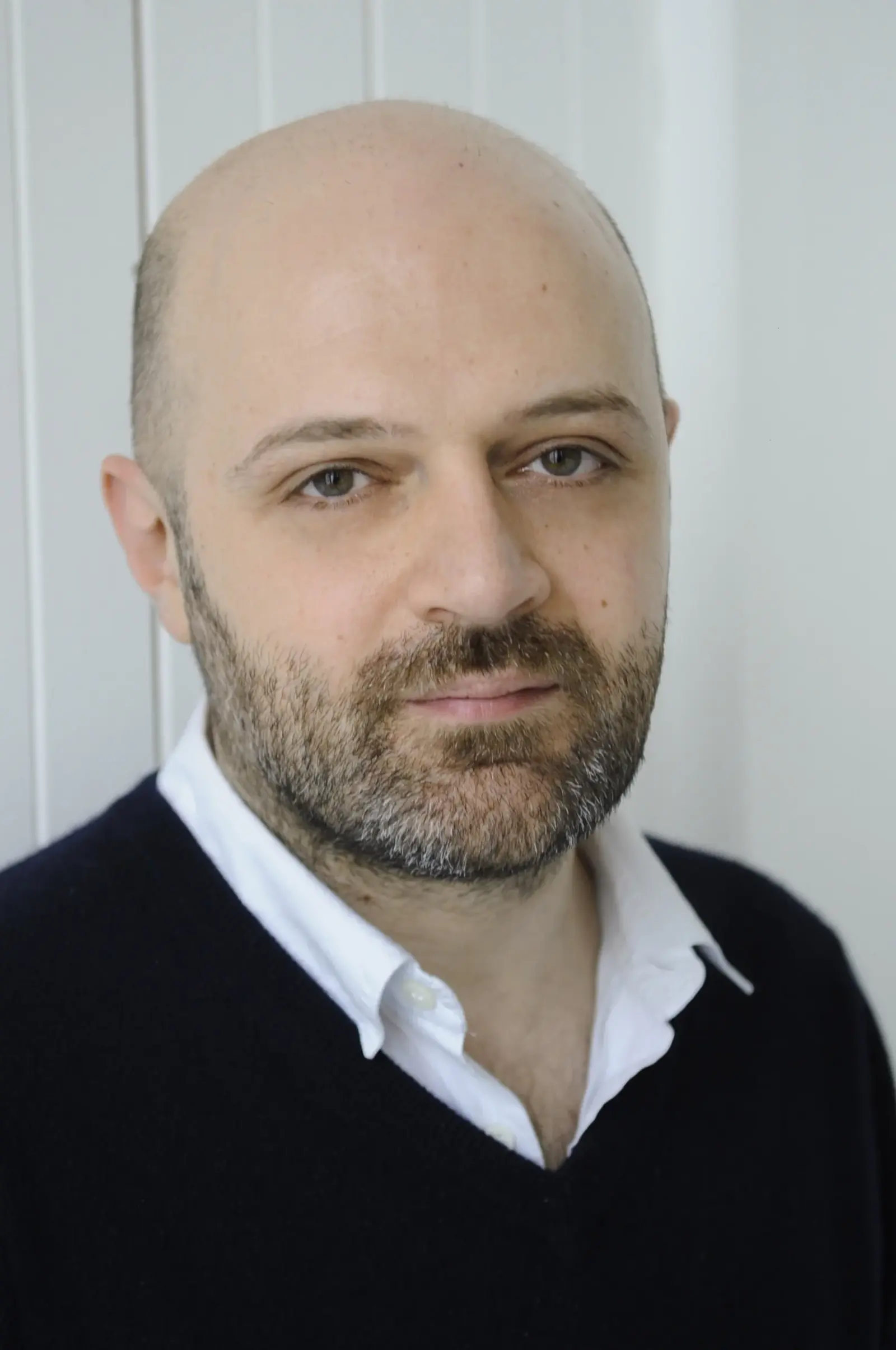
- Hussein Chalayan, portrait by Chris Moore. Photograph courtesy of Presschalayan, Wikimedia Commons, CC BY-SA 3.0.
- Hussein Chalayan, telescopic coffee table skirt from the Autumn/Winter 2000 "Afterwords" presentation. Photograph by Manuelarosi, Wikimedia Commons, CC BY-SA 3.0.
- Hussein Chalayan, remote-controlled composite airplane dress from Spring/Summer 2000 "Before Minus Now". Photograph by Manuelarosi, Wikimedia Commons, CC BY-SA 4.0.
- Hussein Chalayan, LED video dress from Autumn/Winter 2007 "Airborne", exhibited at the Design Museum, London. Photograph by renaissancechambara, Wikimedia Commons, CC BY 2.0.