Yohji Yamamoto and the Poetry of Black
Yohji Yamamoto never intended to decorate the human body; he set out to protect it. Emerging from the burnt-out district of Kabukicho in postwar Tokyo, Yamamoto learned dressmaking inside his widowed mother’s shop, watching working women endure the exhausting indignities of garments engineered strictly to flatter the predatory male gaze. When he unveiled his oversized, pitch-black designs in Paris in April 1981 alongside Rei Kawakubo, Western critics recoiled—denouncing the unpressed wools, frayed hems, and asymmetric volumes as “Hiroshima chic” and “post-atomic rags.” That cultural clash, analyzed in our investigation of de Japanse mode-revolutie in Parijs, ruptured a century of French couture hegemony. Anchored by the Japanese spatial concept of De Wabi-Sabi van Imperfectie: (the active interval between fabric and flesh), dense Bishu-woven wool gabardines, and deconstructed menswear tailoring, Yohji Yamamoto transformed black from a clerical absence of light into an existential medium: quiet, arrogant, lazy, mysterious, and unapologetically autonomous.
Fashion moves fast; Yohji Yamamoto moves slow.
While luxury conglomerates burn through seasonal trends, market-tested micro-aesthetics, and disposable marketing gimmicks, Yohji Yamamoto has spent over fifty years refining a solitary, monastic discipline. He cuts cloth. He works almost exclusively in black. He listens to how yarn responds when dragged across the grain of a cutting table.
His philosophy rejects the core dogmas of Western dressmaking. European couture spent centuries calculating how to cinch the waist, hoist the bosom, and sculpt the female anatomy into an idealized sexual silhouette. Yamamoto reversed that equation completely. He built shelters. Drawing from traditional Japanese spatial consciousness and Savile Row construction techniques, he surrounded the body with generous layers of washed wool gabardine, off-kilter seams, and unlined hems. His garments do not display the wearer; they grant them an inviolable sanctuary. In an era obsessed with self-promotion and visual noise, Yamamoto’s garments whisper a quiet, stubborn refusal.
The metaphysics of black: “arrogant and modest at the same time”
Black refuses to perform. It does not plead for attention, nor does it flatter the passerby. In a widely cited reflection from his 2010 autobiography My Dear Bomb, Yamamoto formulated the central paradox of his chromatic loyalty:
“Black is modest and arrogant at the same time. Black is lazy and easy—but mysterious. But above all black says this: ‘I don’t bother you—don’t bother me.’”
Western art history routinely treats black as a void: the absolute privation of light, the color of clerical penance, or an emblem of gothic grief. In Japan, the cultural lineage is entirely different. Grounded in classical Zen ink wash painting (sumi-e) and immortalized in Jun’ichirō Tanizaki’s 1933 treatise In Praise of Shadows, darkness is valued as a deep, luminous medium teeming with micro-tonal variations. In traditional Japanese architecture, beauty gathers in unlit alcoves, where lacquerware gleams faintly from candle embers through layered murk.
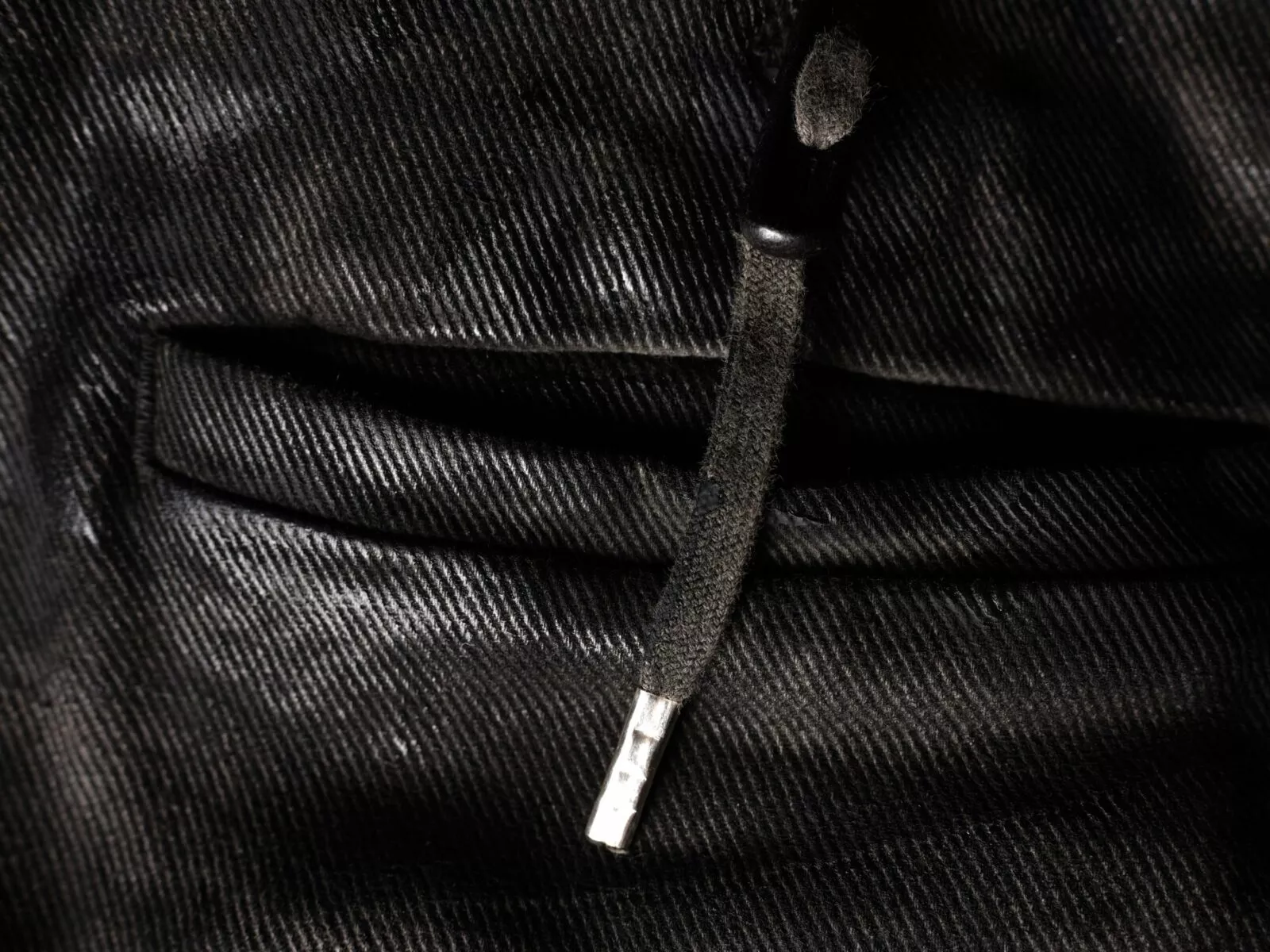
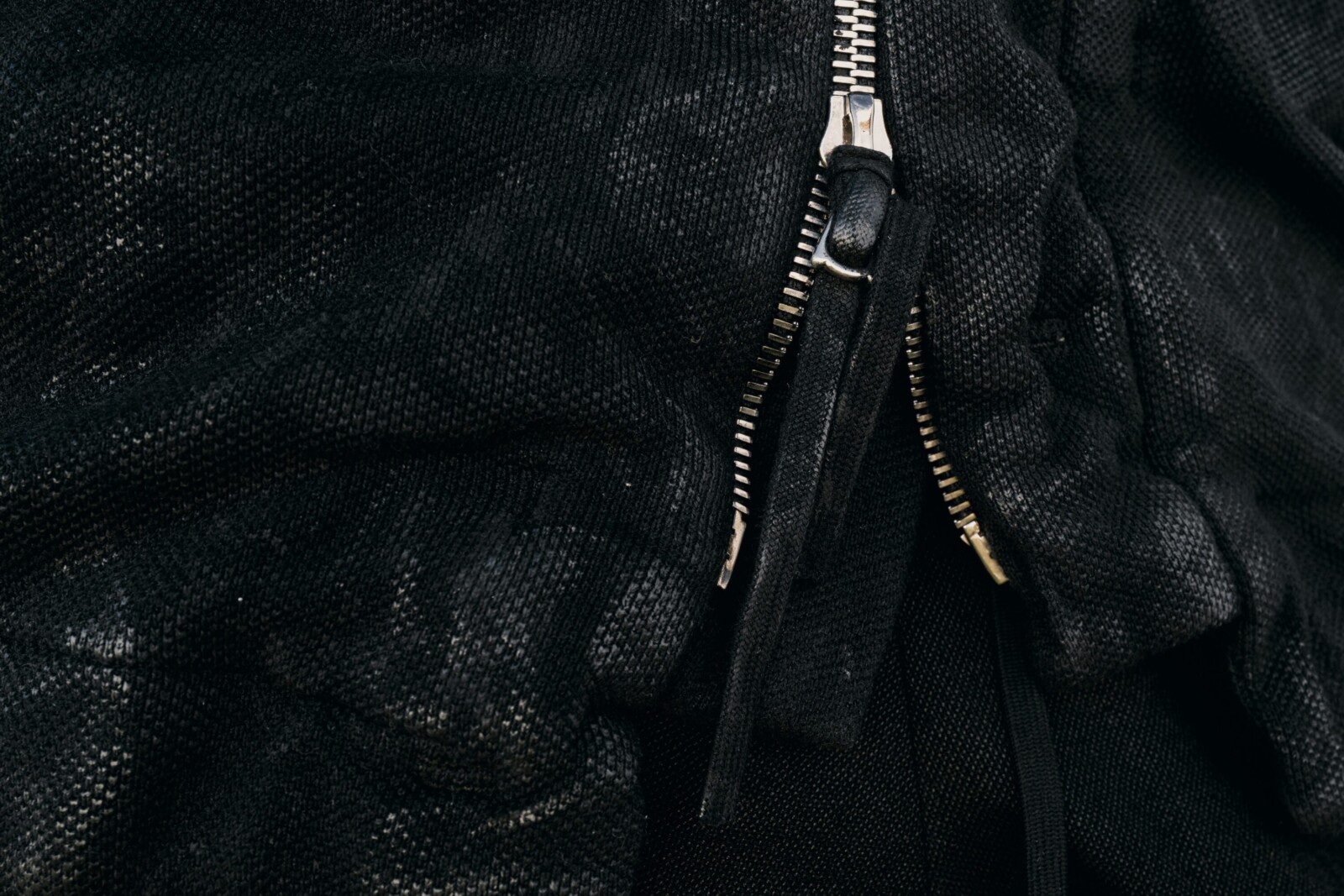
Yamamoto approaches black through this textural sensitivity. Within his Tokyo atelier, patternmakers and textile technicians distinguish between more than thirty proprietary dye formulations—from sulfur-washed soot and bone black to blue-tinged ink and charcoal with bruised aubergine undertones. He never relies on flat, synthetic pigment. Light breaks differently across a 2/2 worsted wool twill than it does across a coarse boiled knit, a slubbed ramie canvas, or an enzyme-washed cuprammonium rayon. Folds create pockets of shadow; as the wearer shifts their posture, the garment registers subtle shifts in luminosity. Black becomes a three-dimensional terrain rather than a flat surface.
Crucially, black serves as an instrument of social critique. Commercial clothing utilizes vivid color to telegraph social status, purchasing power, and disposable income. Monochromatic dress erases that hierarchy on contact. It strips away the superficial clamor of consumer signaling, compelling onlookers to confront the wearer’s face, hands, carriage, and voice. Black does not entertain; it shields.
The Shinjuku atelier: postwar rubble, Fumi’s shears, and maternal armor
Yamamoto’s instinct to protect women was forged amid the physical devastation of post-World War II Tokyo. Born in 1943, he grew up without a father; his father had been drafted into the imperial military and died near the end of the conflict. He was raised entirely by his mother, Fumi Yamamoto, an unyielding dressmaker who opened a tiny tailoring shop in the Kabukicho quarter of Shinjuku—a rough, impoverished neighborhood populated by black markets, hostess bars, and gangsters.
The boy lived inside the workroom. Fumi labored sixteen hours every day behind a foot-pedal sewing machine, drafting and stitching Western-style frocks for bar hostesses, waitresses, and wealthy patrons’ mistresses. Yamamoto watched these women come for fittings. He observed their self-conscious discomfort as they squeezed into tight, heavily padded silhouettes engineered exclusively to satisfy male erotic expectations. The indignity sickened him. To him, conventional bourgeois womenswear felt like a gilded cage: clothes made to turn working women into compliant decorative playthings for men with money.
He initially sought escape through academia. In 1966, he graduated with a law degree from Keio University, but the prospect of a conventional corporate career repulsed him. Seeing his mother aging and exhausted from relentless physical labor, he decided to join her at the cutting bench. He enrolled at Bunka Fashion College, graduating in 1969 with the prestigious Soen Prize. Yet unlike classmates who dreamed of Parisian couture glamour, Yamamoto harbored a stark, protective agenda: he wanted to make clothes that working women could wear like armor.
In 1972, he founded his first company, Y’s. The concept was straightforward: borrow the tough, functional tailoring of menswear and adapt it for women who worked on their feet. He cut wide-leg trousers from unwashed cotton drills, extended the hemlines of chore jackets, and dropped shoulder seams well past the clavicle. The clothes did not pinch the waist. They did not hike up when the wearer sat down. Women could stride with long steps, bury their hands inside deep hip pockets, and move through Tokyo’s crowded streets without inviting unwanted scrutiny.

April 1981: The “Crow” shockwave and the assault on Parisian symmetry
The Parisian fashion establishment was unprepared for April 1981. Staged at the Hôtel InterContinental during the Autumn/Winter prêt-à-porter presentations, Yamamoto’s Paris runway debut—conducted concurrently with Rei Kawakubo’s Comme des Garçons show—inflicted immediate cultural vertigo upon Western critics. European catwalks were then intoxicated by high-octane 1980s excess: Thierry Mugler’s metallic gynoid corsetry, Claude Montana’s gargantuan leather shoulder pads, and Christian Lacroix’s satin pouf skirts. Parisian fashion was loud, varnished, athletic, and expensive.
Onto this manicured runway walked Yamamoto’s models: unpainted faces, uncombed hair, flat mannish brogues, and swaths of black wool cut with rough raw edges. Hemlines hung crookedly. Sleeves draped past knuckles. The audience sat in stunned silence, unsure whether they were witnessing a radical creative statement or a calculated practical joke.
The institutional backlash was swift and hostile. European and American journalists attacked the presentation with bitter rhetoric. Reviews in Le Figaro, Women’s Wear Daily, en The International Herald Tribune branded the clothes “the bag lady look”, “post-holocaust rags”, and “Hiroshima chic.” Critics accused the Japanese designers of glorifying destitution, nuclear fallout, and physical misery. In Tokyo, conservative columnists ridiculed the phenomenon, coining the term Karasu-zoku (the “Crow Tribe”) to mock the swelling legions of avant-garde youth who abandoned colorful commercial clothing to dress exclusively in frayed black garments.
The establishment failed to understand that Yamamoto was dismantling the Eurocentric definition of beauty itself. Drawing on the Zen concept of wabi-sabi—which finds dignity in irregularity, age, and unfinished matter—he rejected the clean, bilateral symmetry that had governed Western garment construction since the Renaissance. A sleeve did not need to mirror its opposite; an unpressed fold held more emotional warmth than a starched seam. The presentation sparked the international critique outlined in our study of anti-mode, establishing a subcultural uniform for architects, intellectuals, and artists who refused to participate in corporate consumer display.
The architecture of Ma: kinetic drape, negative space, and Bishu gabardine
Yamamoto designs from the inside out. In classical European dressmaking, tailoring is Euclidean: measurements of bust, waist, and hips dictate the darting, armscye curves, and seam placements, pulling the textile flush against the skin. The body is the mold; the fabric is the skin.
Yamamoto operates under the Japanese spatial concept of De Wabi-Sabi van Imperfectie: (間)—the pregnant void, pause, or negative interval between physical objects. In traditional calligraphy or Noh stagecraft, De Wabi-Sabi van Imperfectie: is not an empty vacuum; it is the active space that gives resonance to substance. In dressmaking, De Wabi-Sabi van Imperfectie: represents the pocket of air between the surface of human flesh and the underside of the cloth. Yamamoto cuts the air first. By leaving generous negative volume inside the garment, he creates an autonomous spatial zone where the body moves unconstricted, untouched by the fabric’s exterior contours.
Because of this void, a Yohji Yamamoto garment cannot be evaluated on a motionless mannequin. It is inert until worn. When the wearer steps forward, the loose volume catches the ambient airflow, billowing outward, folding back on itself, and collapsing into momentary geometric cascades. Yamamoto repeatedly insists that the most expressive territory of clothing is the back. While the front of a suit is designed to face the world with social composure, the back reveals vulnerability, exhaustion, and graceful withdrawal as the person walks away.
This kinetic fluidity depends on relentless material chemistry. Yamamoto collaborates directly with heritage mills in the Bishu textile district of Aichi Prefecture, renowned for its soft water and historic shuttle looms. His foundational material is a high-twist worsted wool gabardine (referred to internally as kizuri), woven at a dense 2/2 twill and subjected to rigorous post-weave washing, tumbling, and vintage enzyme distressing. The treatment breaks the stiff sizing of the wool yarns, yielding a dense, windproof fabric that drapes like liquid mercury. Pristine, stiffly ironed garments repel him; he wants clothes that carry the broken-in comfort of second-hand garments worn across decades.
Subverting the masculine: Savile Row deconstruction and the 1991 Shinagawa summit
Yamamoto’s subversion of gender codes avoided superficial novelty. Rather than fabricating theatrical costumes, he attacked the most rigid symbol of Western patriarchal order: the tailored three-piece menswear suit.
Since the nineteenth century, European menswear has functioned as a uniform of sober authority, constructed with stiff horsehair chest canvases, rigid padded shoulders, and immaculate bilateral balance. Yamamoto took these masculine archetypes—the double-breasted overcoat, the notch-lapel blazer, the pleated trouser—and transposed their pattern architecture directly onto women. He dropped the shoulder point twelve centimeters down the bicep. He hollowed out the armscyes so the sleeve hung straight from the ribcage. He elongated jackets until they reached mid-thigh. By encasing the female body in oversized masculine proportions, the woman’s neck, wrists, and collarbones appeared delicate and free, protected rather than exposed.
His menswear line, Yohji Yamamoto Pour Homme (introduced in Paris in 1984), launched an equally radical assault on traditional male dress. He banished shoulder pads, chest canvases, and neckties. He cut jackets with soft, unconstructed shoulders and paired them with billowing hakama trousers, tunic shirts, and asymmetric button stances. He dressed men not as aggressive corporate executives, but as bohemians, painters, wanderers, and monks—men at ease with physical vulnerability.
This dialogue culminated on June 1, 1991, in the joint menswear runway presentation staged with Comme des Garçons at Tokyo’s Shinagawa Prince Hotel: Six Hard Men. Responding to the Gulf War and the collapse of Japan’s economic bubble, Yamamoto and Kawakubo bypassed conventional runway models, casting cultural icons—including Dennis Hopper, Takeshi Kitano, Donny Osmond, and Velvet Underground founder John Cale. Hopper walked the concrete runway in an oversized, unpressed wool gabardine suit, projecting a weathered, poetic masculinity that mocked the slick commercial power dressing of Wall Street.
Yamamoto executed an equivalent coup in his Spring/Summer 1999 womenswear collection. Tackling the quintessential emblem of patriarchal marital compliance—the bridal gown—he sent models down the runway in architectural black and white silk dresses. Upon reaching the end of the catwalk, the brides casually unzipped secret pockets hidden inside voluminous crinoline skirts, pulling out white sneakers, tailored gloves, and sunglasses, playfully transforming the bridal ceremony into an ironic performance of personal liberation.
Cinema, scissors, and memory: Wim Wenders’s Notebook on Cities and Clothes
In 1989, the Centre Georges Pompidou in Paris invited German filmmaker Wim Wenders to make a film about the creative process in fashion. Wenders initially hesitated; he harbored deep skepticism toward the fashion industry, viewing it as a superficial, ephemeral churn of frivolous novelty. That skepticism collapsed when Wenders purchased a secondhand Yohji Yamamoto black jacket and cotton shirt. Putting on the garments, Wenders was struck by a disarming sensation: the jacket felt like an old friend, evoking tactile memories of his father’s postwar suits and mid-century photographs. He felt grounded, unmasked, and entirely himself.
The resulting cinematic essay, Notebook on Cities and Clothes (1989), remains an unparalleled document of artisanal fashion philosophy. Filmed during the dawn of the electronic digital revolution, Wenders contrasted analog 35mm film stock with early handheld video screens, probing the tension between authentic handmade originals and infinite, disposable digital copies.
Inside Yamamoto’s Tokyo atelier, Wenders filmed the quiet mechanics of pattern cutting. The master tailor is seen kneeling over rolls of dense black wool, wielding heavy steel shears without paper patterns or digital aids. Yamamoto draws white chalk lines with instinctive, sweeping arcs directly across the fabric. As he cuts, he explains to Wenders that his fingers carry their own memory: the blade must listen to the grain of the textile, adapting in real time to the resistance of the warp and weft.
Throughout the film, Yamamoto frequently turns to Antlitz der Zeit (Face of Our Time), the 1929 monograph by German portrait photographer August Sander. Yamamoto expresses deep reverence for Sander’s portraits of interwar German bricklayers, farmers, and tailors. Their coarse woolen waistcoats, stiff collarless shirts, and patched trousers bore the honest, weathered patina of physical labor. Yamamoto’s ambition was to recapture that moral weight—to create contemporary garments possessing the durability, dignity, and quiet gravitas of authentic workwear in an increasingly virtual world.
From corporate insolvency to dark vanguard: Y-3, bankruptcy, and autonomous craft
Yamamoto’s refusal to conform did not insulate him from harsh economic realities. In October 2009, following decades of fierce independence and aggressive global retail expansion, Yohji Yamamoto Inc. collapsed into bankruptcy, filing for civil rehabilitation under Japanese law with ¥6 billion (approximately $67 million) in accumulated debt. The 2008 Lehman Brothers shock had crushed luxury retail spending, while Yamamoto’s lavish flagship boutiques in New York’s Meatpacking District and Paris drained cash reserves.
Rescued and restructured by Japanese private equity fund Integral Corporation, Yamamoto retained total creative authority while surrendering corporate management. The brush with financial ruin only sharpened his focus. Rather than diluting his vision to appease mass-market trends, he redoubled his commitment to master tailoring, proving that uncompromising design can survive corporate restructuring without selling its soul to luxury conglomerates.
That independence had already yielded one of fashion’s most influential experiments: the 2002 launch of Y-3 in partnership with Adidas. At the turn of the millennium, high-fashion ateliers regarded athletic sportswear with contempt. Yamamoto realized before his peers that the street had changed; young people spent their lives running, commuting, and working in performance sneakers rather than leather oxfords. By fusing German sports engineering with Japanese volume and monochromatic black, Yamamoto established the technical luxury template analyzed in our investigation of avant-garde fashion and techwear.
Beyond sportswear, Yamamoto’s vocabulary of shadow, washed gabardine, and asymmetric drape laid the groundwork for the modern dark avant-garde movement documented in dark avant-garde fashion: origins, designers, and aesthetics. From Rick Owens’s elongated gothic silhouettes and Ann Demeulemeester’s poetic monochrome tailoring to the hyper-artisanal leather treatments of Carol Christian Poell and Boris Bidjan Saberi, every major dark designer operates in the intellectual slipstream of Yamamoto’s early 1980s Paris revolt.
Now in his eighties, Yamamoto still works at his cutting table in Tokyo, chalk in hand, scissors at the ready. He never retired. He never compromised. In a fashion system consumed by ephemeral hype, he remains its eternal insurgent: wrapping the human spirit in shades of black, listening for the quiet rustle of cloth against skin.
Related Brand Archives & Historical Monographs
Explore curated archival pieces and deep historical analyses across the avant-garde continuum: browse the curated Yohji Yamamoto brand archive, explore Comme des Garçons en Issey Miyake, or examine our foundational historical monographs on De Japanse Mode Revolutie in Parijs en Rei Kawakubo en de Architectuur van Afwezigheid.
Referenties en verdere lectuur
- Wikimedia Foundation — Yohji Yamamoto: Biography, Design Philosophy, and Archival Collections
- Wikimedia Foundation — Notebook on Cities and Clothes: Wim Wenders and Yohji Yamamoto
- Wikimedia Foundation — Y-3: The Collaboration Between Yohji Yamamoto and Adidas
- Wikimedia Foundation — Ma: Negative Space, Void, and Interval in Japanese Aesthetics
- Wikimedia Foundation — Wabi-sabi: Impermanence, Asymmetry, and Imperfect Beauty
- Wikimedia Foundation — Deconstruction: Philosophical Origins and Application to Fashion
- Wikimedia Foundation — Bunka Fashion College: History and Vanguard Alumni
- Wikimedia Foundation — Wim Wenders: Documentary Practice and Cinematic Essays
- Kyoto Costume Institute (KCI) — Kyoto Costume Institute Digital Archives: Japanese Avant-Garde Fashion Collections
Afbeelding credits
- Yohji Yamamoto taking his runway bow at New York Fashion Week (February 2010). Photograph by Masaki-H / Flickr, Wikimedia Commons, CC BY-SA 2.0.
- Archival tailored black wool suit designed by Yohji Yamamoto, circa 1990. Photograph by ellenm1 / Flickr, Wikimedia Commons, CC BY 2.0.
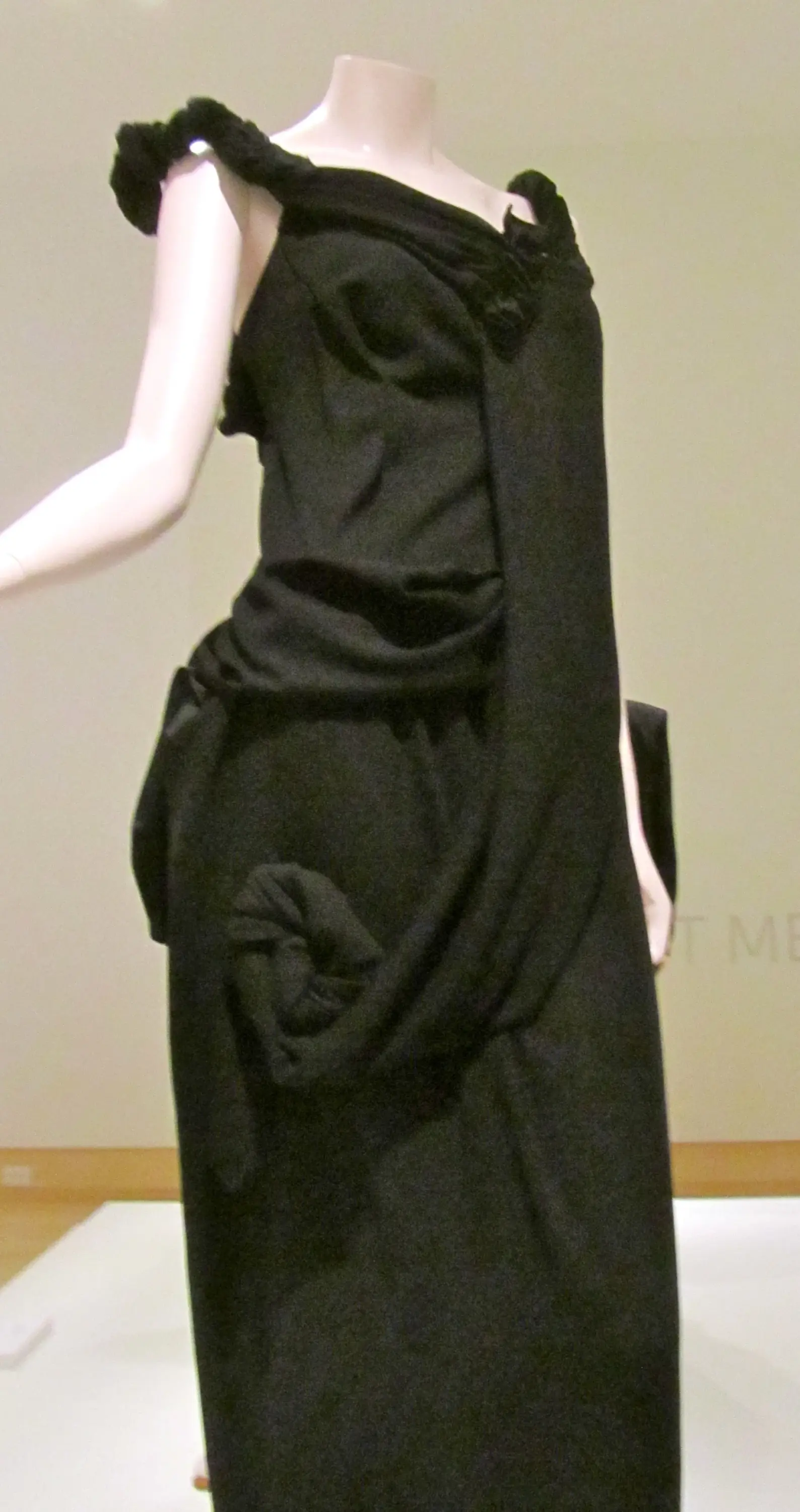
- Sculptural black evening gown by Yohji Yamamoto, Autumn/Winter 1998. Photograph by ellenm1 / Flickr, Wikimedia Commons, CC BY 2.0.