0
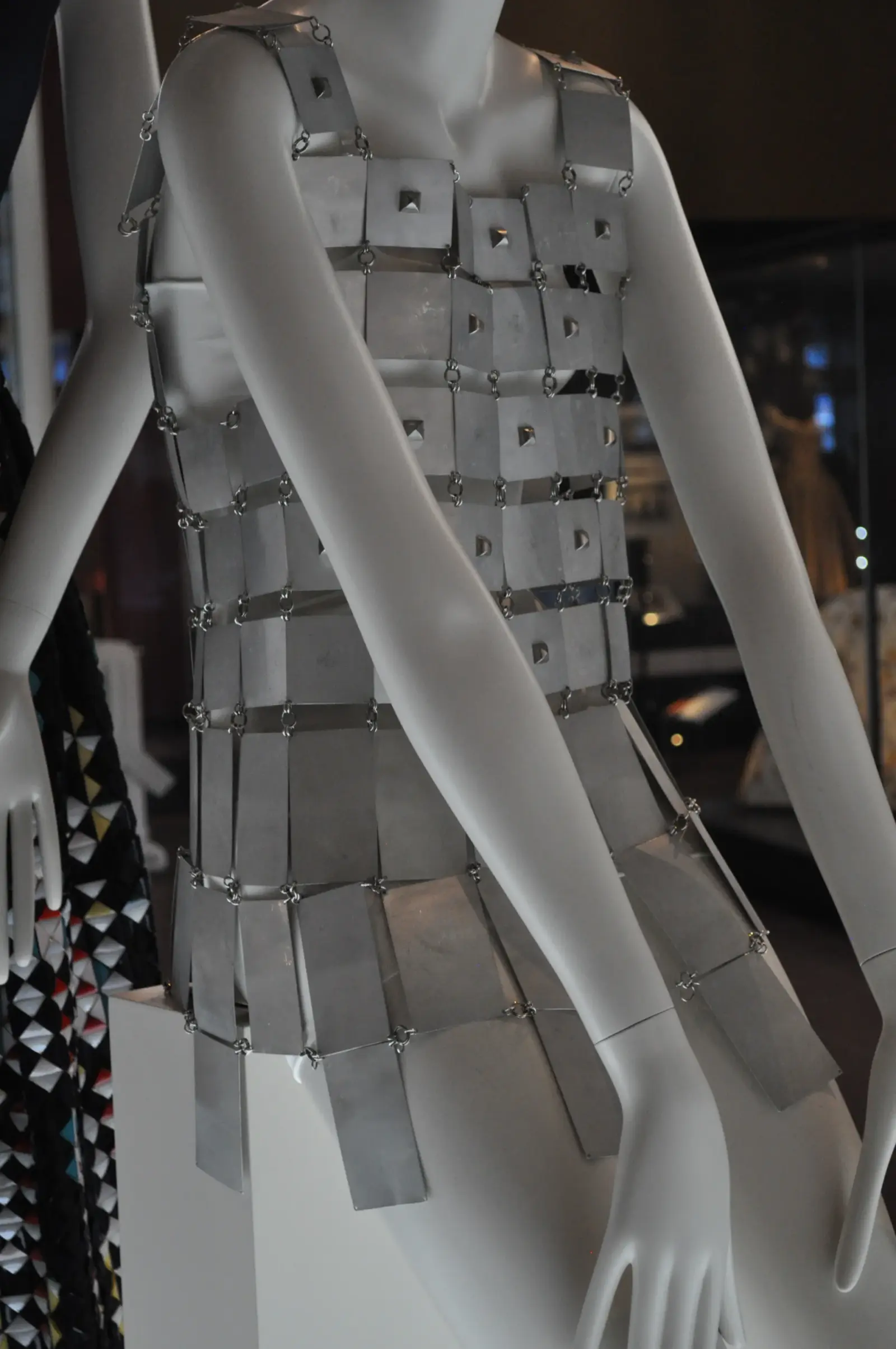
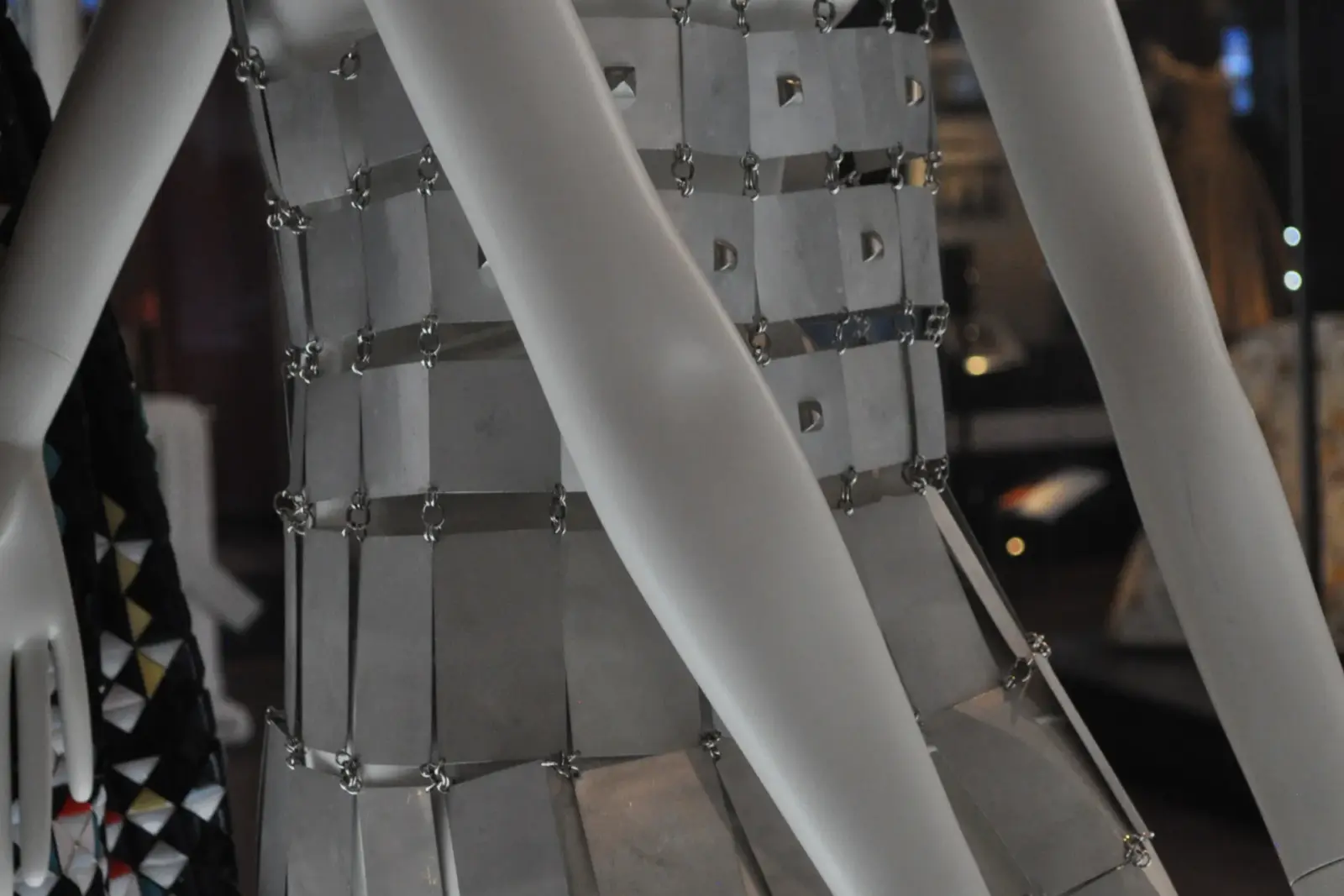
帕科·拉巴纳1967年无袖长袍,由链条连接的矩形铝板和电线制成,展出于苏格兰国家博物馆
Paco Rabanne, Tunic, Paris, 1967. Chain-linked aluminum plates and metal wire. Permanent collection of the National Museum of Scotland, Edinburgh. CC0 Public Domain Dedication. Constructed without needle or thread, this chainmail-inspired garment materialized Rabanne’s provocative manifesto of "12 Unwearable Dresses in Contemporary Materials," turning clothing into kinetic, modular architectural armor.
动作

1960年代的太空时代时尚

发布 9 月 18, 2026 最后审查 9 月 21, 2026

In the 1960s, the Apollo moonshot and atomic-age techno-optimism shattered the polite salon traditions of European couture. Led by a radical Parisian triumvirate—André Courrèges, Pierre Cardin, and Paco Rabanne—Space-Age fashion discarded silk thread, boning, and decorative embroidery in favor of vinyl, Rhodoid plastic discs, thermoformed synthetic fibers, and chain-linked aluminum plates. By re-engineering clothing as kinetic industrial armor for an egalitarian, interstellar future, the Space-Age movement established the technical and material vanguard that continues to inspire modern avant-garde and techwear design.

The geopolitical countdown: Apollo, Sputnik, and the future body

Between Yuri Gagarin’s orbital flight in 1961 and the Apollo 11 lunar landing in 1969, human imagination escaped gravitational orbit. The Space Race was not merely a military and technological contest between superpowers; it was a profound cultural rupture that rendered the historical traditions of European civilization instantly obsolete. In Paris, where haute couture had spent decades catering to an aging bourgeois elite, the sudden focus on rocketry, lunar probes, and telecommunications created an ideological crisis.

Why should modern women dress in silk brocades, floral chiffons, and 19th-century corsetry when humanity was preparing to walk on the moon? A youthful, revolutionary generation rejected the heavy emotional baggage of postwar Europe, demanding clothing that mirrored the speed, lightness, and scientific optimism of the coming millennium.

From this tectonic shift emerged Space-Age Fashion. Spearheaded by three visionary Parisian figures—André Courrèges, Pierre Cardin, and Paco Rabanne—the movement transformed fashion from an artisanal trade of decorative tailoring into an industrial discipline of geometric architecture, polymer chemistry, and kinetic protection.

André Courrèges: the engineer of the Moon Girl

The philosophical architect of Space-Age fashion was André Courrèges. Having spent a decade working as the master tailor and right hand to Cristóbal Balenciaga, Courrèges inherited an absolute mastery of pattern cutting, fabric grain, and tectonic structure. In 1961, he opened his own couture house, and in his historic Spring 1964 “Space Age” collection, Courrèges dismantled Parisian couture from within.

Courrèges discarded the high-heeled pump, the indented waist, the bustier, and the decorative floral print. In their place, he engineered the iconic “Moon Girl” silhouette: crisp, architectural A-line mini-dresses, pristine white double-faced wool coats, and flat, square-toed calf-high boots made from gleaming white vinyl with cut-out portholes. He replaced hats with sleek helmet bonnets and sunglasses with slitted white plastic goggles inspired by Inuit snow goggles.

Courrèges’ garments were constructed like modernist buildings. Seams were not concealed within linings; they were outlined with bold contrasting piping that accentuated the structural framework of the body. Color was reduced to blinding lunar whites, optical silver, and saturated accents of primary yellow, orange, and lime green. Most radically, Courrèges championed the trouser suit for women in couture, insisting that modern women required total physical mobility to drive automobiles, board passenger jets, and run without anatomical impediment.

Paco Rabanne 1967 sleeveless tunic constructed from chain-linked rectangular aluminum plates and wire at the National Museum of Scotland
Paco Rabanne, Tunic, Paris, 1967. Chain-linked aluminum plates and metal wire. Permanent collection of the National Museum of Scotland, Edinburgh. CC0 Public Domain Dedication. Constructed without needle or thread, this chainmail-inspired garment materialized Rabanne’s provocative manifesto of "12 Unwearable Dresses in Contemporary Materials," turning clothing into kinetic, modular architectural armor.

Pierre Cardin: cosmocorps, geometric voids, and thermoformed plastics

While Courrèges engineered structural tailoring for earthly movement, Pierre Cardin envisioned a total cosmic civilization. A former student of architecture who had tailored Christian Dior’s 1947 Bar suit, Cardin possessed an obsessive fascination with non-representational geometry—circles, spheres, targets, cones, and cylinders.

In 1964, Cardin unveiled his “Cosmocorps” collection, establishing a radical unisex aesthetic that eliminated traditional gender distinctions. Male and female models walked the runway in streamlined tunics, ribbed astronaut tights, tabard overlays, and collarless jackets that completely obscured the anatomical waist. Cardin treated the human body as a living cylinder inside which geometric apertures—circular cut-outs exposing the hip, the midriff, or the clavicle—served as architectural portholes into the flesh.

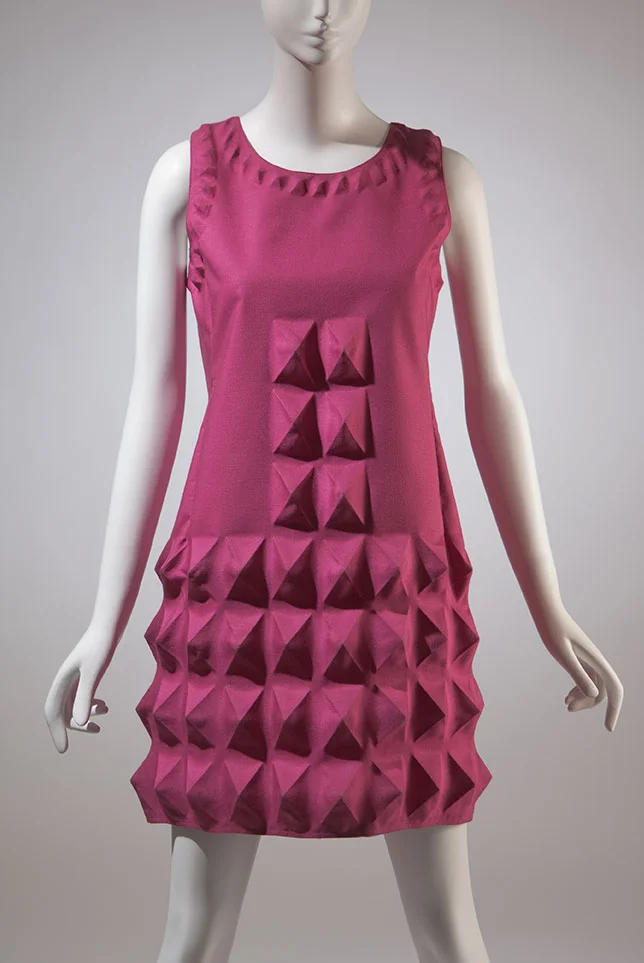
Pierre Cardin 1968 pink heat-moulded Dynel Cardine dress with geometric circular 3D chest molding from the collection of Lauren Bacall at The Museum at FIT
Pierre Cardin, Shift Dress, 1968. Pink heat-molded "Cardine" synthetic Dynel fiber. Gift of Lauren Bacall to The Museum at FIT (Acc. # 70.62.1). Photograph by Eileen Costa, CC BY-SA 2.0. Cardin invented Cardine—a proprietary non-woven polymer bonded under high-frequency heat—to emboss permanent three-dimensional geometric discs directly into the garment without seams or stitching.

Paco Rabanne and the manifesto of unwearable metal

If Courrèges was the engineer and Cardin the cosmic architect, Paco Rabanne (born Francisco Rabaneda y Cuervo) was the radical metallurgical saboteur. Trained as an architect at the École Nationale Supérieure des Beaux-Arts in Paris, Rabanne spent the early 1960s designing experimental plastic jewelry for Balenciaga, Givenchy, and Dior. In February 1966, he rocked the fashion world by presenting his debut collection at the Hotel George V in Paris, provocatively titled: “Manifesto: 12 Unwearable Dresses in Contemporary Materials.”

The models walked barefoot on the carpet to the metallic soundtrack of Pierre Boulez, wearing shift dresses made entirely without thread, needles, sewing machines, or fabric. Instead, Rabanne used pliers, soldering irons, and wire cutters to link together hundreds of iridescent Rhodoid plastic discs, polished aluminum plates, leather squares, and steel chain links with brass jump rings.

Coco Chanel dismissively dubbed Rabanne “the metal worker,” but the title was a badge of honour. Rabanne’s garments functioned as kinetic shields. As the wearer walked, the metal tiles clinked, reflected room lighting like a disco sphere, and modulated around the joints like medieval chainmail. His designs were celebrated as wearable armor for an emancipated woman who no longer required male protection—an aesthetic crystallized in his costumes for Jane Fonda in the 1968 cult science-fiction film Barbarella.

Vinyl, Perspex, and Rhodoid: abolishing the needle and thread

The true radicalism of 1960s Space-Age fashion lay in its total rejection of traditional textile hierarchies. For centuries, couture had measured luxury through hand-woven silks, rare furs, and delicate laces. The Space-Age designers replaced these bourgeois natural fibers with the products of petrochemistry and modern industrial factories:

  • Glossy Polyvinyl Chloride (PVC): High-shine, waterproof vinyl coats and boots that transformed clothing into an impermeable, reflective technological barrier.
  • Thermoformed Synthetics (Cardine): In 1968, Pierre Cardin introduced Cardine, a proprietary non-woven polymer created from Dynel synthetic fiber. Using high-frequency electrical heat molds, Cardin pressed three-dimensional concentric circles and geometric reliefs directly into the garment, creating structural forms that could never lose their shape or crease.
  • Rhodoid Plastic Discs: Cellulose acetate tiles punched in precise circular and rectangular geometries, allowing modular garment repair: if a disc broke, it could be replaced with a single ring without unraveling a seam.
  • Industrial Hardware: Exposed chrome zippers, vacuum-formed plastic helmets, leather-bound seatbelt webbing, and metallic snap-closures replaced ornamental mother-of-pearl buttons.

This material shift democratized avant-garde thinking. While haute couture had historically been an exclusive craft of slow handwork, synthetic polymers could theoretically be mass-produced, heat-sealed, and molded at scale, promising an industrial future where clothing was cheap, hygienic, and universally accessible.

The Space-Age blueprint in contemporary avant-garde and techwear

The retro-futuristic optimism of the 1960s eventually waned in the early 1970s amid the oil crisis, environmental consciousness, and the rise of raw, distressed anti-fashion. Yet the structural principles pioneered by Courrèges, Cardin, and Rabanne left an indelible mark on the avant-garde imagination, providing the fundamental technical vocabulary for modern conceptual fashion and techwear.

The metallic articulation and armor-like construction of Paco Rabanne lives on directly in the high-tensile hardware, articulated knee panels, and magnetic Fidlock buckles of modern technical darkwear. Designers like Errolson Hugh at Acronym and Boris Bidjan Saberi treat clothing as an engineered exoskeleton: waterproof seam-taped laminates, articulated gussets, and high-tenacity polymers engineered to protect the human body from hostile urban climates—a direct terrestrial continuation of the Space-Age astronaut suit.

Junya Watanabe continuously resurrects Space-Age synthetic rigor, engineering polyurethane honeycombs, geometric vinyl capes, and architectural bonded jackets that recall Courrèges’ geometric purity. Similarly, 艾瑞斯·范·赫本 utilizes 3D-printing polymers, magnetic grown textiles, and thermoformed resin ribs to sculpt ethereal garments that transcend weaving entirely, fulfilling Cardin’s dream of clothing as pure seamless industrial sculpture.

The Space-Age experiment permanently proved that clothing is not bound to the organic loom or seasonal nostalgia. By daring to build dress from aluminum, wire, vinyl, and heat, the 1960s avant-garde established that the future of fashion belongs to the engineers of radical material innovation.

Continue exploring the history of radical fashion in 战后现代主义与实验服装, contrast techno-optimism with the subversive rage of 达达、荒诞与反时尚, and investigate movement definitions in 开始,以获得精确的定义,然后使用.

参考资料和进一步阅读

图片来源

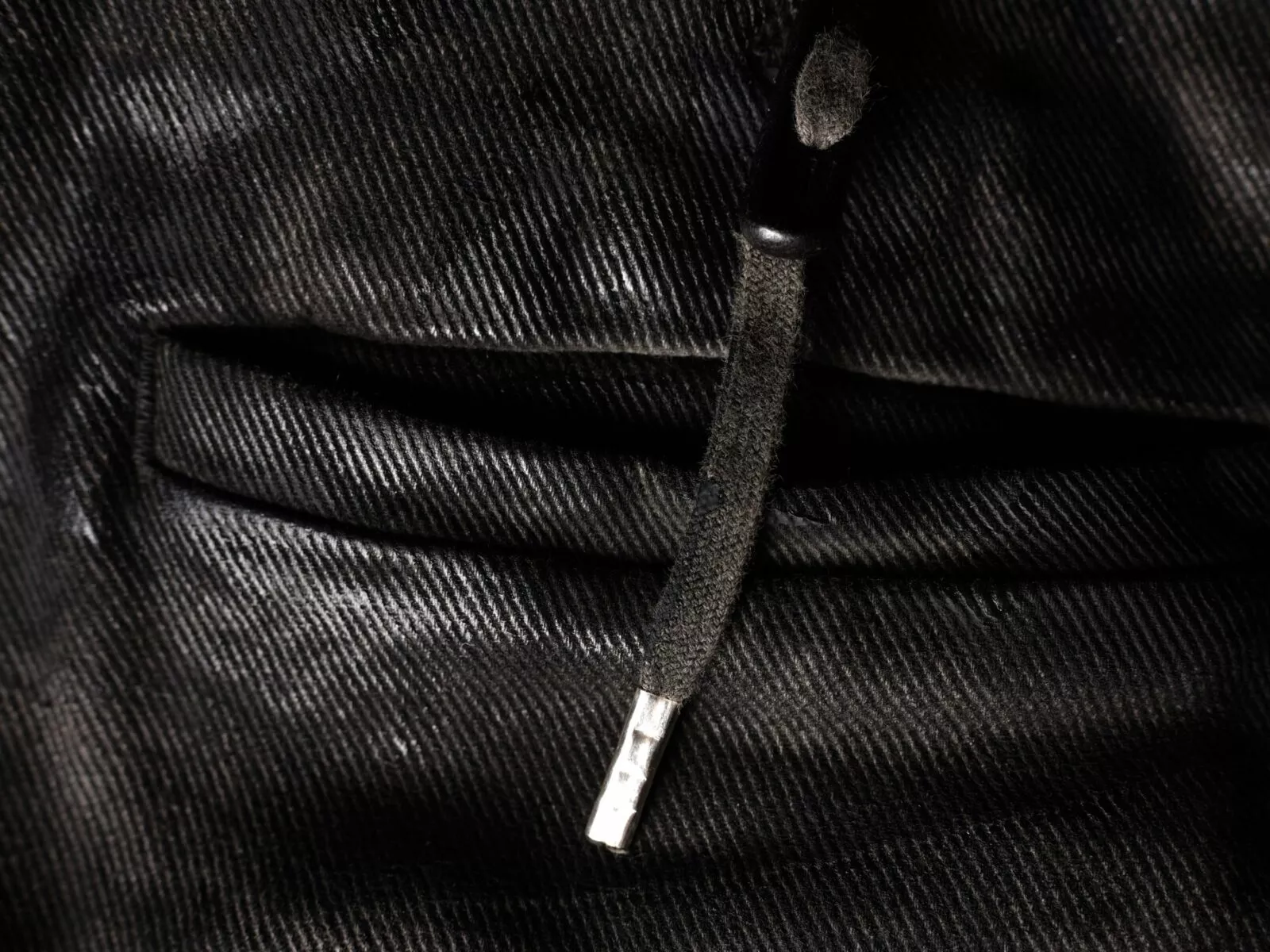
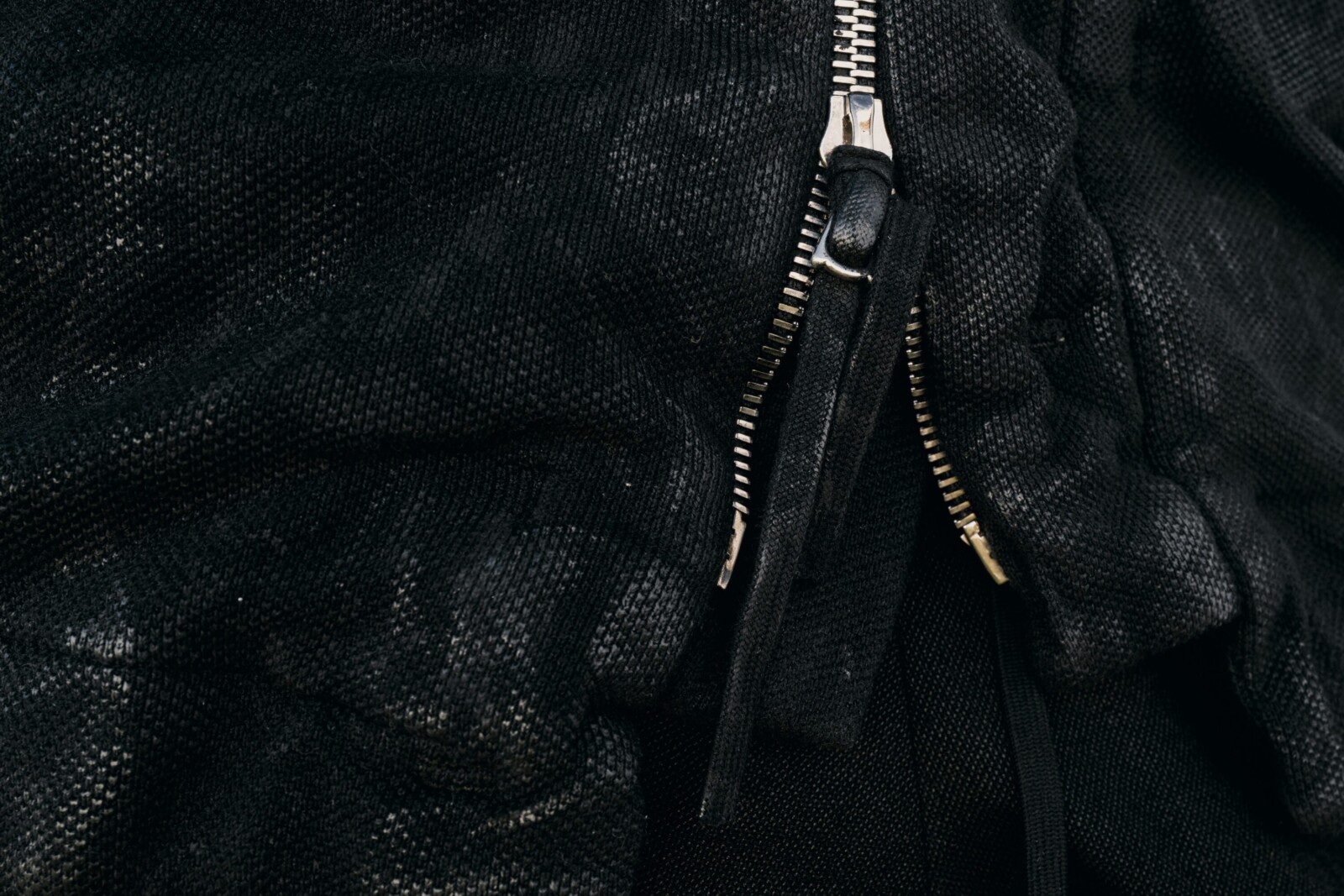
Boris Bidjan Saberi P23 裤子 P34 涂层蜡质细节

注册 - 享受我们的福利

  • 保存你喜欢的品牌和店铺
  • 获取你喜欢品牌的新款和独家产品通知
  • 专享优惠券码和折扣

加入我们

订阅我们的独家邮件列表,接收通知 当我们推出新品牌或店铺时获取信息,当我们 发布新的精选产品时, 并接收 独家促销优惠,直接发送到你的邮箱。

品牌

    门店

      文章

        产品

          精选产品

            知识库

              Boris Bidjan Saberi P23 裤子 P34 涂层蜡质细节

              注册 - 享受我们的福利

              • 保存你喜欢的品牌和店铺
              • 获取你喜欢品牌的新款和独家产品通知
              • 专享优惠券码和折扣