0
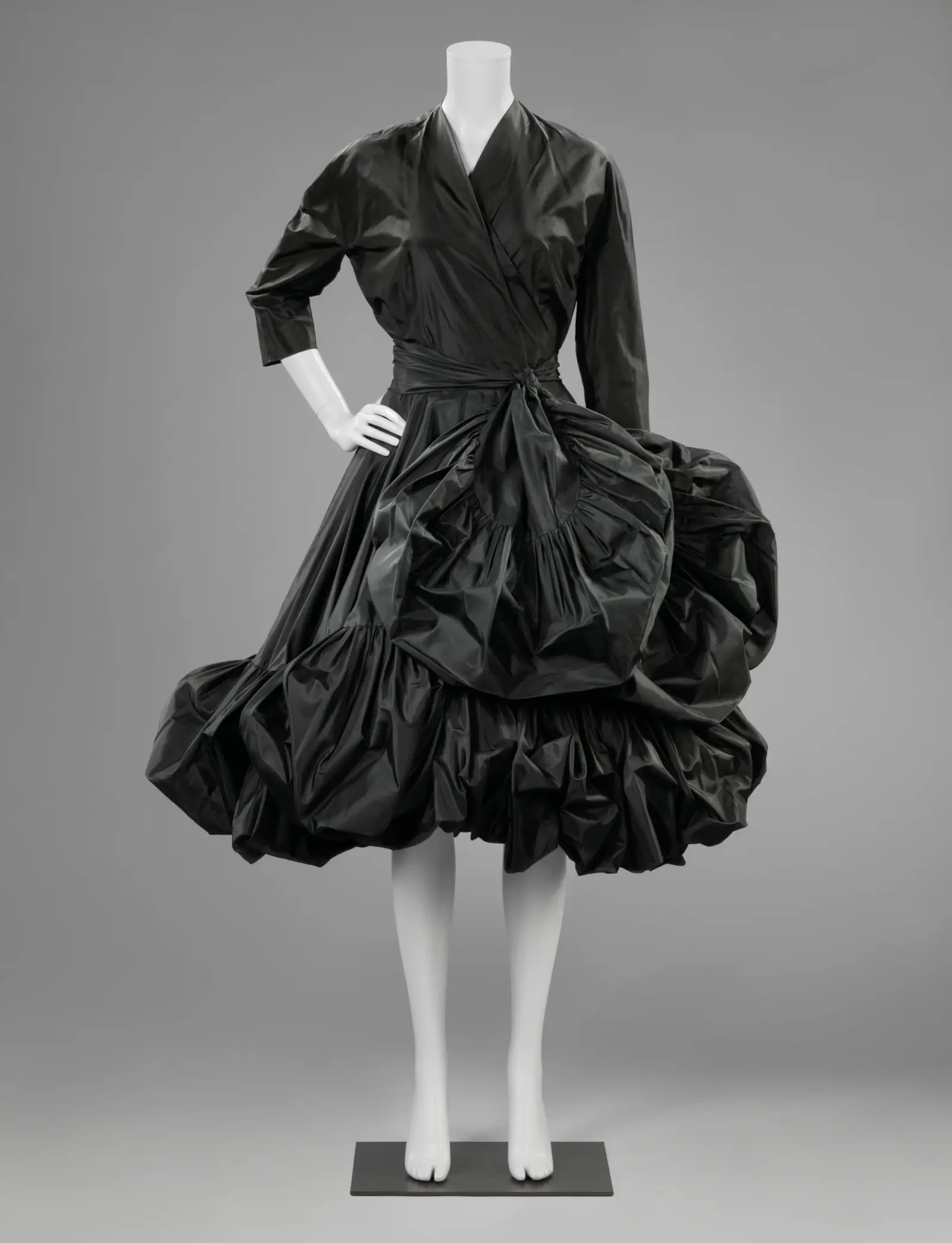
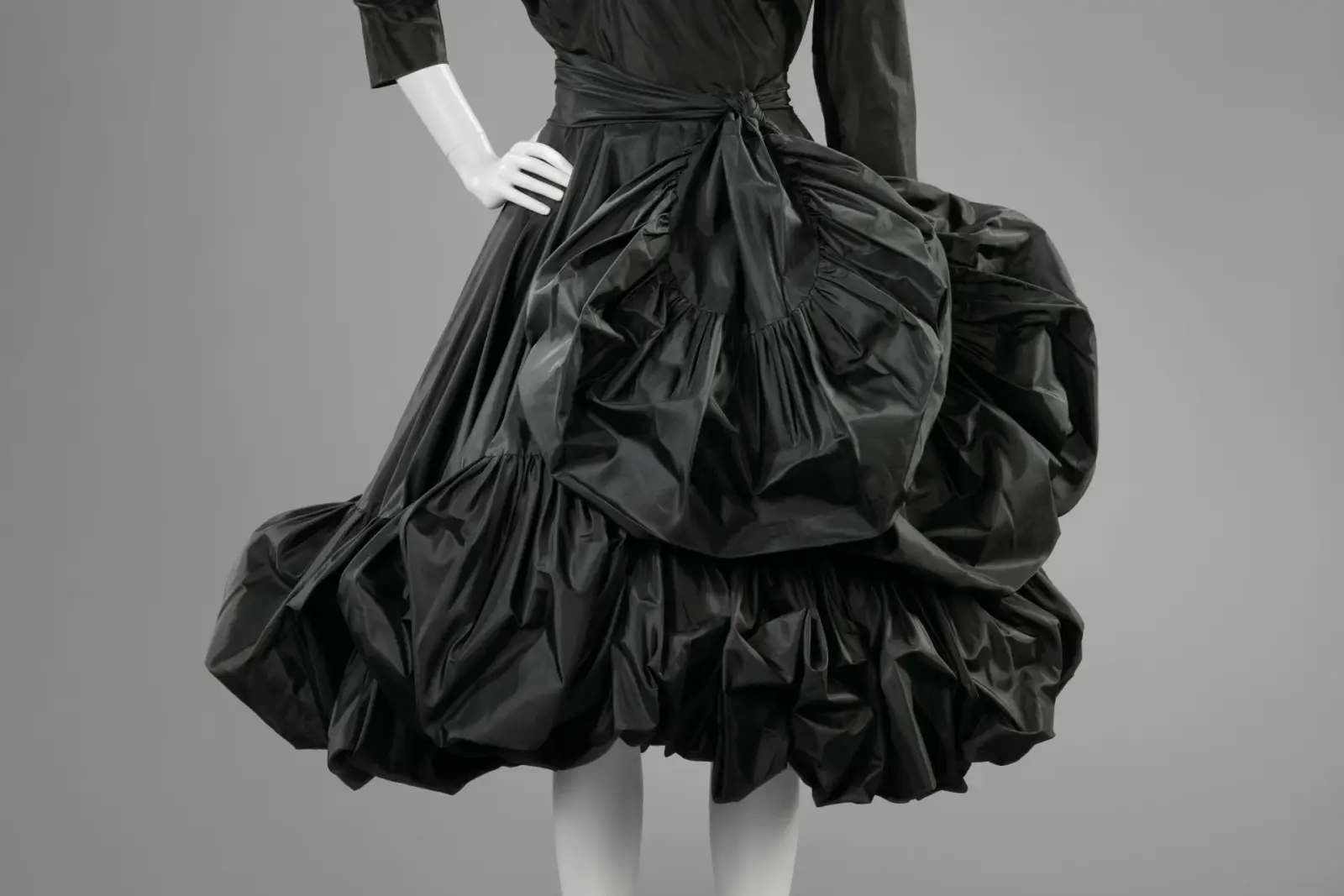
克里斯托巴尔·巴伦西亚加1951年建筑风格黑色塔夫绸鸡尾酒裙,带有悬臂气泡裙摆和结构化背部垂坠,阿姆斯特丹国立博物馆
Cristóbal Balenciaga, Cocktail Gown, 1951. Black silk taffeta. Collection of the Rijksmuseum, Amsterdam (Object # BK-1986-58). Public Domain, Open Access. Created during the pivotal moment Balenciaga broke with postwar corsetry, this architectural gown suspends sculptural volume away from the torso, demonstrating his radical mastery of tectonic fabric tension.
历史

战后现代主义与实验服装

发布 9 月 18, 2026 最后审查 9 月 21, 2026

Following the devastation of the Second World War, fashion split between nostalgic escapism and radical architectural modernism. While Christian Dior’s 1947 “New Look” reinstated 19th-century corsetry, boned corsets, and padded hips, vanguard couturiers led by Cristóbal Balenciaga, Charles James, and Claire McCardell engineered a profound counter-revolution. By liberating the torso from bourgeois constriction, mobilizing heavy architectural silks, and eliminating superfluous seams, postwar experimental dress transformed clothing from decorative ornamentation into an autonomous, three-dimensional discipline that established the modern avant-garde silhouette.

The postwar ideological fracture: retroversion versus abstraction

The conclusion of the Second World War in 1945 left Europe physically shattered, financially depleted, and culturally disoriented. The fashion system, centered on the historic ateliers of Paris, faced an existential crossroads. In February 1947, Christian Dior unveiled his debut haute couture collection, baptized by Carmel Snow as the “New Look.” Dior’s aesthetic was a deliberate, nostalgic retreat into the luxurious security of the 19th century: tiny pinched waists, boned corselets, heavily padded hips, and sweeping ankle-length skirts requiring up to twenty meters of fabric.

While the New Look was celebrated as a joyful resurrection of Parisian feminine opulence following years of wartime austerity and rationing, modernists and progressive designers viewed it with deep dismay. To enforce an hourglass silhouette through rigid internal boning and physical compression was, in essence, to reconstruct the patriarchal anatomical cage that early 20th-century avant-gardists had fought so fiercely to dismantle.

In opposition to Dior’s retrospective historicism, a vanguard of radical designers pursued an entirely different path: postwar modernism. Rather than forcing the female body back into an artificial Belle Époque template, they approached garment design as an autonomous spatial, engineering, and architectural discipline. The body was no longer treated as a corset mannequin to be cinched, but as an active kinetic center around which three-dimensional sculptural planes could float with total physical freedom.

Cristóbal Balenciaga: the architect of haute couture

At the apex of this architectural modernism stood the Basque master Cristóbal Balenciaga. While his contemporaries draped fabric instinctively or drew fashion illustrations to be interpreted by premier tailors, Balenciaga was a consummate technical patternmaker who understood every stress point, bias grain, and seam allowance. Christian Dior famously called him “the master of us all,” while Gabrielle Chanel conceded that Balenciaga alone was a true couturier capable of cutting fabric, assembling a garment, and sewing it by hand.

Cristóbal Balenciaga architectural black taffeta cocktail gown with cantilevered bubble peplum and structural back drape, 1951, Rijksmuseum Amsterdam
Cristóbal Balenciaga, Cocktail Gown, 1951. Black silk taffeta. Collection of the Rijksmuseum, Amsterdam (Object # BK-1986-58). Public Domain, Open Access. Created during the pivotal moment Balenciaga broke with postwar corsetry, this architectural gown suspends sculptural volume away from the torso, demonstrating his radical mastery of tectonic fabric tension.

Beginning in the late 1940s and accelerating through the 1950s, Balenciaga launched a systematic formal assault against the conventional female silhouette. Instead of tailoring garments that hugged the skin, he introduced empty volume (what Japanese aesthetics calls ma) between the fabric and the flesh. The space within the garment became as critical as the textile shell itself.

His structural interventions followed a chronological progression of radical abstractions:

  • The Barrel Line (1947): Softly rounded shoulders and a curved, elliptical back that broadened across the shoulder blades and tapered at the hem, rejecting the rigid verticality of traditional tailoring.
  • The Semi-Fitted Suit (1951): Tailored close and fitted at the front torso, while hanging entirely straight and loose at the back, creating a dual visual reality that responded dynamically as the wearer walked.
  • The Tunic Dress (1955): A clean, two-piece rectilinear silhouette consisting of a straight, hip-length over-tunic worn over a narrow pencil underskirt, paring dress down to two intersecting rectangular planes.
  • The Sack Dress / Chemise (1957): An unbelted, waistless wool column that bypassed the bust, waist, and hips entirely, provoking outrage among fashion critics who accused Balenciaga of eliminating the female form.
  • The Baby Doll Dress (1958): A high-waisted trapeze that flared dramatically from the collarbones into a floating triangular bell of silk taffeta, giving the wearer complete anatomical detachment.
  • The Envelope Dress (1967): Constructed from folded planes of heavy gazar with minimal seams, folding around the body like an origami envelope and creating a radical quadrilateral sculpture in motion.

From the barrel line to the sack dress: liberating the waist

The introduction of the 1957 Sack Dress (la robe sac or chemise) represented a watershed moment in fashion theory. By completely eliminating the indented waistline—the ancient focal point of Western feminine dress—Balenciaga broke the erotic contract that defined women’s social value through anatomical display.

Cristóbal Balenciaga 1957 black bouclé wool chemise or sack dress at the RISD Museum
Cristóbal Balenciaga, Chemise or "Sack Dress," 1957. Black bouclé wool. Collection of the Rhode Island School of Design (RISD) Museum (Acc. # 1997.83). CC0 Public Domain Dedication. By completely eliminating the waist seam and suspending the wool in an unbroken architectural column, Balenciaga scandalized the press while defining the primary prototype of the modern abstract silhouette.

Initially greeted with mockery in the popular press—journalists joked that women looked like potatoes wrapped in burlap sacks—the silhouette was rapidly adopted by women who discovered its extraordinary ergonomic comfort and modernist dignity. The sack dress proved that a garment could command deep visual authority without clinging to the body.

Simultaneously, Balenciaga altered the framing of the face and neck. He cut collars away from the nape of the neck (the “stand-away” collar), exposing the feminine neck vertebrae and elongating the throat without necessitating deep, revealing décolletage. He shortened sleeves to bracelet length (the three-quarter sleeve), framing the wrists and hands as expressive instruments. In Balenciaga’s hands, clothing did not objectify the wearer; it framed her as an autonomous architectural entity.

Material engineering: gazar, faille, and standalone textiles

Realizing these unprecedented volumetric shapes required materials that did not collapse or drape limply against the body. Postwar modernism demanded textiles with structural stiffness, memory, and tactile integrity.

In 1958, Balenciaga partnered with the Swiss textile manufacture Abraham and its director, Gustav Zumsteg, to develop a revolutionary new silk: gazar. Made from double-twisted high-twist organzine silk yarns woven with controlled density, gazar possessed a clay-like, sculptural stiffness while remaining remarkably lightweight. For the first time in couture history, a fabric could hold curved domes, sharp cantilevered pleats, and freestanding collars away from the body without requiring horsehair padding, stays, or internal wire skeletons.

This breakthrough marked the transition from decorative dressmaking to material engineering. Balenciaga cut gazar with sculptural economy, reducing seams to absolute mathematical minimums. A cape or evening coat was frequently cut from a single, unbroken length of fabric, letting the grain of the textile support its own architectural volume.

Charles James and mathematical garment engineering

Across the Atlantic in New York, the Anglo-American couturier Charles James was conducting parallel experiments in rigorous architectural garment construction. James viewed himself not as a dressmaker, but as an engineer and sculptor whose medium happened to be cloth. He spent decades refining singular patterns, calculating the gravitational pull, torque, and tensile distribution of layered fabrics.

His masterpiece, the 1953 “Four-Leaf Clover” (or “Abstract”) ball gown, weighed over five kilograms, yet its weight was balanced so impeccably across the hips and pelvis that the wearer experienced complete physical lightness. Built from thirty distinct pattern pieces including a stiff pellon armature, the skirt swept outward into four mathematical lobes that never touched the floor or the wearer’s legs, operating as an autonomous cantilevered structure.

In 1937, James had designed the first pneumatic quilted satin evening jacket—stuffed with eiderdown feathers—which anticipated the modern puffer coat by nearly half a century. In 1948, Salvador Dalí declared James’s quilted jacket “the first soft sculpture,” acknowledging that James had turned garment construction into a radical branch of modern sculpture.

The postwar architectural imprint on modern avant-garde dress

The radical propositions established by Balenciaga and James between 1945 and 1968 form the primary structural grammar of contemporary avant-garde fashion. When modern designers bypass the waist, engineer freestanding silhouettes, or manipulate raw fabric stiffness, they are directly extending the postwar modernist lineage.

Yohji YamamotoComme des Garçons founder Rei Kawakubo openly acknowledged Balenciaga as their spiritual European predecessor. When the Japanese vanguard arrived in Paris in 1981 with voluminous, oversized, all-black garments that bypassed the waist and floated around the body, Western critics were shocked—yet Kawakubo and Yamamoto were simply universalizing the structural freedom and empty volume (ma) that Balenciaga had pioneered three decades earlier.

Rick Owens channels Balenciaga’s monastic gravity into post-apocalyptic tailoring: funnel collars that frame the throat, dropped architectural shoulders, and monolithic columnar skirts cut from heavy stiffened leathers and waxed cottons. Similarly, Issey Miyake built his entire philosophical practice around “A Piece of Cloth,” continuing Balenciaga’s quest to generate complex three-dimensional form from minimal, uninterrupted lengths of material.

The radical legacy of postwar modernism proved that clothing does not derive its power from decorative nostalgia, but from tectonic honesty, spatial daring, and the liberation of the moving body within an architectural form.

Continue exploring the evolution of radical dress in 包豪斯时尚原则, discover the psychological subversions of Surrealism and Fashion, and trace the full historical trajectory in 一份完整的先锋时尚时间线.

参考资料和进一步阅读

图片来源

Boris Bidjan Saberi P23 裤子 P34 涂层蜡质细节

注册 - 享受我们的福利

  • 保存你喜欢的品牌和店铺
  • 获取你喜欢品牌的新款和独家产品通知
  • 专享优惠券码和折扣

加入我们

订阅我们的独家邮件列表,接收通知 当我们推出新品牌或店铺时获取信息,当我们 发布新的精选产品时, 并接收 独家促销优惠,直接发送到你的邮箱。

品牌

    门店

      文章

        产品

          精选产品

            知识库

              Boris Bidjan Saberi P23 裤子 P34 涂层蜡质细节

              注册 - 享受我们的福利

              • 保存你喜欢的品牌和店铺
              • 获取你喜欢品牌的新款和独家产品通知
              • 专享优惠券码和折扣