Helmut Lang and Radical Minimalism
Luxury worshiped ornament; Helmut Lang stripped clothing down to utilitarian armor. While late-twentieth-century European fashion remained suffocated by operatic couture theatricality, gilded hardware, and nostalgic salon silhouettes, Lang looked at the city street and saw pure industrial velocity. Born in Vienna in 1956 and opening his first artisanal atelier in 1986, the Austrian designer dismantled decorative excess with surgical coolness. Alongside contemporaries explored across our archives—from Martin Margiela y Ann Demeulemeester to Rei Kawakubo—Lang re-engineered the modern silhouette around everyday archetypes: the firefighter turn-out coat, the postal uniform, military aviator flight suits, and rugged worker denim. Through the curated Helmut Lang archive, we trace an uncompromised aesthetic arc: pioneering the digital runway broadcast, disrupting the global fashion week schedule, fusing industrial nylon with razor-cut tailoring, and ultimately incinerating his own physical garments into monolithic contemporary sculpture.
Luxury worshiped ornament; Helmut Lang stripped clothing down to utilitarian armor.
Fashion throughout the late 1980s was intoxicatingly loud. Couturiers layered gold bullion embroidery over heavy duchesse satins; shoulders billowed outward in pleated silk taffeta; supermodels twirled on elevated runways to thumping stadium rock. Clothing served as an extravagant costume of bourgeois triumph. Helmut Lang looked at that gold leaf spectacle and felt revulsion.
He did not make costumes. He engineered systems. Operating out of Central Europe rather than the gilded ateliers of Avenue Montaigne, Lang understood that modern city dwellers inhabited a reality governed by concrete transit corridors, subterranean trains, cold rain, and electronic communication. Clothes needed to function like ergonomic machines. His garments were lean, austere, and cut with mathematical rigor.
The silhouette was pared to its skeletal essentials: high armholes that clamped the chest without restricting the reach, flat-front trousers that fell straight over sturdy leather soled boots, and razor-sharp lapels that eliminated historical decorative fluff. Lang stripped tailoring of its aristocratic pretense, making everyday urban archetypes the new baseline for avant-garde sophistication.

The Vienna chrysalis: 1986 beginnings, Austrian loden, and the rejection of Parisian theatricality
Helmut Lang did not pass through the formal ateliers of couture, nor did he graduate from prestigious design academies like Antwerp or Saint Martins. Born in Vienna in 1956, he spent his formative childhood years in the alpine seclusion of Vorarlberg, living with his shoemaker grandfather amidst rough timber, snowfields, and durable Austrian mountain garments. When he returned to Vienna as a teenager, he trained briefly in finance, but felt alienated by bureaucratic routine. He wanted clothes he could actually wear—clean, quiet, unadorned—and found none in Viennese shops. He purchased a sewing machine and taught himself patternmaking from scratch.
In 1986, working from a modest studio on Rudolfsplatz in Vienna, he established his brand. That same year, the Austrian government invited him to participate in a collective cultural exhibition at the Centre Pompidou in Paris titled Vienne 1880–1938: L’Apocalypse Joyeuse. While his compatriots presented decorative Secessionist references, Lang showed stark, unlined jackets and lean shirts made from raw linen and dense alpine wool. The Parisian press, startled by his austere restraint, immediately took notice.
His early collections subverted Austrian heritage textiles. Instead of using delicate silk crepes, Lang sourced dense, water-repellent Austrian loden—the heavy, felted wool fabric traditionally reserved for Tyrolean hunters and alpine gamekeepers. He sheared the pile flat, treated it with industrial polyurethane coatings, and cut it into unpadded overcoats that resisted winter rain without bulk. He blended historic utility with futuristic coolness, laying the foundation for a design methodology that would redefine European ready-to-wear.
While Paris celebrated runway drama, Lang’s shows remained ascetic rituals. Models walked at brisk, purposeful cadences under unvarnished fluorescent tubes, eyes locked forward, devoid of the theatrical mugging common in 1980s fashion shows. As explored in our survey on what is anti-fashion, Lang’s refusal of salon melodrama marked a profound turning point: clothing ceased to be entertainment and became a silent statement of intent.
The seismic transatlantic shift: Moving to SoHo and rewriting the global fashion calendar
By 1997, Lang had outgrown Vienna. European fashion was locked into rigid hierarchies: Milan dictated industrial luxury knitwear; Paris guarded high conceptualism; London bred unruly youth rebellion. Lang felt that the true pulse of contemporary life had shifted across the Atlantic to New York City. In late 1997, he made the unprecedented decision to relocate his entire design studio, administrative headquarters, and personal residence from Vienna to downtown Manhattan.
He set up operations at 80 Greene Street in SoHo. To design the flagship store, he bypassed traditional fashion retail decorators, hiring minimalist architect Richard Gluckman instead. Gluckman gutted the cast-iron interior, replacing plush carpeting and gilded vitrines with sandblasted concrete floors, brushed steel clothing rails, black administrative desks, and stark industrial light fixtures. The boutique felt less like a luxury shopping salon and more like an austere contemporary art foundation.
Then, in September 1998, Lang detonated an institutional bombshell that reshaped the global fashion calendar forever. Historically, New York Fashion Week sat meekly at the end of the seasonal circuit, showing in November and April after Milan and Paris had already locked in global retail budgets and editorial coverage. Lang announced that he would show his Spring/Summer 1999 collection in New York in mid-September—weeks ahead of Europe.
The European fashion chambers were furious, threatening retribution and accusing Lang of sabotaging centuries of tradition. American designers, sensing an opportunity to break European hegemony, immediately rallied behind him. Calvin Klein, Donna Karan, and Tommy Hilfiger shifted their shows forward to match Lang’s timeline. In a single strategic masterstroke, an Austrian immigrant forced the entire global fashion apparatus to reorganize its calendar around New York City. The modern fashion calendar that exists today is Lang’s direct architectural invention.
The digital runway and cab lightboxes: Autumn/Winter 1998 on CD-ROM and conceptual text art
Having rewritten the fashion calendar, Lang set about dismantling the runway show itself. In March 1998, for the Autumn/Winter 1998–1999 season, he cancelled his scheduled physical runway presentation in New York. While journalists and retailers panicked, Lang digitized his entire collection, photographing each look front, back, and detail against flat white cycloramas. He uploaded the eighty-one looks to his freshly coded website and mailed CD-ROM discs in minimalist jewel cases to editors across the globe.
It was the first digital runway broadcast in fashion history. In 1998, when traditional fashion houses regarded personal computers and internet modems with aristocratic disdain, Lang recognized that digital transmission was instantaneous, democratic, and infinitely sharper than sitting three rows back in a crowded exhibition tent. Anyone with a dial-up connection could view the entire collection simultaneously with the editor-in-chief of American Vogue.
His advertising campaigns abandoned conventional fashion photography entirely. Instead of paying exorbitant fees for double-page spreads in glossy monthly magazines, Lang booked roof-top advertising lightboxes across a fleet of hundreds of New York City medallion taxicabs. The adverts featured no photographs, no celebrities, and no models: just black Helvetica letters printed on white vinyl reading simply: HELMUT LANG. For months, his name traversed the five boroughs on speeding yellow sedans, immersed in the fumes, asphalt, and concrete of daily city life.
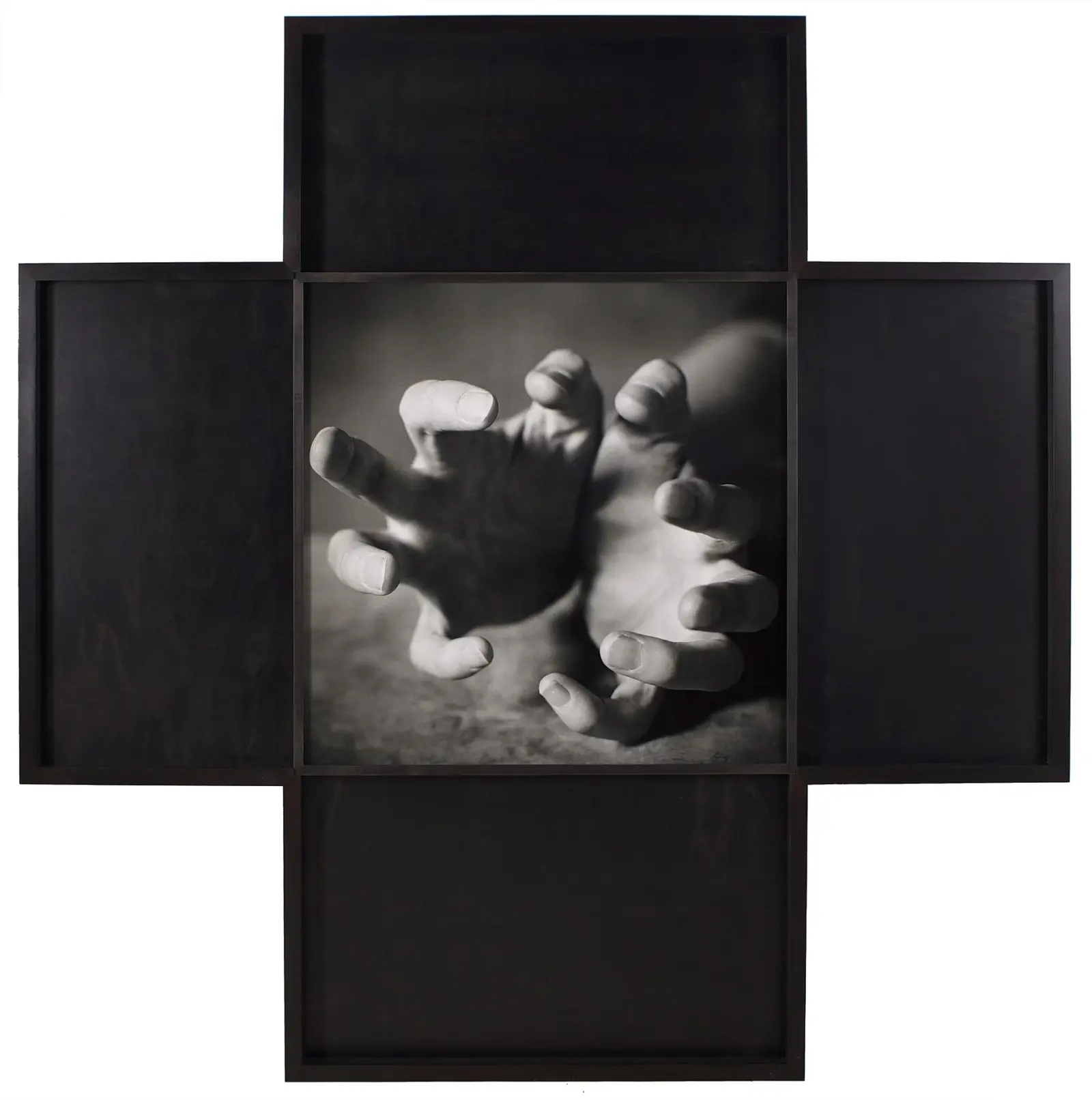
When he did use print media, he turned to conceptual artists rather than fashion photographers. He formed an enduring creative partnership with American neo-conceptual artist Jenny Holzer. For his 2000 fragrance launch, Holzer composed haunting, fragmented text phrases—“I SMELL YOU ON MY SKIN” y “YOU ARE MY OWN”—which Lang printed in white capital letters across full-page newspaper spreads and projected onto urban facades. He collaborated similarly with sculptor Louise Bourgeois and featured raw archival photographs by Robert Mapplethorpe. Advertising became fine art documentation, stripping fashion marketing of its patronizing glamour.
Anatomy of utilitarian armor: Painter denim, latex drips, and the ballistic nylon vest
Lang’s radical minimalism was never about sterile emptiness. It was an intense investigation into tactile mechanics, industrial textiles, and urban utility. Where American minimalists reduced garments to beige cashmere and simple silk slips, Lang injected raw subcultural friction into every seam.
His Spring/Summer 1998 collection codified his greatest contribution to streetwear: painter denim. Taking classic five-pocket jeans cut from stiff, unwashed Japanese raw selvedge denim, Lang applied hand-painted strokes of white oil paint and resin drips across the thighs, shins, and back pockets. These were not the phony, sandpapered distressing effects churned out by commercial mass-market brands. Lang’s paint splatters looked like genuine splashes from an artist’s studio floor or an industrial construction site. He paired these workwear trousers with high-twist wool blazers, silk organza shirts, and razor-toed boots, proving that working-class utility possessed an innate architectural nobility.
Equally radical was his introduction of protective tactical gear into ready-to-wear. In his Autumn/Winter 1997 and Autumn/Winter 1999 collections, Lang sent models down the runway wearing ballistic nylon vests modeled directly on police bulletproof body armor. Worn as waistcoats over unbuttoned poplin shirts and tailored wool suits, the vests featured heavy nylon cordura shells, thick velcro adjustment straps on the shoulders, and padded collar protection. They did not project military aggression; they signaled emotional and physical defense against an indifferent urban environment.
Material experimentation extended into synthetic polymers and aerospace fabrics. Lang integrated iridescent polyamide, translucent technical organza that revealed internal seam allowances, rubberized cotton coatings, liquid latex bands applied directly to wool trousers, and metallic foil interior linings that reflected body heat. As examined in our analyses on avant-garde fashion and techwear y deconstrucción en la moda, Lang invented the modern lexicon of technical streetwear decades before the term gained mainstream commercial currency.
The Astro biker and bondage harness: Ergonomic ribbed leather and kinetic utility
The pinnacle of Lang’s technical design vocabulary arrived in Autumn/Winter 1999 with his seminal “Seance de Travail” collection. The centerpiece of this runway was the “Astro” biker jacket, produced in heavyweight cotton canvas, ballistic nylon, and supple washed calfskin. The garment drew inspiration simultaneously from vintage motorcycle gear, high-altitude military flight jackets, and astronaut space suits.
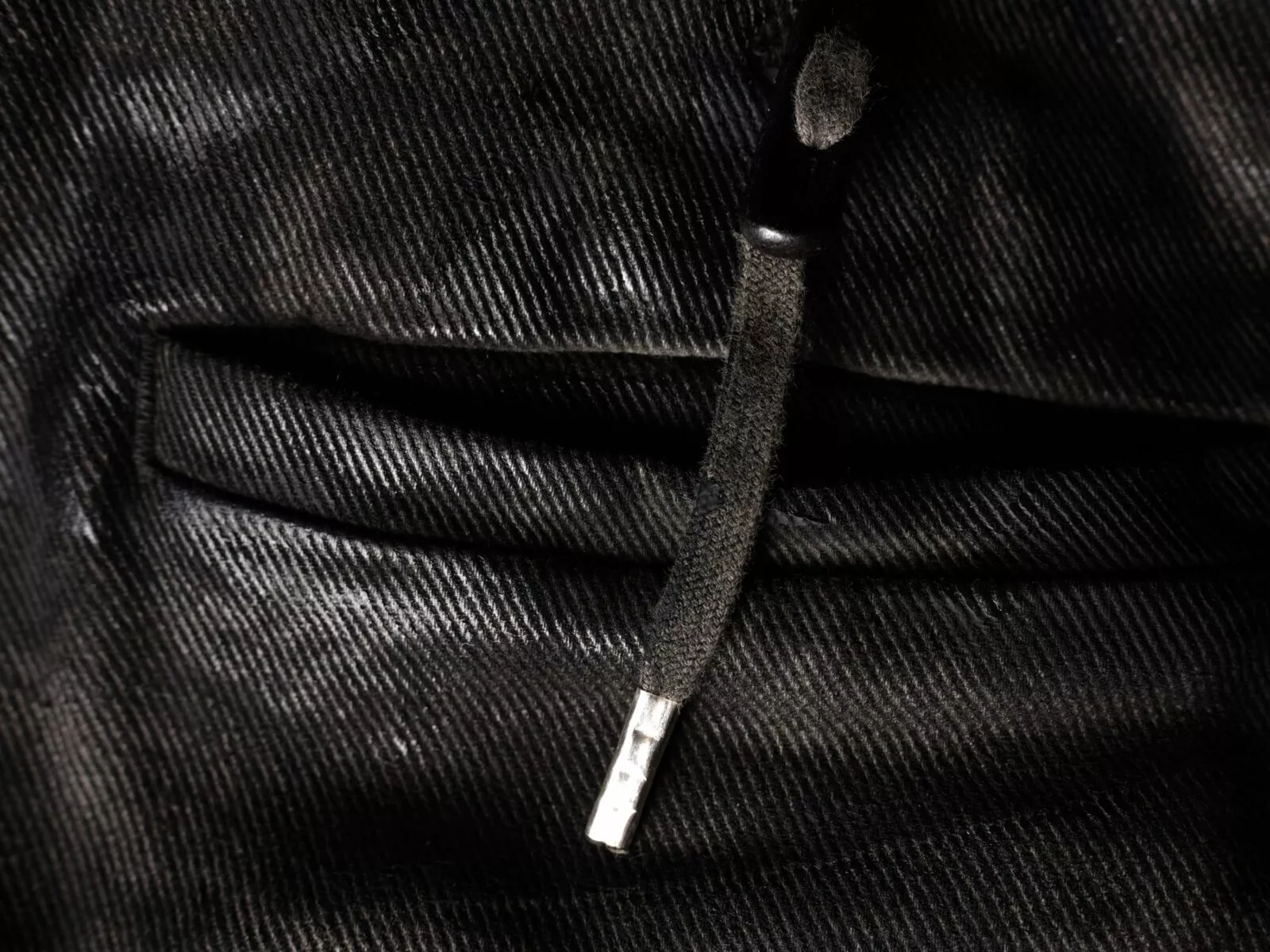
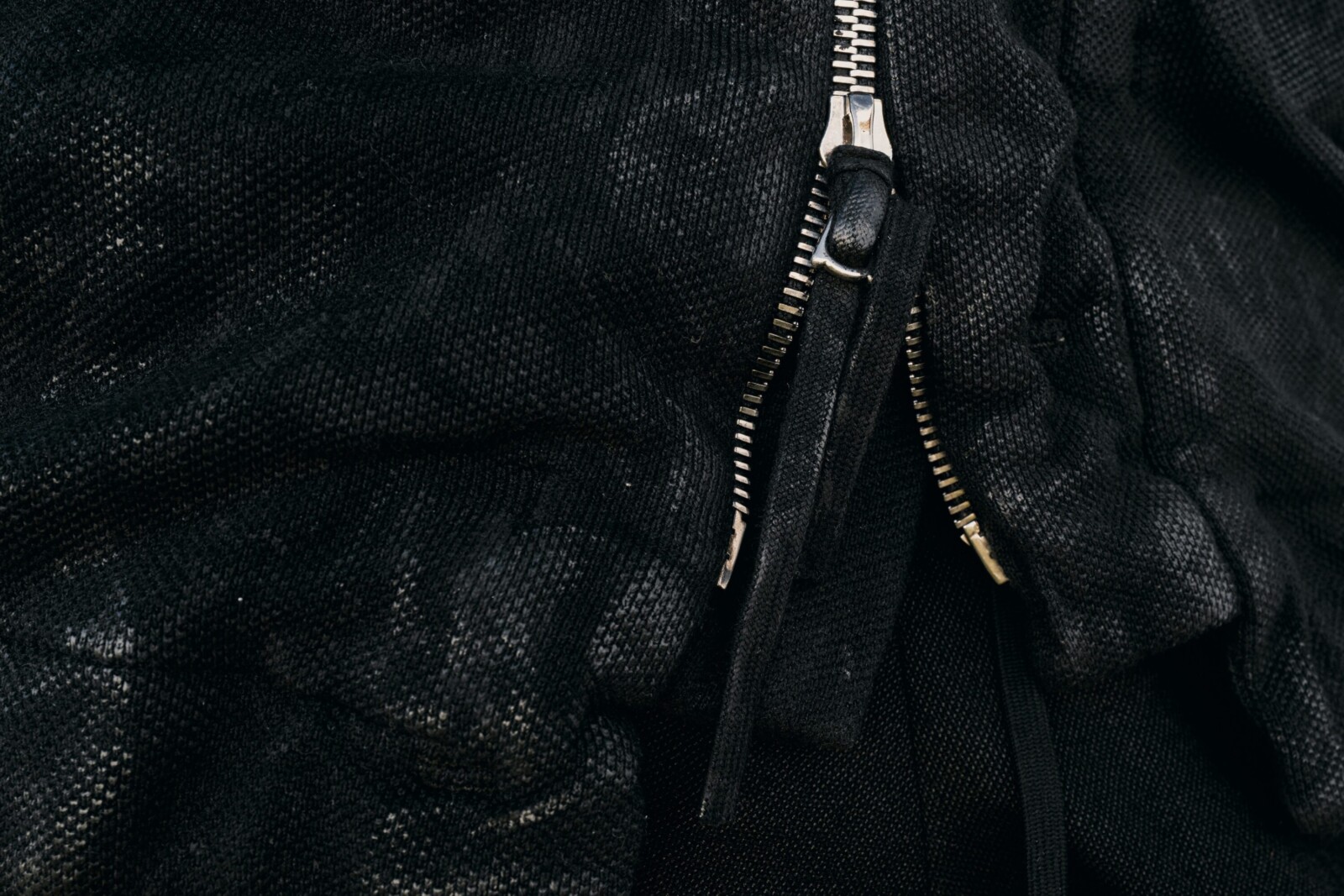
The engineering was astonishing. The elbows featured dense, horizontal articulated leather quilting that accommodated the natural flex of the arm without bunching. The collar was trimmed in plush sheep shearling and equipped with heavy wire-stiffened storm flaps that could be molded around the throat. Asymmetric industrial zips allowed the wearer to adjust ventilation across the chest, while utility slash pockets sat angled for rapid access while seated or riding.
Inside the jacket lay Lang’s most celebrated mechanical invention: the bondage backpack harness. Sewn into the interior armscyes and rear shoulder seams were heavy-duty nylon webbing straps. When stepping into an overheated subway car, art gallery, or crowded bar, the wearer did not need to carry a bulky coat over their arm. They simply slid their arms out of the sleeves, allowing the jacket to hang suspended down the back from the internal straps like a backpack.
This was kinetic utility in its purest form: clothing that adapted dynamically to the physical temperature shifts and spatial frictions of the modern metropolis. By integrating bondage-derived harness straps with ergonomic outerwear, Lang fused subcultural eroticism with cold industrial pragmatism.
The corporate clash and the great exit: Prada Group friction and the 2005 withdrawal
By the end of the 1990s, the fashion industry had entered a phase of aggressive financial consolidation. Independent ateliers found it increasingly difficult to compete against multinational luxury conglomerates armed with billion-dollar marketing budgets and global retail networks. Lang, whose business had grown into an international powerhouse generating over one hundred million dollars annually, needed external capital to fund worldwide retail expansion, perfume manufacturing, and accessories production.
In March 1999, Lang signed a deal selling a 51 percent controlling stake in his company to the Prada Group, led by CEO Patrizio Bertelli and Miuccia Prada. On paper, the partnership seemed like an intellectual match: both brands championed minimalist restraint, industrial nylon, and conceptual rigor. In practice, the union was catastrophic.
Bertelli was an authoritarian executive driven by rapid financial scaling, aggressive retail rollouts, and high-margin leather goods. Lang, by contrast, was an exacting auteur who insisted on microscopic control over every button choice, thread tension, and fabric formulation. Bertelli demanded that Lang launch lucrative commercial handbag lines; Lang refused to manufacture generic luxury status bags, insisting on utility holster pouches and functional nylon carryalls. Bertelli moved manufacturing out of Lang’s trusted, family-owned Austrian and northern Italian workshops to consolidate production within Prada’s own factories. Production delays mounted, deliveries were missed, and wholesale stockists grew frustrated.
Relations between Lang and Bertelli deteriorated into open hostility. In 2004, Prada acquired the remaining 49 percent of the company, leaving Lang with zero financial control. Recognizing that his creative autonomy was utterly compromised, Lang made an extraordinary decision: in January 2005, at the peak of his international fame and commercial influence, he quietly resigned from his own fashion house. He gave no farewell press conference, issued no self-congratulatory retrospectives, and never returned to the fashion industry. He simply stepped out the door and never looked back.
Make It Hard: The 2011 industrial shredding of the 6,000-piece archive as sculpture
After walking away from fashion in 2005, Lang retreated to Long Island, New York, dedicating himself entirely to visual art. Meanwhile, the Prada Group mismanaged his namesake brand, accumulating massive financial losses before selling the intellectual property in 2006 to Link Theory Holdings. The corporate label continued under various rotating creative directors, producing commercial streetwear that bore little connection to the founder’s original rigor.
Lang retained one irreplaceable treasure: his personal physical archive. Housed in his studio building in Long Island, the collection comprised over six thousand historic garments—runway prototypes, one-off samples, experimental textile trials, painter denim, Astro bikers, ballistic vests, and custom shoes spanning 1986 to 2005. In February 2010, an electrical fire broke out in the building. While the archive was not completely consumed by flames, thousands of irreplaceable pieces suffered smoke and water damage.
Most designers would have hired conservation teams to restore the damaged clothing or auctioned the surviving pieces to wealthy fashion collectors for millions of dollars. Lang did something unprecedented and uncompromising. He contacted museums and donated selected pristine pieces to institutions including the MAK in Vienna, the Musée Galliera in Paris, and the Costume Institute at the Metropolitan Museum of Art. Then, with what remained of the six-thousand-piece archive, he carried out an astonishing act of creative destruction.
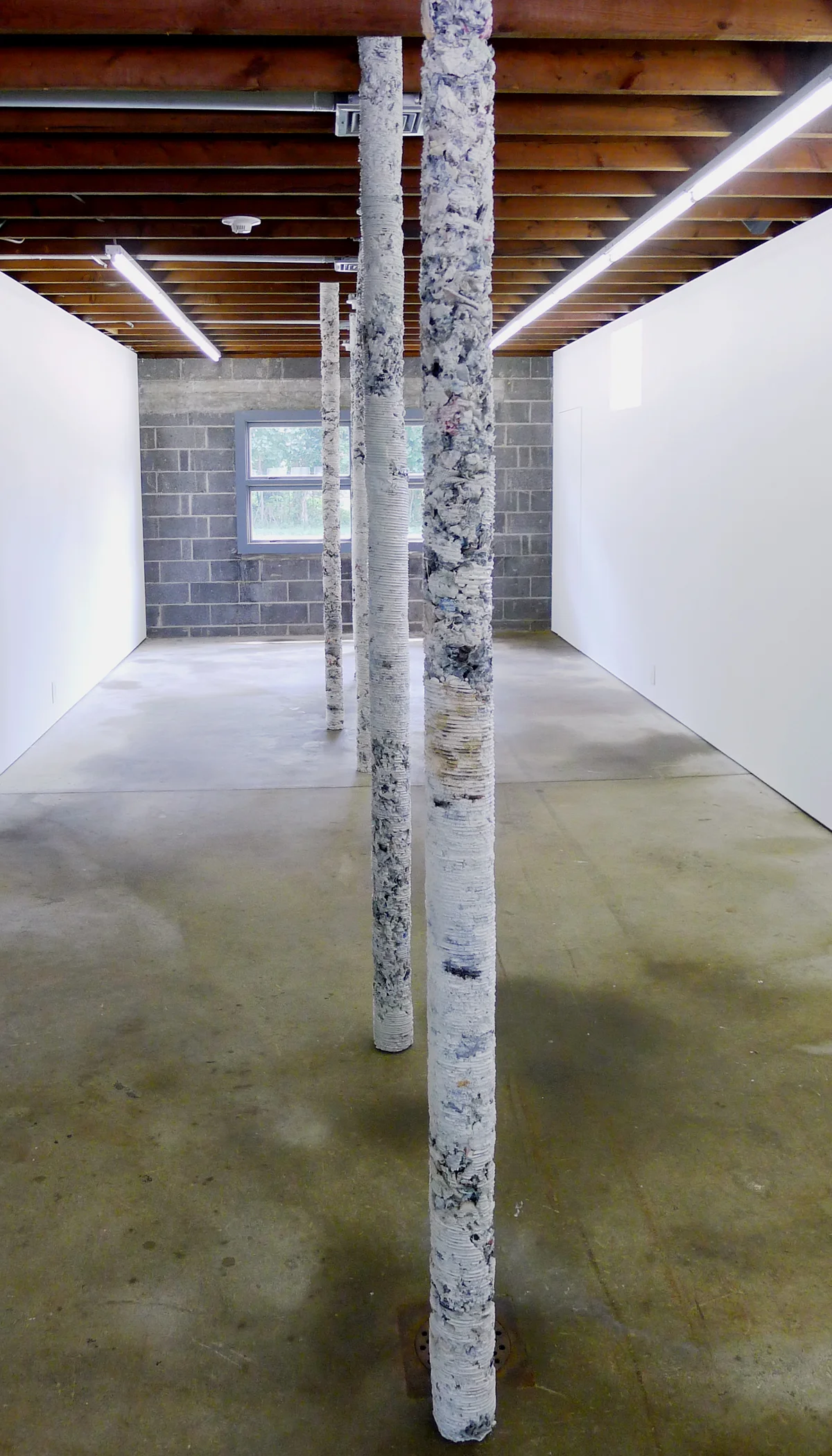
In 2011, Lang fed the surviving archive into an industrial shredder. Decades of groundbreaking fashion history—the denim, the leather, the bulletproof nylon, the silk organza, the rubberized loden, the metal zippers and horn buttons—were ground down into fine textile shreds and particulate dust. Lang then mixed this pulverized mass with industrial epoxy resin and raw pigment, casting the composite material into towering cylindrical and rectangular monoliths.
He debuted the resulting sculptures in 2011 at The Fireplace Project in East Hampton, and subsequently at the MAK in Vienna, under the title Make It Hard. Standing like charred, weathered totems or archaeological sediment cores, the sculptures compressed twenty years of sartorial revolution into dense, petrified matter. By annihilating his own garments to forge fine art, Helmut Lang delivered his final, radical statement on minimalism: true freedom from consumer fashion is achieved only when the garment itself is dissolved into stone.
Related Brand Archives & Historical Monographs
Explore curated archival pieces and deep historical analyses across the avant-garde continuum: inspect the curated Helmut Lang brand archive, examine our monographs on Maison Margiela, Ann Demeulemeester, Comme des Garçons, y Yohji Yamamoto, or study foundational historical analyses including Moda de vanguardia y techwear, Darkwear y la escena vanguardista de los 2000, Deconstrucción en la moda, ¿Qué es la anti-moda?, y De la subcultura al lujo: la moda vanguardista hoy.
Referencias y lecturas adicionales
- Wikimedia Foundation — Helmut Lang: Biography, Fashion Innovations, and Art Career
- Wikimedia Foundation — Jenny Holzer: Conceptual Art, Text Installations, and Fashion Collaborations
- Wikimedia Foundation — Louise Bourgeois: Sculptural Practice and Collaborative Visual Culture
- Wikimedia Foundation — Robert Mapplethorpe: Monochromatic Photography and Visual Identity
- Wikimedia Foundation — Prada: Corporate History, Luxury Acquisitions, and Modern Restructuring
- Fashion Channel Archive — Helmut Lang Autumn/Winter 1997-1998 New York Collection
Créditos de imagen
- Helmut Lang, self-portrait, 2007. Photograph courtesy of HL-ART, Wikimedia Commons, CC BY-SA 3.0.
- Conceptual artist Jenny Holzer in Leipzig, 1996. Photograph by Oliver Mark, Wikimedia Commons, CC BY-SA 4.0.
- Helmut Lang, MAKE IT HARD, 2011. Resin, pigment, and mixed media. Photograph by Jandreasson, Wikimedia Commons, CC BY-SA 3.0.