Martin Margiela and the Language of Deconstruction
Martin Margiela never gave an interview, never stepped onto a runway for a final bow, and refused to let his face be photographed. While late-twentieth-century fashion accelerated toward celebrity excess, gilded hardware, and corporate megalomania, the Belgian designer operated as an anonymous ghost inside a whitewashed Parisian atelier. Graduating from the Royal Academy of Fine Arts Antwerp in 1979—alongside the generational peers profiled in our history of the Antwerp Six and the rise of Belgian fashion—Margiela resisted their collective touring circus to map an independent, solitary rupture. Together with business partner Jenny Meirens, he founded Maison Martin Margiela in 1988 on a radical premise: clothing should not announce wealth or celebrate a superstar author. By exhuming discarded flea-market textiles, stripping shoulder pads bare, exposing raw basting threads, and imprinting runway floors with the scarlet cloven hooves of the Tabi boot, Margiela dismantled the architecture of Western dressmaking. He converted fashion from a theater of commercial vanity into a forensic inquiry into time, labor, and sartorial memory.
Fashion houses manufacture illusions of perfection; Maison Margiela exhibited the anatomy of the wound
While Parisian haute couture in the late 1980s functioned as an insulated fortress of gilded baroque excess, padded power shoulders, and glossy lacquer, Martin Margiela arrived with tailor shears to perform a surgical autopsy on garment construction. He did not introduce deconstruction as an academic buzzword or an ephemeral styling flourish. Instead, he treated the garment as an architectural document whose internal history had been forcibly repressed by bourgeois etiquette.
Tailoring had spent three centuries concealing its seams. Traditional pattern cutters pressed raw edges inward, disguised darts beneath silk linings, and ironed canvas stays into submission so that the finished coat appeared magically formed, untouched by sweating human hands. Margiela systematically reversed this cosmetic deceit. Influenced by Jacques Derrida’s philosophical interrogation of texts—though Margiela himself was driven by practical workbench instincts rather than literary theory—the Maison dragged the interior apparatus into daylight. Interfacings became lapels; shoulder pads hung naked from unstitched armholes; basting threads trailed across unhemmed hems like forensic clues. To understand Margiela is to recognize that clothing does not begin on the runway. It begins on the cutting table, and it carries the ghost of every hand that touched it.
Belleville, October 1989: The runway stripped of hierarchy
The turning point occurred on an overgrown wasteland in northeastern Paris. For his third presentation, Autumn/Winter 1989–1990, Margiela rejected the gilded chandeliers of the Cour Carrée du Louvre, where luxury titans held court before seated aristocrats and champagne-sipping editors. He chose an abandoned municipal playground in the immigrant working-class neighborhood of Belleville. There were no reserved seats, no velvet ropes, and no private security guards barring the gates.
Chaos reigned from the opening minute. Neighborhood North African and West African children, curious about the strange commotion on their football pitch, swarmed the perimeter. Margiela and Jenny Meirens invited them in. Local kids sat cross-legged on the dirt runway, perched on the shoulders of fashion critics, and ran alongside models as the first looks emerged. The lighting was crude, powered by makeshift cables running from an obliging neighbor’s second-floor kitchen. The models—street-cast friends, non-professionals, and art students—stumbled unevenly over potholes, broken asphalt, and patches of weed.
Fashion editors wept; others stormed out in disgust. Suzy Menkes later recalled looking down to see a local child sitting on her lap, mesmerized by garments cut from repurposed plastic bags and shredded butcher aprons. Traditional critics labeled the presentation an insult to French craft. They failed to grasp the ideological ambush. In a single afternoon, Margiela smashed the caste system of the front row. The presentation was no longer a corporate transaction for buyers; it was a communal festival where the street claimed ownership of the cloth.
Anatomy of the Tabi: Cleft hooves, red footprints, and economic necessity
No footwear design provoked greater bewilderment than the Tabi boot. Debuted in Margiela’s inaugural Spring/Summer 1989 collection at the Café de la Gare, the boot featured a cleft toe separating the hallux from the remaining digits, resting atop a chunky cylindrical wooden heel. The silhouette derived directly from fifteenth-century Japanese jika-tabi—the divided-toe cotton footwear worn by laborers, carpenters, and farmers to grip outdoor scaffolding. Transplanted into supple leather footwear, the split toe transformed human feet into pagan cloven hooves.
The design was a gamble born of severe financial desperation. Margiela possessed virtually no working capital. Sourcing a traditional shoemaker willing to carve a radical split-toe wooden last was an ordeal; Italian cobbler factories repeatedly dismissed the prototype as grotesque and unwearable until Antwerp retailer Geert Bruloot helped broker production. When the boots finally arrived, Margiela knew he could not afford to manufacture a new shoe design for his second season.
He turned financial starvation into conceptual immortality. Before sending models onto the runway for Spring/Summer 1989, Margiela dipped their leather soles into trays of wet crimson house paint. As models walked down long rolls of untreated white cotton unrolled across the floor, their footsteps left distinct scarlet hoof prints. For the following season’s show, Margiela salvaged the stained cotton runner, taped it together with duct tape, and tailored it into the opening waistcoats of Autumn/Winter 1989–1990. The shoe became self-generating mythology: by marking its own footprint, the Tabi ensured that any subsequent revision would carry the physical imprint of its historical birth.
The semiotics of absence: Four corner stitches, blank labels, and blouses blanches
Branding is capitalism’s signature; Margiela erased the signature. In 1988, when fashion houses plastered monogrammed logos across luggage, denim, and belt buckles, Jenny Meirens proposed a blank white textile rectangle. Not a name, not a logo, not a house slogan. The tag was completely unprinted, secured to the garment’s neckline by four crude white basting stitches visible on the exterior.
The design carried a subversive functional command: the client was intended to cut the stitches immediately upon purchase. Meirens reasoned that true luxury exists between the wearer and the cloth, stripped of brand exhibitionism. Yet the semiotic irony was devastating. By refusing to label the garment, the four external white corner stitches became the most unmistakable cult signifier in contemporary fashion. Connoisseurs recognized the absence faster than any gilded monogram. Later, when the Maison introduced its numerical grid (0 to 23) in 1997 to designate product lines, the circled digit retained the ascetic anonymity of an industrial parts catalog.
Inside the atelier at 163 Rue Saint-Maur, individual identity yielded to collective anonymity. Every member of the design team, commercial staff, and retail crew wore identical knee-length white lab coats—the blouses blanches worn by vintage couture seamstresses and laboratory scientists. When journalists faxed questions to the studio, responses were returned using the collective plural: “We at Maison Martin Margiela believe…” Margiela refused interviews, declined post-show bows, and avoided photo calls. By removing his physical body from the marketing machine, he forced the press to look exclusively at the seams.
Structural dissection: The Stockman dummy, exposed linings, and inside-out seams
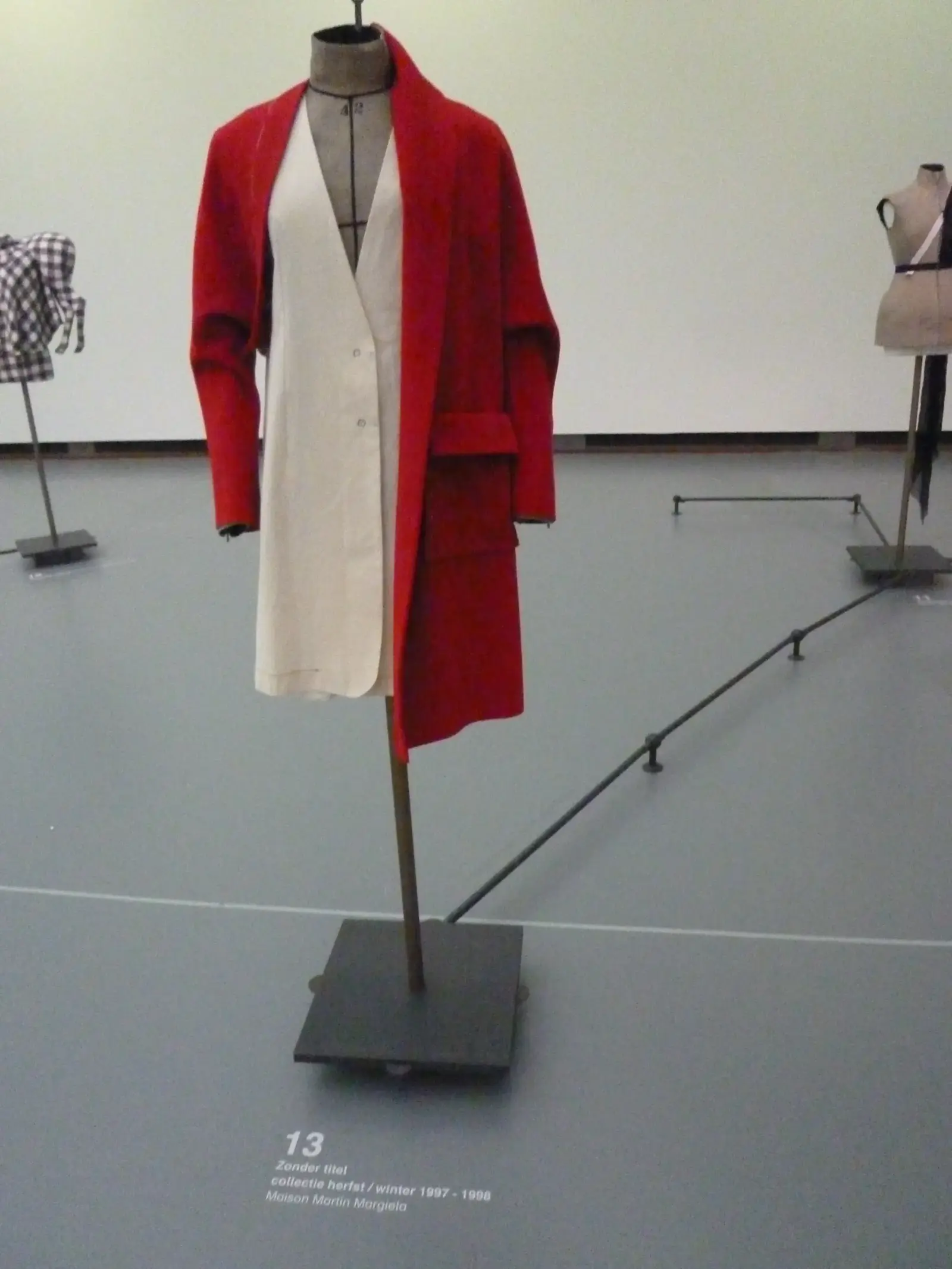
Haute couture relies on the mannequin as an invisible partner. In Spring/Summer 1997 and Autumn/Winter 1997–1998, Margiela transformed that partner into the garment itself. He produced the famous Stockman series: jackets, waistcoats, and dresses constructed directly from coarse ecru linen stamped with manufacturer stencils (“Stockman Paris, Breveté S.G.D.G., 42”). These garments replicated the dressmaker’s padded dummy down to its raw seams, printed sizing numbers, and rough cotton interfacings.
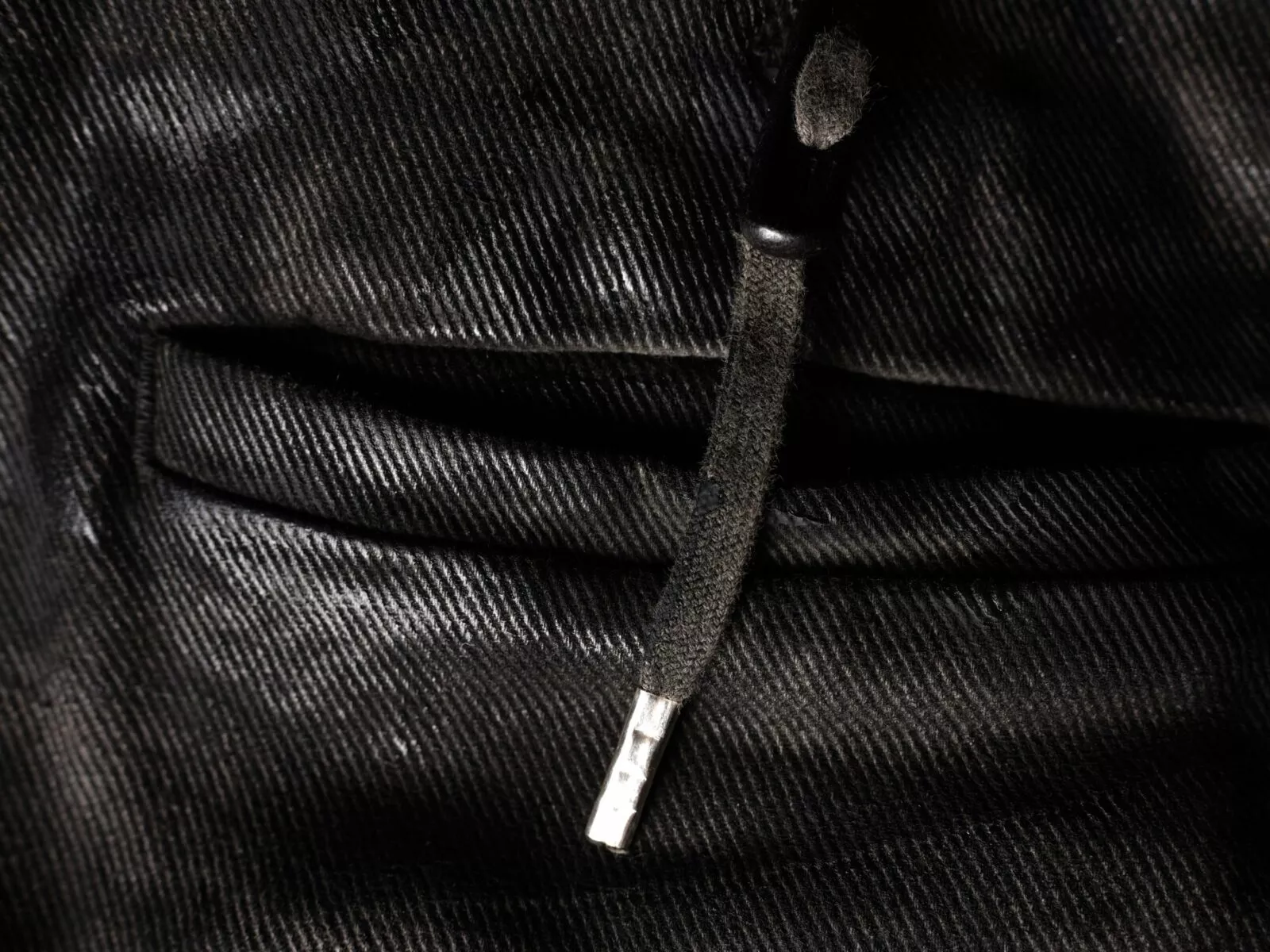
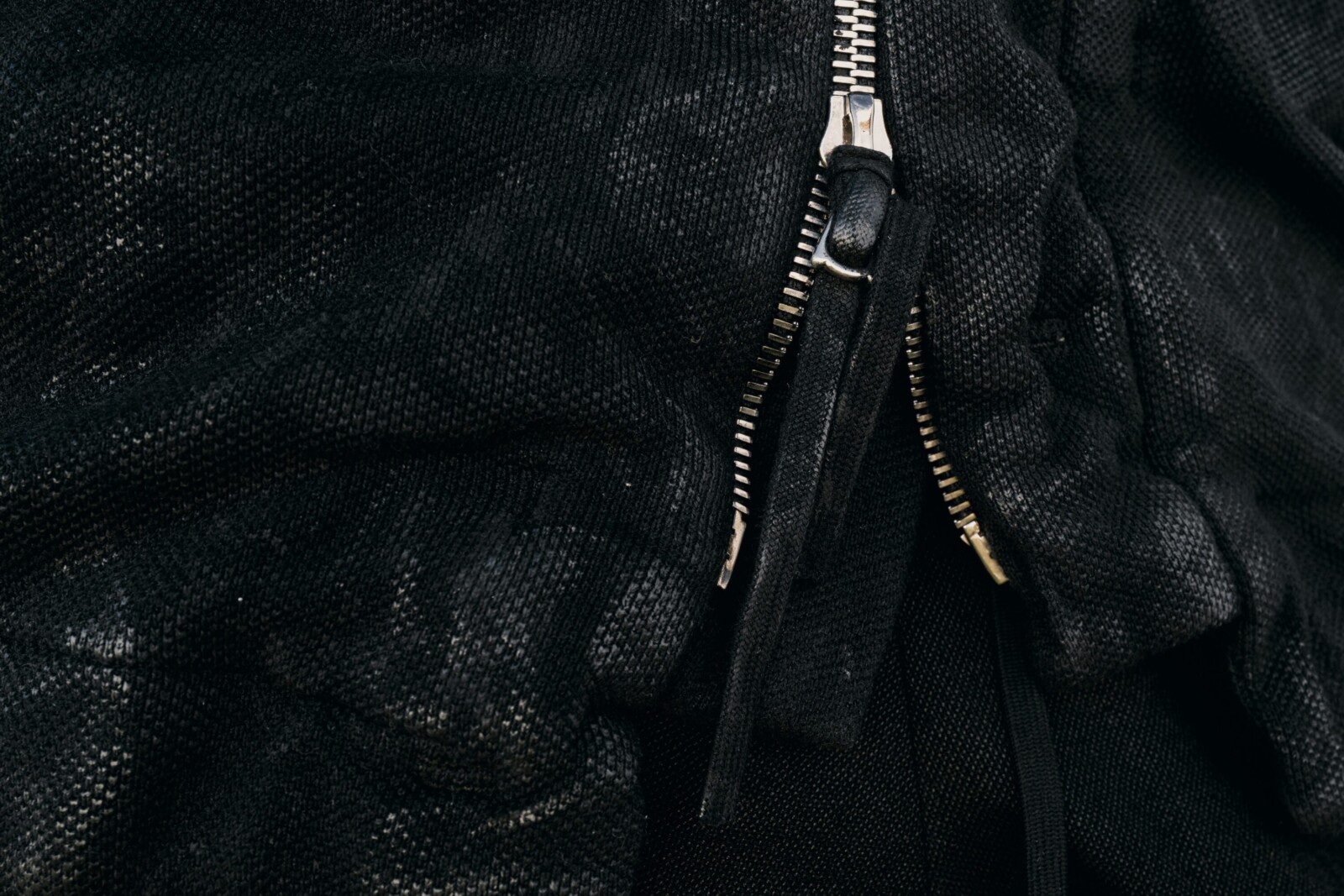
The garments looked unfinished; they were meticulously calculated. Margiela severed the lapels from tailored coats, leaving raw shoulder pads exposed like stripped muscle tissue over naked bone. He exposed inside-out darting, allowing canvas stays and unraveling silk facings to drape down the torso. Zipper teeth, traditionally concealed behind neat plackets, were sewn directly onto jacket fronts as aggressive structural ridges. By presenting the dressmaker’s armature as finished eveningwear, Margiela collapsed the hierarchical distance between the atelier workroom and the salon.
This anatomical transparency exposed the fiction of seasonal novelty. In our critical review of deconstructie in mode, garments cease to be passive adornments and become structural essays. Margiela demonstrated that a jacket is not a seamless sculpture dropped from the heavens; it is an assemblage of twenty distinct geometric pattern pieces held together by cotton tension. When you slice those threads, the illusion of perfection vanishes, leaving the vulnerable labor of the artisan in plain view.
Line 0 and the Artisanal line: Flea markets, broken crockery, and domestic salvage
Modern luxury exploits rarity through exorbitant expense; Margiela discovered rarity in the dustbins of Paris. From the inception of the house, he instituted what would become formalized in 1997 as Line 0: The Artisanal Collection. The rules were uncompromising: every garment had to be constructed entirely by hand from existing vintage garments, domestic artifacts, or discarded industrial materials, requiring dozens or hundreds of hours of manual reconstruction inside the atelier.
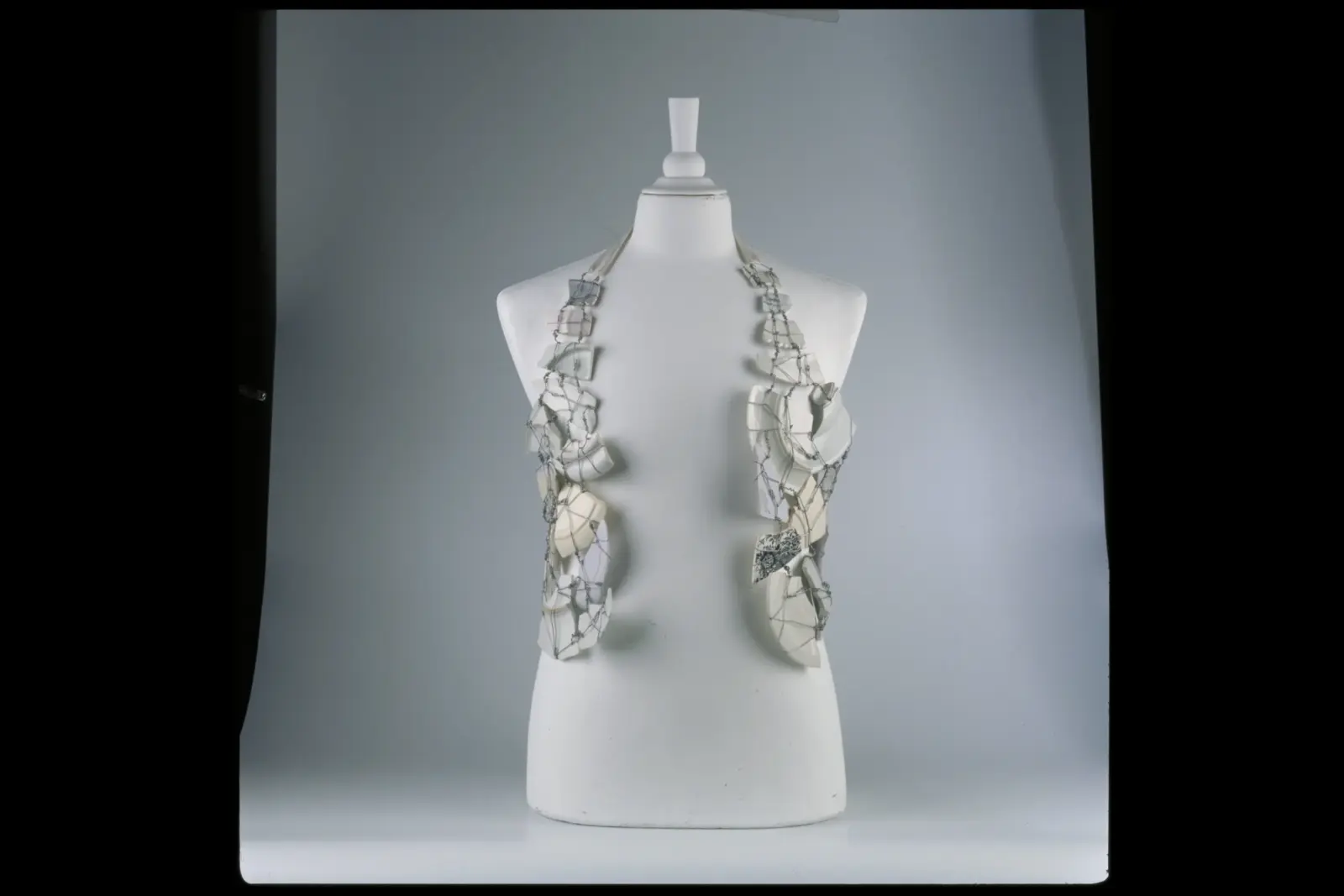
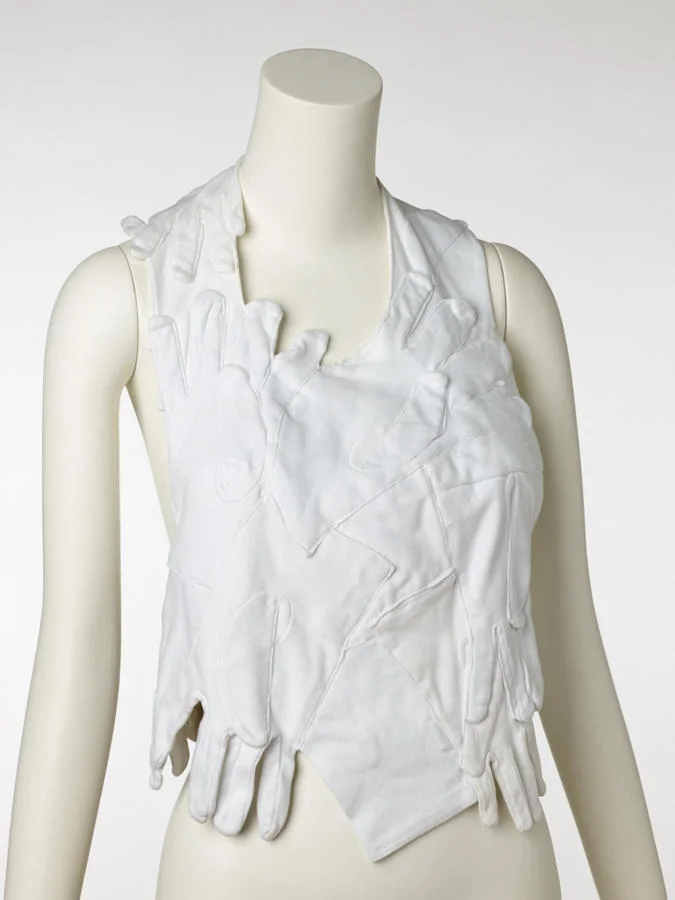
The materials were defiantly mundane. For Autumn/Winter 1989–1990, he wired together shards of smashed ceramic tableware bought for pennies at the Marché aux Puces de Saint-Ouen, forming an exquisite mosaic waistcoat that clinked like medieval chainmail. In Autumn/Winter 1991–1992, he disassembled vintage silk foulards and army trench coats. He stitched together flea-market leather ski gloves into structured corsets, gathered white cotton hospital gloves into ruffled evening tunics, assembled ball gowns from plastic supermarket carrier bags, and unraveled vintage wool army socks to re-knit them into dense, high-neck fishermen’s sweaters.
Line 0 preceded the contemporary corporate lexicon of upcycling and circularity by thirty years. Yet unlike modern greenwashing campaigns that hide their recycled origins behind pristine synthetic finishes, Margiela accentuated the patina of previous life. Stains, worn elbows, sun-faded folds, and repaired moth holes were deliberately preserved. Each Artisanal piece carried an attached tag recording the exact origin of the materials and the hours spent assembling it by hand. It was an archaeological practice: resurrecting dead objects and elevating forgotten human labor above the sterilized output of the automated assembly line.
The Hermès paradox: Subverting French luxury from within (1997–2003)
When Jean-Louis Dumas appointed Martin Margiela artistic director of women’s ready-to-wear at Hermès in 1997, the Parisian fashion establishment anticipated an apocalypse. How could the renegade of frayed seams and unwashed flea-market socks take the helm of the most conservative saddle-making dynasty on the Rue du Faubourg Saint-Honoré? Critics braced for shredded orange silk scarves and graffiti-scrawled Birkin bags.
Margiela engineered the ultimate counter-intuitive revolution: he delivered absolute, radical restraint. Over twelve collections between Autumn/Winter 1998 and Spring/Summer 2004, he stripped Hermès of all decorative vanity. He banished logos, horse motifs, and gilded brass hardware. He avoided bright colors, executing entire collections in a meditative palette of slate grey, taupe, chalk white, and deep peat brown.
His engineering subverted luxury through tactile intimacy. He introduced the vareuse—a tailored tunic featuring a plunging deep V-neck that could be slipped on effortlessly over the head without unfastening buttons. He designed double-faced cashmere overcoats without seams or linings, reversible shearling jackets with seamless magnetic closures, and six-button trench coats whose collar points folded inward to form sculptural capes. While competitors manufactured noisy status symbols for the paparazzi flashbulb, Margiela designed clothes whose luxury was known only to the woman wearing them. He proved that radicalism does not require loud destruction; sometimes the most devastating rebellion is absolute simplicity.
The 200% distortion, OTB commercialization, and the quiet exit
Margiela never settled into a signature formula. Having thoroughly interrogated the internal anatomy of dressmaking, he redirected his attention in Autumn/Winter 2000 toward scale and proportion. In the Oversize Collection, he took standard vintage garments—an Italian men’s size 48 trench coat, a classic denim jacket, a cable-knit sweater—and magnified every measurement by 130% to 200%. The resulting coats corresponded to an Italian men’s size 74.
Crucially, Margiela did not simply grade the pattern upward to fit a giant body. He magnified every component in exact mathematical unison: giant zipper teeth, buttonholes four inches wide, collars that engulfed the shoulders, and enormous knit loops. Worn on an average female frame, the clothes collapsed under their own gravity, creating cavernous drapery that questioned Western assumptions about human fit. Concurrently, his trompe-l’œil print collections photorealistically screen-printed images of heavy denim jackets, sequined tuxedo lapels, and vintage trench coats onto wafer-thin silk jersey slips, collapsing three-dimensional weight into a two-dimensional optical mirage.
The conceptual purity could not survive corporate expansion forever. In 2002, Renzo Rosso’s Only The Brave (OTB) acquired a majority stake in Maison Martin Margiela. Commercial retail stores multiplied globally; diffusion lines proliferated; fragrance licensing deals followed. The friction between Margiela’s ascetic anonymity and corporate growth became untenable. In October 2009, following the house’s twentieth-anniversary retrospective exhibition at MoMu Antwerp, Martin Margiela quietly resigned. There was no farewell runway speech, no retrospective press tour, and no successor immediately announced.
Today, the language Margiela invented permeates contemporary dress. His exposed stitching, raw hems, and deconstructed garments have been recycled by luxury conglomerates and streetwear brands alike. Yet the imitators frequently mistake the syntax for the substance. Margiela did not shred fabric to generate cheap dystopian aesthetics; he dismantled garments to confront our relationship with time, labor, and human obsolescence. In a fashion system still suffocated by digital vanity and disposable consumerism, his thirty-year silence remains the most eloquent statement on the rack.
Related Brand Archives & Historical Monographs
Explore curated archival pieces and deep historical analyses across the avant-garde continuum: browse the curated Maison Margiela brand archive, examine historical studies including De Antwerpse Zes en de Opkomst van de Belgische Mode, study Belgische Deconstructie Na de Antwerp Six, investigate Deconstructie in de Mode, or examine foundational monographs on Comme des Garçons en Wat is anti-mode?.
Referenties en verdere lectuur
- Wikimedia Foundation — Martin Margiela: Archival Monograph, Career, and Collections
- Wikimedia Foundation — Maison Margiela: Founding, Artisanal Collections, and House History
- Wikimedia Foundation — Tabi: Traditional Japanese Split-Toe Footwear and Modern Adaptations
- Oscilloscope Laboratories / Reiner Holzemer Film — Martin Margiela: In His Own Words (2019 Documentary)
- Wikimedia Commons / Museum Boijmans Van Beuningen — Gilet en porcelaine: Martin Margiela Artisanal Waistcoat, 1989–1990
- Wikimedia Commons / MoMu Antwerp — Maison Martin Margiela 20: Semi-Couture Stockman Linen Ensemble (1997)
- Wikimedia Commons / RISD Museum — Artisanal White Glove Top: Martin Margiela Spring/Summer 2001
Afbeelding credits
- Maison Martin Margiela Artisanal (Line 0) waistcoat composed of shards of broken ceramic plates wired together, Autumn/Winter 1989–1990. Collection of Museum Boijmans Van Beuningen, photograph by Museum Boijmans Van Beuningen, Wikimedia Commons, CC BY-SA 3.0.
- Semi-couture linen dress derived from a Stockman tailoring dummy paired with a tailored red wool coat, Autumn/Winter 1997–1998. Photograph by Regine Debatty (we-make-money-not-art) at MoMu Antwerp, Wikimedia Commons, CC BY-SA 2.0.
- Artisanal top assembled entirely from vintage white cotton gloves, Spring/Summer 2001. Photograph by Staff Photographer, Rhode Island School of Design Museum of Art, Wikimedia Commons, CC BY-SA 4.0.