Bauhaus-Prinzipien in der Mode
The Bauhaus never established an official fashion department, yet its philosophical synthesis of craft, industrial production, and structural geometry fundamentally transformed how modern clothing is engineered. Guided by the imperative that form follows function and materials must speak honestly, the school broke the decorative spell of historicist dress. Through the radical technical weavings of Gunta Stölzl and Anni Albers, alongside Oskar Schlemmer’s stereometric stage costumes, the Bauhaus provided the foundational DNA for architectural silhouettes, modular tailoring, and textile experimentation across contemporary avant-garde fashion.
The total work of art and the absence of fashion
When Walter Gropius founded the Staatliches Bauhaus in Weimar in 1919, his founding manifesto declared an ambitious utopian goal: the unification of all creative disciplines—architecture, sculpture, painting, and craft—into a single collective structure, the Gesamtkunstwerk (total work of art). The school was founded on a pedagogical conviction that the divide between the decorative artisan and the fine artist was an artificial class construct that had impoverished the physical environment of everyday life.
Curiously, among the carpentry, metal, stained glass, mural, and pottery workshops, there was never an official department for garment design. Gropius and many of the school’s early masters viewed fashion with acute suspicion. To traditional modernists, seasonal fashion was the very antithesis of architectural durability: an irrational, ephemeral commercial cycle engineered by Parisian couture to manufacture superficial obsolescence and cater to bourgeois vanity.
Yet despite this institutional exclusion, the Bauhaus exerted a revolutionary influence on 20th and 21st-century dress. Rather than accepting fashion as ornamental decoration applied to the skin, Bauhaus thinking treated clothing as portable, wearable architecture. Garments were reimagined from first principles: structural systems governed by the anatomical mechanics of the human skeleton, the tensile properties of raw yarn, the ergonomics of movement, and the moral integrity of materials.
The weaving workshop: technical rebellion in thread
The primary arena where Bauhaus principles collided with wearable material was the weaving workshop (Weberei). When the school opened, large numbers of female students enrolled, drawn by Gropius’s promise of total equality between sexes. In practice, however, the faculty channeled the majority of women away from architecture, metalwork, and sculpture, herding them into the textile department under the conservative assumption that textiles were a natural domestic extension of women’s craft.
What the administration failed to anticipate was that these women would convert the weaving workshop into the most radical, commercially successful, and intellectually vanguard department in the entire school. Under the visionary direction of Gunta Stölzl—who became the first female Bauhaus master—the weavers abandoned sentimental embroidery, traditional figurative tapestry, and floral domestic patterns. Instead, they approached the loom as a precision industrial laboratory.

Stölzl, Otti Berger, and their peers introduced rigorous scientific methodologies to cloth manufacturing. They studied chemical dye formulations, calculated yarn tensile strengths, and deconstructed the geometry of the warp and weft into mathematical grids. They experimented fearlessly with unconventional, non-traditional industrial fibers—cellophane, metallic threads, synthetic rayon, horsehair, and lead wire—creating upholstery and garment fabrics that possessed unprecedented light-reflecting, acoustic, and thermal properties.
By shifting the focus from surface ornamentation to the internal tectonic structure of the weave itself, the Bauhaus weavers proved that beauty in textiles does not derive from pictorial motifs printed over cloth, but from the organic rhythm and material tension of interlaced threads.
Anni Albers: tactile structuralism and material honesty
Among the extraordinary pioneers of the weaving workshop, Anni Albers (née Fleischmann) emerged as the definitive theorist of modernist textile structuralism. Albers arrived at the Bauhaus in 1922 initially desiring to paint, but upon entering the workshop discovered that the loom possessed its own profound formal discipline.
Albers’ philosophy was rooted in material honesty (Materialgerechtigkeit)—the principle that every material must be handled according to its innate physical characteristics without imitation or deceit. Cotton should look and behave like cotton; wool must reveal its natural crimp; metal threads should communicate their tensile stiffness. In her landmark diploma project in 1929—a sound-absorbing, light-reflecting wall covering engineered for an auditorium in Bernau—Albers paired a synthetic cellophane face with a cotton chenille backing, solving an architectural acoustic problem through pure textile engineering.
In her later seminal treatises, On Designing (1959) and Beim Weben (1965), Albers articulated a vision of textile production that anticipated modern modular clothing design. She argued that pre-industrial weaving was the original architectural structure of human civilization—predating stone masonry and timber framing. For Albers, fabric was not a passive flat sheet waiting to be tailored into garments, but an active tactile skin whose weight, porosity, and draping resistance dictated its own three-dimensional possibilities.
Oskar Schlemmer and the Triadic Ballet: the body as spatial architecture
While the weaving workshop revolutionized the two-dimensional architecture of cloth, Oskar Schlemmer tackled the three-dimensional geometry of the human body in space. Appointed head of the Bauhaus stage workshop in 1923, Schlemmer approached the theater not as dramatic narrative, but as an empirical investigation into the relationship between the human organism and mathematical space.
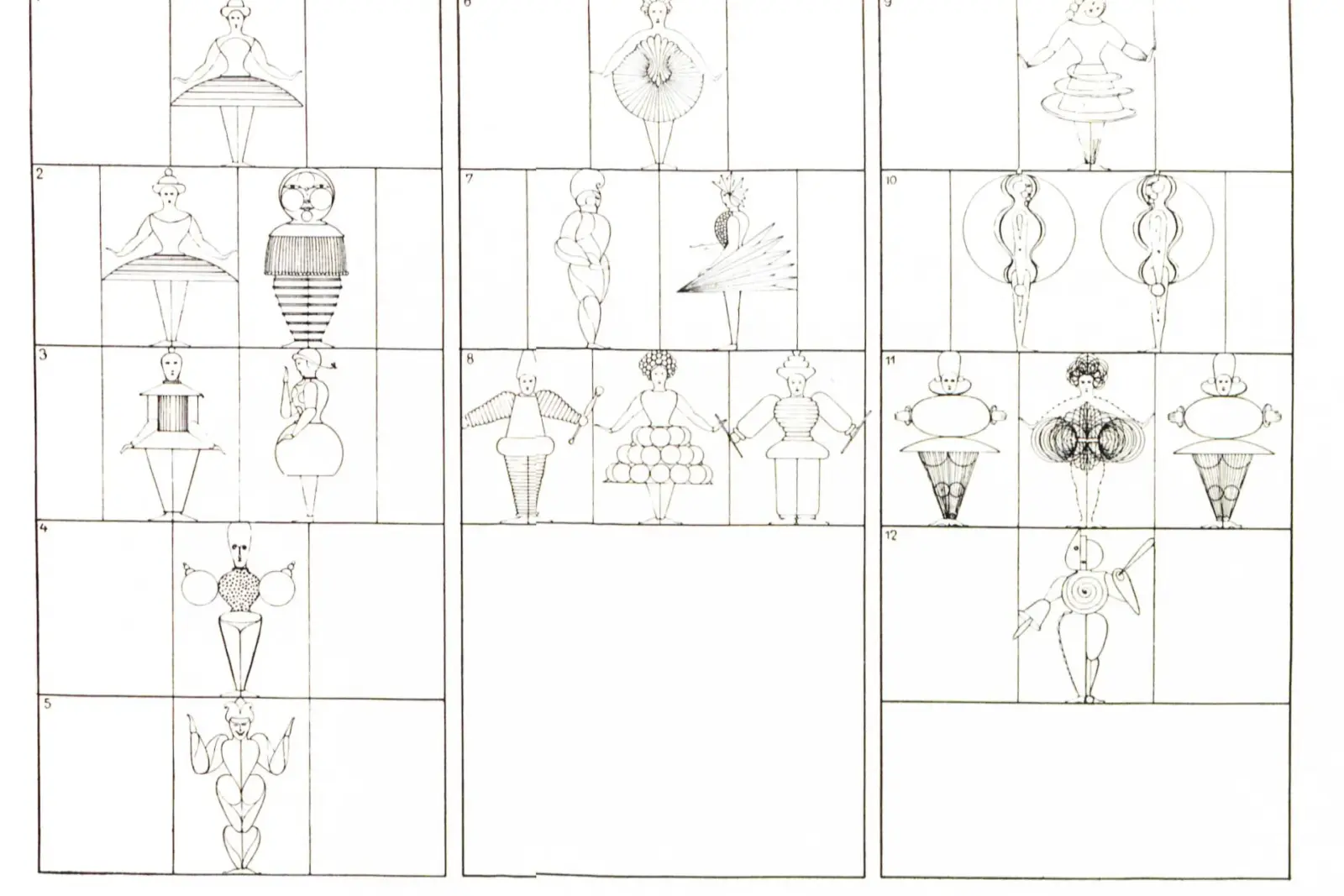
His magnum opus, the Triadic Ballet (Das Triadische Ballett), premiered in Stuttgart in 1922 and was performed throughout the 1920s across Weimar, Frankfurt, and Berlin. Structured in three movements progressing from cheerful burlesque yellow, through ceremonial pink, to mystical black, the ballet featured dancers encased in extraordinary sculptural costumes constructed from rigid padded cloth, polished wood, papier-mâché, glass globes, and metallic sheets.
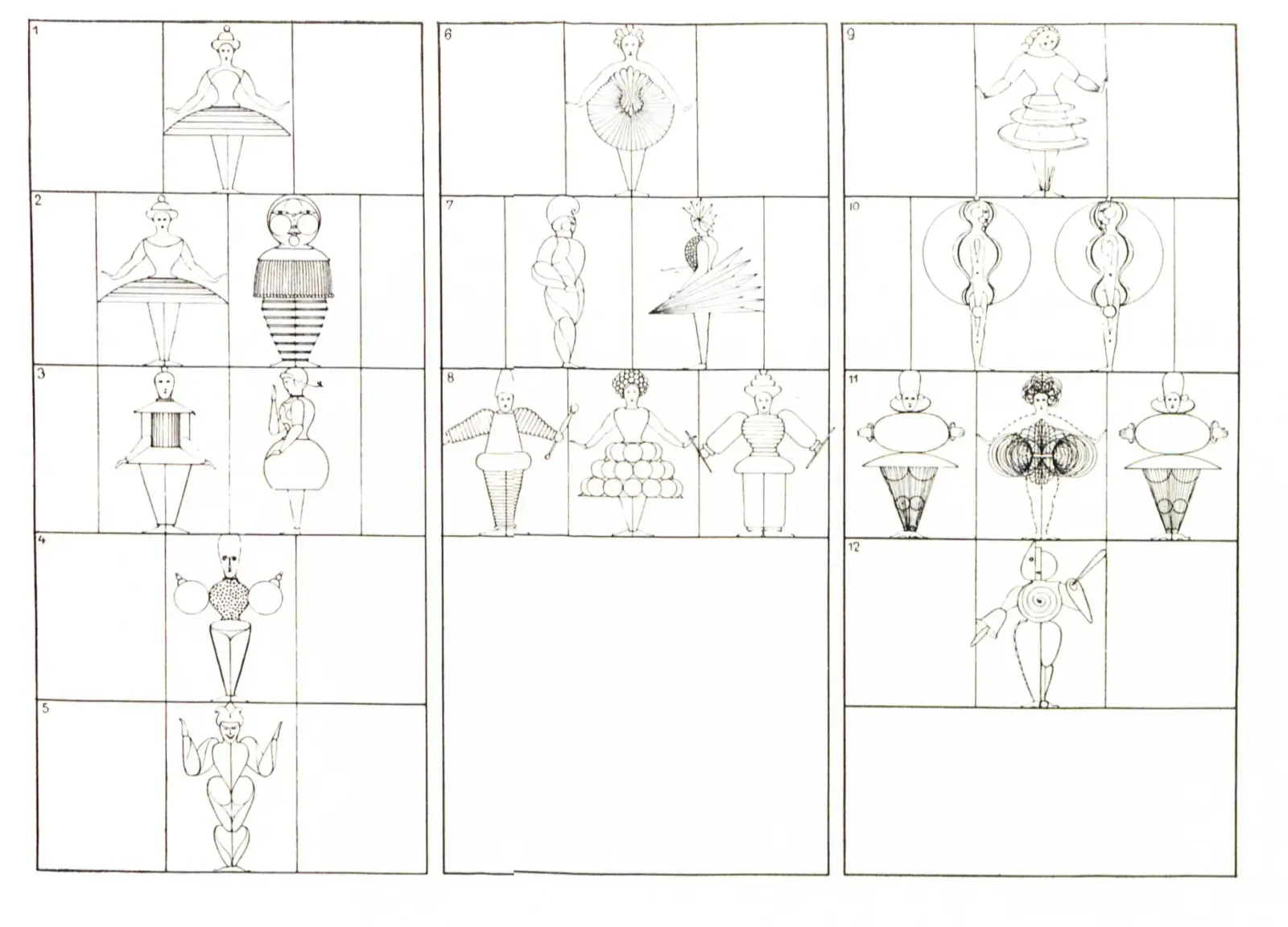
Schlemmer identified four distinct methods through which clothing reshapes the human figure:
- The “Laws of Surrounding Space”: Enclosing the body in cubic, spherical, and conical volumes that directly mirror the geometry of the architectural room.
- The “Functional Laws of the Body”: Emphasizing joint articulation, skeletal pivots, and kinetic rotation through contrasting discs, banded spirals, and radial segments.
- The “Laws of Motion”: Generating forms that trace the body’s physical trajectory through space—such as spinning tops, undulating discs, and aerodynamic cones.
- “Metaphysical Expression”: Utilizing masks, blank reflective faces, and depersonalized symmetry to transform individual personalities into archetypal human figures.
In Schlemmer’s stage works, costume ceased to be an accessory supporting a character; the costume was the performance. The weight, balance, and spatial extension of the garment dictated how fast the dancer could spin, where their limbs could extend, and how their physical volume interacted with stage lighting. Schlemmer transformed dress into kinetic sculpture, permanently establishing that the silhouette of clothing can radically transcend the organic outline of biological anatomy.
Core Bauhaus principles that reshaped garment design
The theoretical framework developed at Weimar and Dessau between 1919 and 1933 provided a permanent lexicon for experimental garment construction:
- Form Follows Function: Every line, seam, cut, and fastening must justify its presence through anatomical, thermal, or practical utility. Decorative flounces, superfluous lapels, and decorative buttons are discarded in favor of tectonic clarity.
- Material Integrity (Materialgerechtigkeit): Rejection of synthetic imitations designed to disguise humble materials as luxury goods. Raw wools, stiff leathers, heavy denims, unbleached canvases, and industrial metals are celebrated in their natural state.
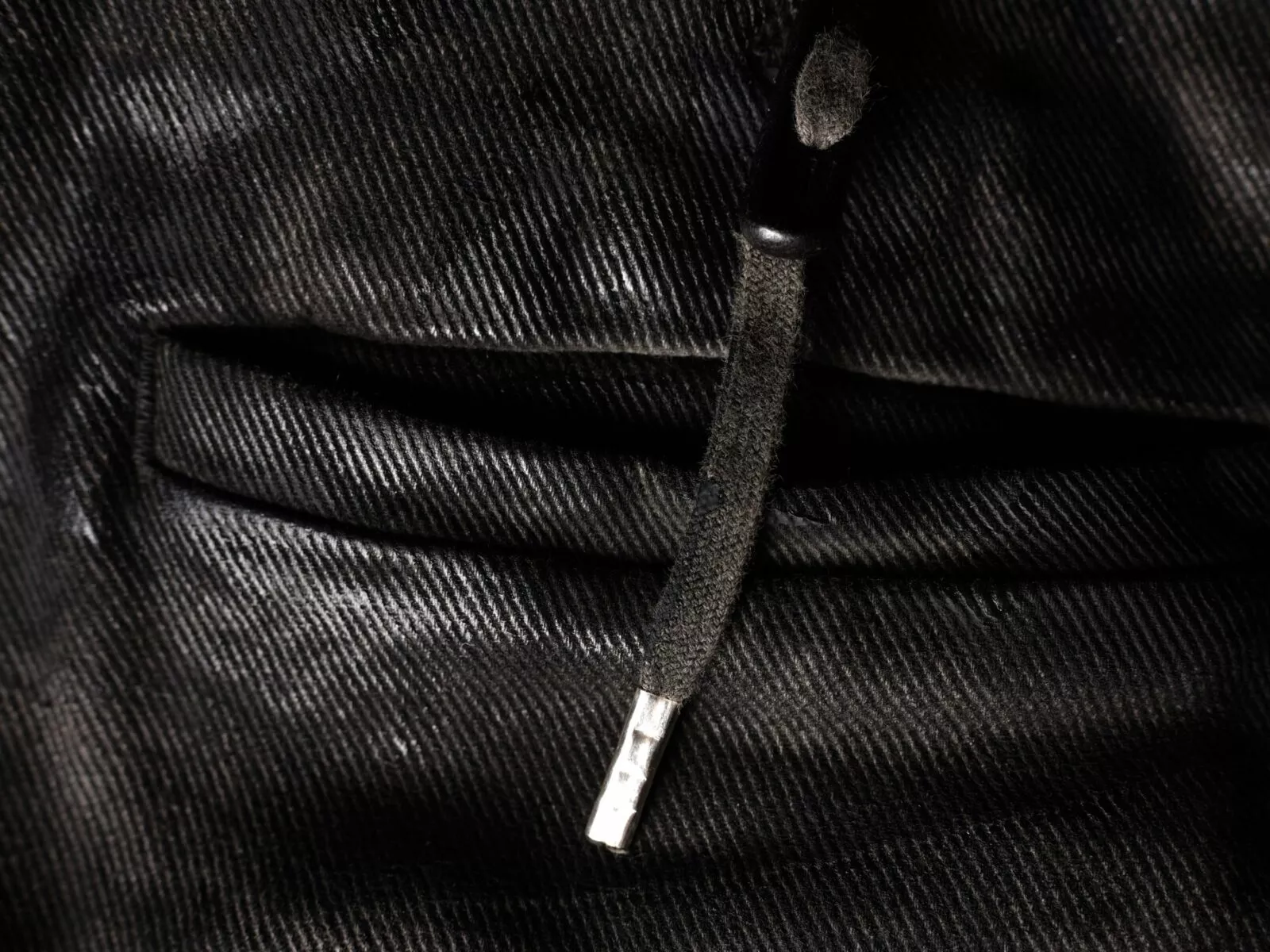
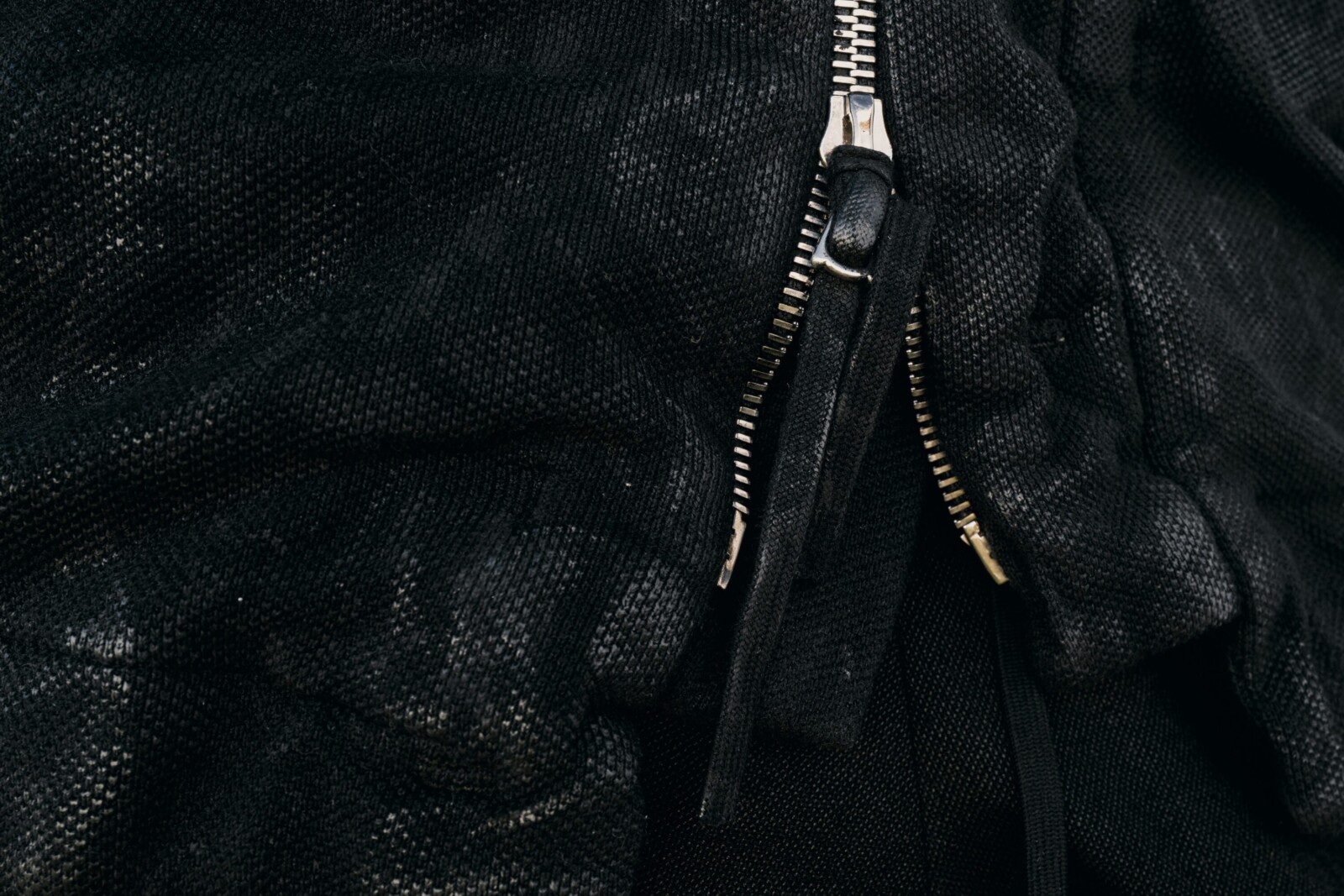
- Exposed Mechanics as Aesthetic Ornament: Rather than concealing functional hardware behind plackets or linings, zippers, drawstrings, eyelets, buckles, and structural seams are brought forward as primary visual elements.
- Modularity and Standardization: Garments designed as interchangeable systems—modular linings, detachable sleeves, and adaptable fasteners that adjust to changing environments and physical requirements.
- Geometric Pattern Drafting: Construction rooted in rectilinear and circular pattern pieces that minimize fabric waste during cutting, allowing the flat two-dimensional geometry of the bolt to shape the three-dimensional drape over the body.
Bauhaus DNA in contemporary avant-garde fashion
The intellectual lineage connecting the Dessau workshops to the vanguard of modern fashion is unbroken. When contemporary designers reject decorative confection in favor of architectural proportion, material research, and anatomical deconstruction, they are operating directly within the Bauhaus tradition.
Issey Miyake represents the ultimate culmination of Bauhaus textile philosophy in modern dress. Miyake’s legendary “A-POC” (A Piece of Cloth) project, launched with Dai Fujiwara in 1998, utilized computer-programmed industrial jacquard looms to output fully formed, seamless garments directly from a single tube of fabric without traditional cut-and-sew operations—a direct realization of Anni Albers’ dream of unified industrial textile engineering. Furthermore, Miyake’s permanent pleating technologies engineer structural springiness and three-dimensional volume directly into the textile weave itself, echoing Schlemmer’s kinetic spatial cylinders.
Junya Watanabe continuously channels Bauhaus geometric construction into visionary runway collections. Watanabe’s historic Fall/Winter 2015 and 2016 collections assembled three-dimensional accordion pleats, mathematical honeycombs, and architectural tessellations from bonded neoprene, wool felt, and industrial polyurethane, turning dresses into wearable geodesic sculptures that recall Oskar Schlemmer’s Triadic Ballet costumes.
The uncompromising minimalism of Helmut Lang in the 1990s stripped the tailored suit down to its elemental functional armature, incorporating utilitarian bondage straps, reflective ballistic nylons, and raw industrial seams in pure homage to functionalist honesty. Similarly, Rick Owens constructs architectural monoliths where geometric pattern cuts, dropped crotches, and exaggerated funnel collars treat the body as a structural monument, while Iris van Herpen collaborates with architects and material scientists to 3D-print kinetic garments that transform the wearer into dynamic spatial mathematics.
By demonstrating that clothing is an architectural discipline governed by geometry, material ethics, and kinetic function, the Bauhaus liberated garment design from the fleeting whims of style, laying the foundation for fashion as an enduring art of construction.
Explore related historical movements in Constructivism and Functional Clothing, trace the anti-art subversion of Dada, Absurdität und Anti-Mode, and investigate the wider evolutionary narrative in Die Geschichte der Avantgarde-Mode.
Literaturverzeichnis und weiterführende Lektüre
- Oskar Schlemmer, László Moholy-Nagy, Farkas Molnár / Bauhausbücher 4 — Die Bühne im Bauhaus (The Theater of the Bauhaus)
- Anni Albers / Wesleyan University Press / Princeton University Press — On Weaving
- Bauhaus-Archiv Berlin / AWARE Research Archive — Gunta Stölzl: Meisterin am Bauhaus Dessau
- Academia — Bauhaus 1919-1933: Workshops for Modernity
- Sigrid Wortmann Weltge / Thames & Hudson — Bauhaus Textiles: Women Artists and the Weaving Workshop
- The University of Chicago Press — Oskar Schlemmer: Visions of a New World
- Tate — How to Weave Like Anni Albers