يوليوس وتطوير ملابس الظلام اليابانية
Founded in Tokyo in 2004 out of Tatsuro Horikawa’s audiovisual project NUKE, Julius turned brutalist concrete, washed lambskin, and industrial techno into the template for modern Japanese darkwear. This monograph traces the label’s pattern-cutting mechanics—from high-funnel leather riders and bellows gasmask cargoes to its confrontational Paris runway debut.
Commercial fashion sells daylight; Julius built a wardrobe for concrete and night.
When Tatsuro Horikawa founded Julius in Tokyo in 2004, he approached menswear from outside the fashion school pipeline. Trained in graphic design and underground video art through his earlier project NUKE, Horikawa treated clothing as spatial enclosure—heavy, matte, and cut close to the bone—rather than seasonal ornament.
Working alongside the darker currents documented across our archives—from يوجي ياماموتو و Jun Takahashi إلى ريك أوينز و Boris Bidjan Saberi—Horikawa established the working vocabulary of contemporary Japanese darkwear. Inside the Julius archive, that discipline shows up in physical details: gusseted gasmask cargo pockets, high-collared leather riders shrunk over heavy Excella zips, raw-edged rayon layered in varying weights of black, and stark Paris presentations scored to original industrial noise.
Tokyo nocturne: From NUKE to the founding of Julius
Tatsuro Horikawa did not come up through a traditional Tokyo atelier. Born in 1973, he spent the mid-1990s inside the city’s graphic design, club, and video-art circuits, founding Third Stone Co. in 1996 to handle sound production, typography, and art direction.
In 2001 he launched NUKE, an audiovisual project built around stark projections of Tokyo’s concrete infrastructure. The earliest garments existed purely as wardrobe for those films. Yet cloth gave Horikawa something video could not: physical weight, drape, and the friction of a body moving inside a room.
Julius formally launched in 2004 as an extension of that multimedia practice—clothing, sound, and gallery space conceived together. Early presentations took place in basements and stripped-out warehouses around Shibuya and Shinjuku, drawing a loyal local audience from Tokyo’s club and art scenes and feeding directly into the movement traced in our study of darkwear and the 2000s avant-garde scene.
The grammar of black: Zen void, Tokyo concrete, and industrial techno
In Western dress, black usually signals mourning or formal restraint. Horikawa worked from a different register—one informed by Japanese aesthetics of shadow and negative space, where darkness reads as density and latent form rather than emptiness.
Post-war Tokyo supplied the surface textures. Highway overpasses, weathered danchi housing blocks, wet asphalt, and unpainted steel railings translated directly into his swatch books. Rather than flat jet black, early Julius racks relied on tonal friction: matte charcoal lambskin against chalky tar-washed denim, dry-hand cotton jersey beside slightly lustrous silk-rayon blends.
Sound set the tempo. Horikawa listened heavily to Berlin and Detroit industrial techno, harsh noise, and dark ambient—music built on repetition, distortion, and strict structural grids. That restraint carried straight into the pattern room, stripping away decorative trim so seam lines, surface grain, and shadow did all the work.
The funnel-neck rider: Asymmetrical zips and hot-washed lambskin
One garment put Julius on international collectors’ radar: the leather rider. In the mid-2000s, Horikawa stripped the classic Schott Perfecto motorcycle jacket down to its chassis, deleting epaulets, waist belts, and coin pockets in favor of a lean, elongated torso.
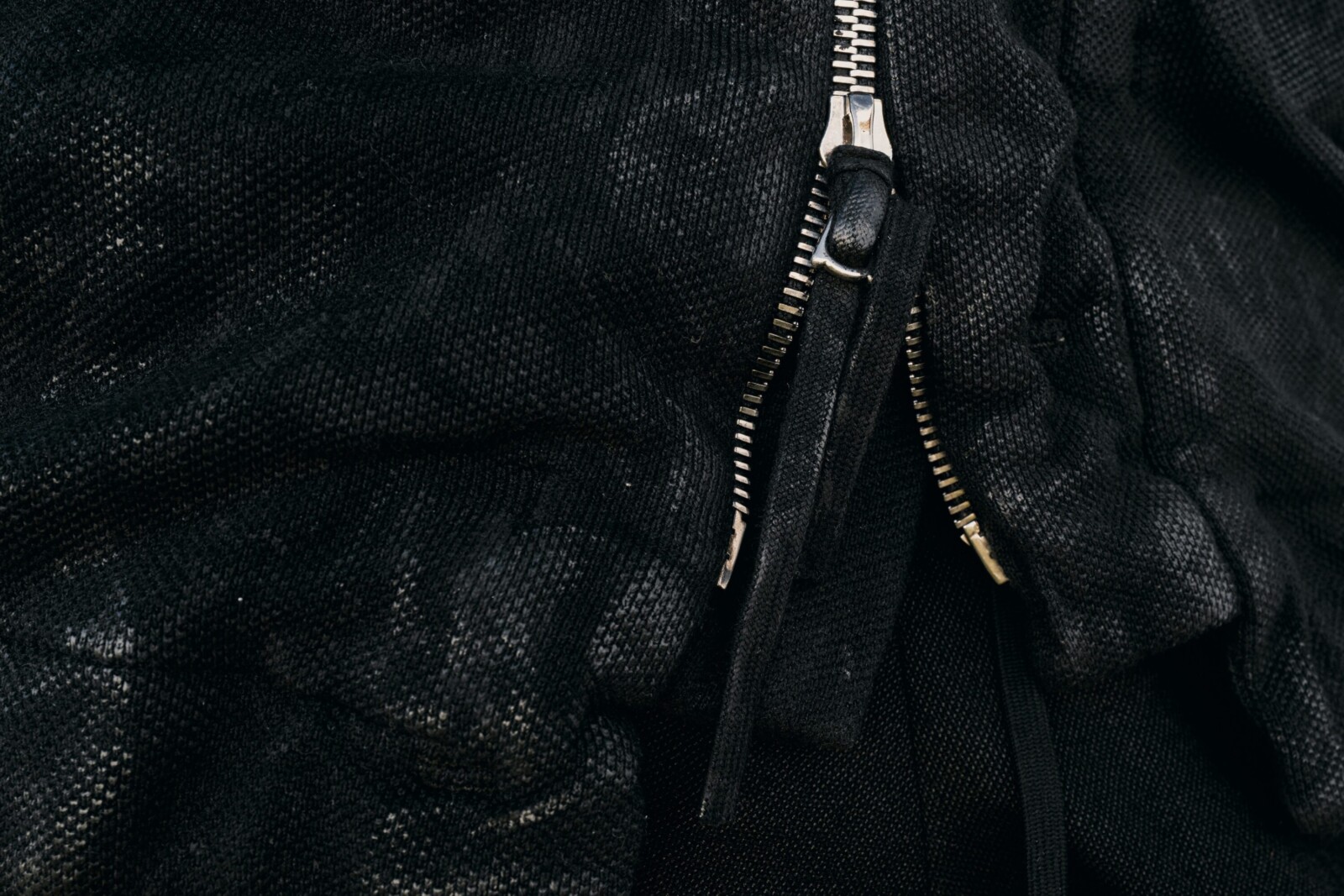
The defining structural shift was the collar. Zipped all the way up, the high funnel neck climbs past the jawline into a rigid leather cylinder. Heavy-gauge Excella zippers cut diagonally across the chest, curving off-center to follow the ribcage rather than bunching at the sternum. Sleeves were drafted narrow and overlong on curved two-piece patterns, forcing the leather to stack in tight horizontal ripples along the forearm.
Surface treatment finished the job. Working with domestic Japanese tanneries on vegetable-tanned lambskin, goat, and calf, Horikawa had assembled jackets hot-washed, tumble-dried, and hand-waxed. Because leather shrinks faster than metal tape, the hides contracted sharply against the Excella zips, pulling deep vertical puckers along every closure. The result had none of the smooth polish of European luxury outerwear; it looked broken-in, dense, and slightly hostile straight off the rack—though the aggressive washing also left early lambskin editions notoriously delicate at high-stress seams.
Architectural tailoring: Gasmask bellows pockets and spiral-seam denim
Beside the leather rider sat the gasmask cargo trouser—arguably the single most imitated silhouette in Japanese darkwear. Introduced in the mid-2000s and reworked nearly every season since, it turned military surplus storage into aggressive leg volume.
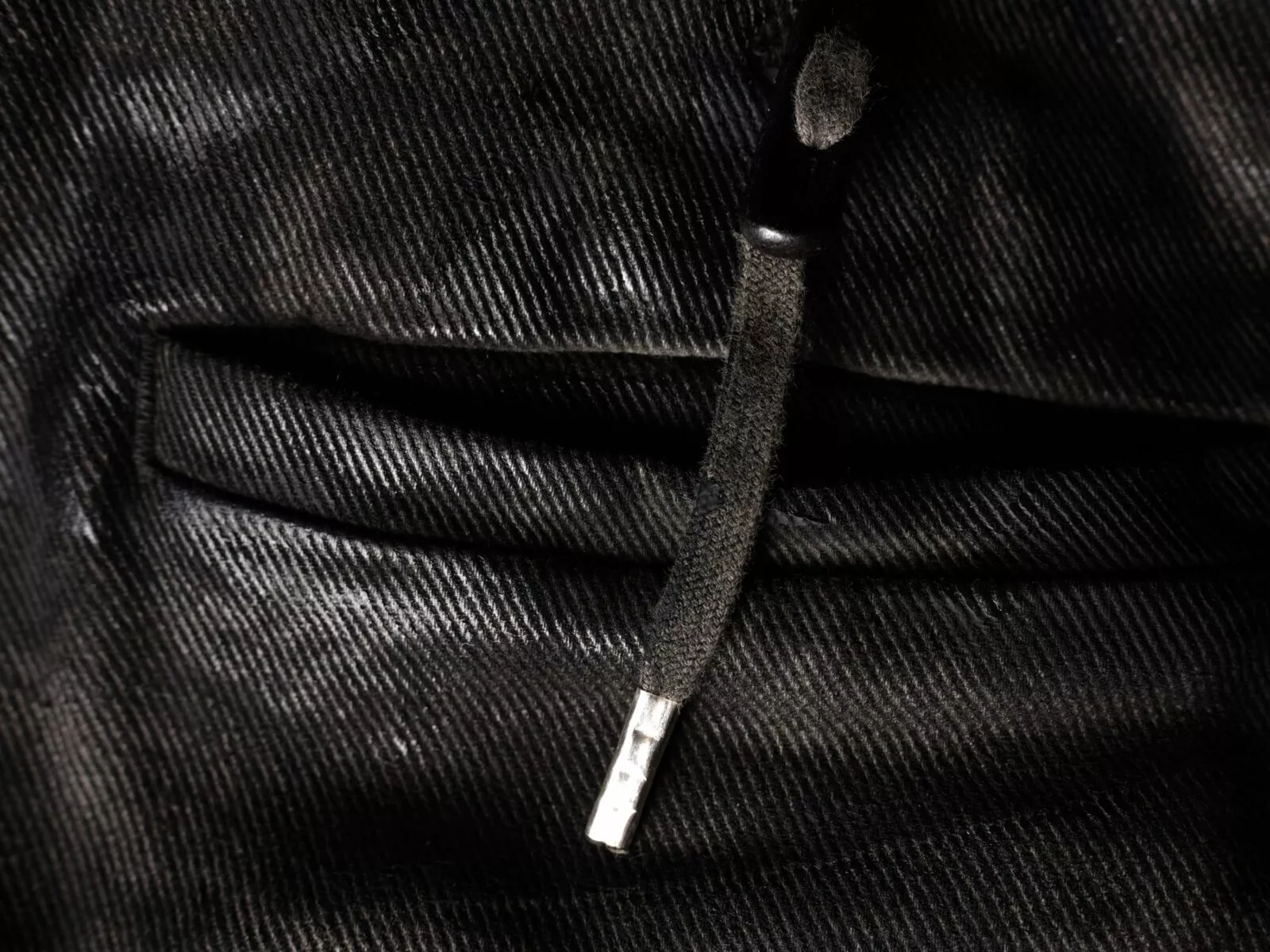
Oversized multi-compartment bellows pockets wrapped the outer thighs, internally gusseted so they held their three-dimensional box shape instead of sagging flat against the fabric. Long cotton webbing tapes trailed from the flaps, letting the wearer cinch the volume down or leave the straps loose in motion. A moderately dropped seat balanced a severe taper below the knee, terminating in a ribbed knit cuff or narrow stacked hem.
Horikawa applied the same anatomical logic to denim. Adapting twisted-seam pattern cutting to heavy raw Japanese selvedge, he drafted seams that spiraled 360 degrees from hip to ankle rather than dropping straight down the leg. Once broken in, that rotational tension pulled the cloth into permanent corkscrew stacks around the calf while keeping the knee clean—a signature technique within avant-garde garment construction.
Sound and silhouette: Industrial techno and Paris Fashion Week 2008
In January 2008, Julius moved from Tokyo’s underground onto the official Paris Fashion Week calendar with its Autumn/Winter 2008 collection, Insurgence.
The staging rejected polite showroom pacing. Models walked through dim, fog-heavy concrete rooms to high-decibel industrial techno and drone scores commissioned specifically for the show, faces half-obscured behind black gauze or deep cowls. Shredded wool knits, oiled lambskin, and trailing webbing straps gave Parisian buyers a rawer, more claustrophobic counterpoint to the season’s cleaner tailoring.
Horikawa did not sand down the edges for European department stores. Over the next four years—Canopy; (SS09), Protection_ism (AW09), NeotomisM (AW10), and Halo (AW11)—Julius locked in its standing alongside ريك أوينز و Ann Demeulemeester at the center of international dark fashion.
Protection_ism (AW09): Utility membranes and defensive tailoring
Autumn/Winter 2009’s Protection_ism remains the clearest statement of Horikawa’s early-period obsession with enclosure. Drawing on civil-defense shelters, chemical-protective outerwear, and modular military packs, the collection treated every layer as physical insulation against the street.
Ballistic nylon was bonded to weather-resistant membranes. High-storm parkas integrated full zip-over hoods with narrow eye slits; leather jackets carried padded ribbing over the lower back and kidneys; gasmask cargo pockets gained snap-on modular hardware.
What separated Protection_ism from costume was the cut. Beneath the straps and technical coatings sat disciplined tailoring—narrow shoulders, elongated sleeves, and carefully weighted hems—turning utilitarian hardware into severe, wearable silhouette work.
The darkwear legacy: Archival influence and commercial friction
More than twenty years on, Tatsuro Horikawa’s early Julius run occupies a distinct chapter in Japanese fashion history. Where يوجي ياماموتو و ري كاواكوبو dismantled Western proportion through volume and asymmetry in the 1980s, Horikawa tightened the silhouette, swapped wool suiting for washed hides and technical nylon, and wired the entire presentation to underground club culture.
That evolution has not been without tension. As Julius expanded into global luxury e-commerce during the mid-2010s—and launched its graphic, streetwear-leaning sub-label NILøS—some early collectors argued the main line traded the raw material density of 2007–2011 for cleaner, more commercial graphics. Even so, the foundational blueprints endure. From Tokyo’s Sendagaya flagship to resale archives across Europe and North America, early gasmask cargoes, spiral-seam denim, and funnel-neck riders remain benchmark pieces for anyone tracing how Japanese avant-garde dress moved into the twenty-first century.